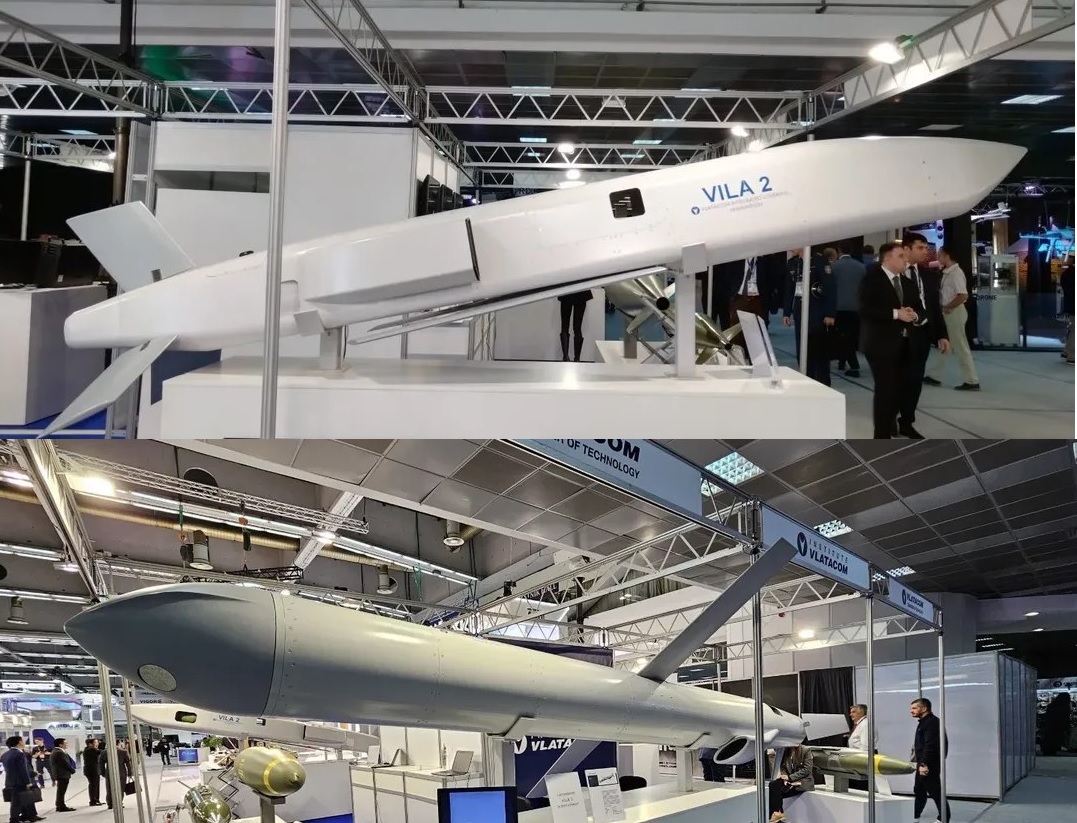
BELGRADE, Serbia — April 2026 : Belgrade-based defence company Vlatacom has announced that development of its new cruise missile family, the Vila-1 and Vila-2, has reached approximately 80 percent completion, with full completion of both systems scheduled by the end of 2026.
The Vila family represents a hybrid class of weapons, combining the flight characteristics of conventional cruise missiles with the endurance and target-acquisition capabilities of loitering munitions. Developed by Vlatacom, a private research institute certified as a research and development centre by Serbia’s Ministry of Science since 2011, the systems are being advanced from concept through testing, while serial production is expected to be assigned to national industrial partners.
Development Progress and International Cooperation
According to the company’s latest statement, both missile variants are progressing toward finalization, with remaining development work focused on system integration and validation. Mock-ups of the Vila-1 and Vila-2 were previously exhibited at the Partner 2023 and Partner 2025 defence exhibitions in Belgrade, highlighting the program’s steady advancement.
As reported last year by Dunav Intel, Vlatacom is cooperating with at least one Middle Eastern country to support testing and technical validation of the systems. However, no further details regarding the partner nation or the scope of cooperation have been officially disclosed.
System Design and Capabilities
Both Vila-1 and Vila-2 are modular unmanned aerial vehicles (UAVs) designed to function as loitering munitions with cruise missile characteristics. The systems share a common architecture, including guidance and navigation technologies, while being tailored for distinct operational roles.
Navigation to the target area is conducted using a combined Global Navigation Satellite System (GNSS) and Inertial Navigation System (INS), supported by a radar altimeter during the initial flight phase. In the terminal phase, both variants employ an optoelectronic seeker integrated with artificial intelligence (AI) to enable autonomous target recognition.
The missiles are equipped with a two-way radio data link, allowing real-time communication with operators. This enables “man-in-the-loop” control, where operators can validate targets prior to engagement while retaining the ability to retask the weapon mid-mission. Both systems are optimized for operations in contested airspace, featuring terrain-skimming flight profiles and extended loitering capabilities.
The weapons are fitted with vAF-M17/vFI-17 fuzing systems, and warheads are selectable depending on mission requirements and target type.
Vila-1: Heavy Long-Range Variant
The Vila-1 is the heavier, long-range variant designed for strikes against distant and high-value targets. It is configured exclusively for ground-based launch platforms.
The missile is housed in a sealed cylindrical launch tube and can be deployed from an 8×8 wheeled chassis or integrated onto compatible naval vessels. Launch is initiated by a solid-fuel booster, after which a turbofan or turbojet engine sustains the cruise phase.
Technical Specifications — Vila-1:
- Length: 5.5 metres (excluding booster)
- Wingspan: 2.7 metres (deployable after launch)
- Operating altitude: 50 metres to over 7,000 metres
- Cruise speed: Mach 0.75
- Warhead: 300–450 kg (some sources indicate up to 500 kg depending on configuration)
- Propulsion: Solid-fuel booster + turbofan/turbojet engine
- Range: Up to 300 km (plus loitering time)
- Launch platforms: Ground-based 8×8 chassis or naval vessels
- Estimated launch weight: Approximately 1,000 kg
Vila-2: Lighter Short-Range Variant
The Vila-2 serves as a lighter and more versatile short-range variant. It is designed for both ground-based and air-launched operations, with primary integration on fighter aircraft, enabling multiple weapons carriage per platform.
The reduction in size and structural weight allows for a slightly higher cruise speed while maintaining similar operational altitude and range characteristics.
Technical Specifications — Vila-2:
- Length: 4.5 metres (excluding booster)
- Wingspan: 2.7 metres
- Operating altitude: 50 metres to over 7,000 metres
- Cruise speed: Mach 0.75–0.8
- Warhead: 300 kg (various types)
- Propulsion: Solid-fuel booster + turbofan/turbojet engine
- Range: Up to 300 km (plus loitering time)
- Launch platforms: Fighter aircraft (multiple weapons possible) or ground-based launch tubes
- Estimated launch weight: 750–800 kg
Industrial and Documentation Support
Vlatacom oversees the full development lifecycle of the Vila systems, from initial design through testing phases. Supporting technical documentation for both missile variants is provided by Yugoimport, Serbia’s state-associated defence export organization, via its official platforms and website.
Operational Role and Outlook
The Vila-1 and Vila-2 systems are designed for operations in contested airspace with complex air defence environments, supporting terrain-skimming flight profiles and enabling real-time retasking during missions.
While the company has confirmed that development will be completed by the end of 2026, no further details have been released regarding production timelines, procurement plans, or potential export customers.
——— End of Article ———