RIYADH — March 12, 2026 : Saudi Arabia has begun redirecting a substantial share of its crude oil exports from the Persian Gulf to its Red Sea facilities after Iranian military strikes and the ongoing regional conflict effectively halted commercial tanker traffic through the Strait of Hormuz, one of the world’s most critical energy transit routes.
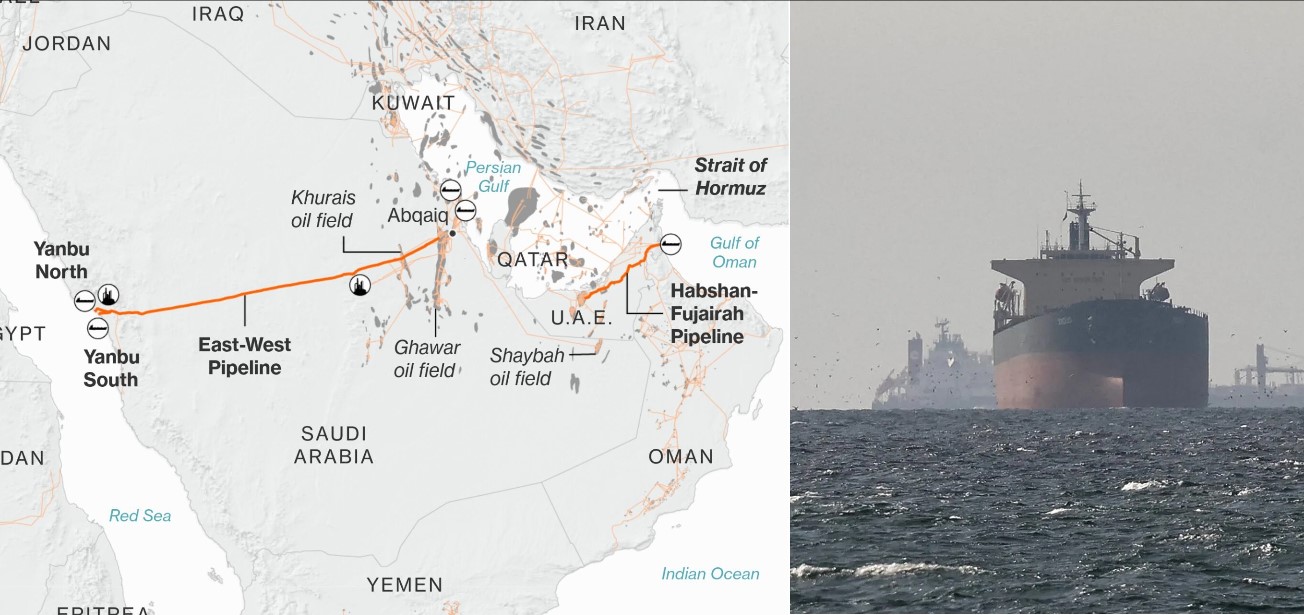
According to shipping and industry data, between 25 and 30 very large crude carriers (VLCCs)—commonly known as supertankers—are currently sailing toward the Saudi Red Sea port of Port of Yanbu to load crude oil. Under normal conditions, the terminal handles only about two tanker loadings per month, making the current traffic surge a significant operational shift.
The move is part of Saudi Arabia’s effort to maintain export flows to global markets despite the disruption of shipping through the Strait of Hormuz, which normally carries around 20% of global daily oil consumption and handles the majority of crude exports from Gulf producers.
Pipeline Network Enables Westward Export Shift
To sustain exports without relying on Persian Gulf shipping routes, Saudi Arabia is utilizing its East‑West Pipeline (Petroline), a major cross-country pipeline system linking the kingdom’s eastern oil fields to Yanbu on the Red Sea coast.
The pipeline has a maximum capacity of approximately 7 million barrels per day (bpd). Of this total:
-
About 2 million bpd normally supply domestic refineries located along Saudi Arabia’s western coast.
-
Roughly 5 million bpd can potentially be redirected for export via Yanbu.
Saudi Aramco has indicated that it intends to utilize the pipeline at or near full capacity in order to sustain deliveries to international customers while the Hormuz route remains unavailable.
Shipping data show that crude exports from Yanbu have already increased sharply. Loadings in early March 2026 averaged about 2.2 to 2.5 million bpd, up from approximately 1.1 million bpd in February and substantially higher than historical averages.
If current tanker arrivals proceed as planned, analysts estimate that March exports from Yanbu could exceed 4 million bpd, potentially reaching record levels. However, port infrastructure and terminal logistics are expected to limit effective loading capacity to roughly 4–4.5 million bpd across the port’s export terminals.
Hormuz Closure Forces Major Export Rerouting
Before the disruption, most Saudi crude shipments departed from eastern Persian Gulf terminals such as Ras Tanura, which typically handled about 5.5 to 6 million bpd of Saudi crude exports.
The conflict involving Iran has led to a near-complete halt of tanker transits through the Strait of Hormuz, forcing Saudi Arabia to redirect flows westward through the Petroline system.
While the alternative Red Sea route bypasses the Persian Gulf chokepoint, it introduces new logistical and security considerations.
Ships departing Yanbu must pass through the Bab al‑Mandab Strait, a narrow waterway linking the Red Sea with the Gulf of Aden and onward to global markets.
Maritime Security Risks in the Red Sea Corridor
The Bab al-Mandab Strait has experienced multiple attacks on commercial shipping over the past two years, primarily linked to Houthi militants operating from Yemen. These incidents have included missile strikes, drone attacks, and small-arms engagements targeting vessels transiting the corridor.
Although such attacks had decreased in frequency prior to the current regional escalation, the shipping lanes remain within the operational range of Iranian missile systems, creating ongoing risk for tanker operators.
As a result, freight rates for crude cargoes loading at Yanbu have more than doubled, and some shipowners have reportedly cancelled charter agreements or hesitated to send vessels into the region due to insurance and security concerns.
Regional Oil Producers Face Storage Constraints
The suspension of shipping through the Strait of Hormuz has also created significant logistical pressure across the broader Gulf energy system.
With export tankers unable to load at Persian Gulf ports, onshore storage facilities across the region quickly reached maximum capacity, forcing several Gulf producers to reduce output.
Iraq has implemented the largest reduction, cutting approximately 2.9 million bpd of production after storage capacity at its southern export terminals filled within days.
The United Arab Emirates has lowered output by between 500,000 and 800,000 bpd. Some of its remaining exports are being redirected through the Habshan‑Fujairah Pipeline, which transports crude from inland fields to the Emirate of Fujairah on the Gulf of Oman, bypassing the Strait of Hormuz.
Kuwait has also reduced production by around 500,000 bpd and declared force majeure on crude and refined product exports after domestic storage facilities reached capacity.
Export Replacement Remains Limited
Despite Saudi Arabia’s ability to reroute exports through the Petroline system, industry analysts note that the Red Sea route cannot fully replace the pre-conflict export volumes normally shipped through the Persian Gulf.
Limitations include pipeline throughput constraints, port loading capacity, and maritime security risks, all of which restrict the scale at which Yanbu can handle diverted crude shipments.
Saudi Aramco has continued supplying customers using the Red Sea route and has reportedly offered additional crude on the spot market to manage contractual obligations during the disruption.
The situation highlights the strategic importance of alternative export infrastructure for Gulf oil producers as regional tensions continue to affect the world’s most critical energy shipping corridor.
——— End of Article ———