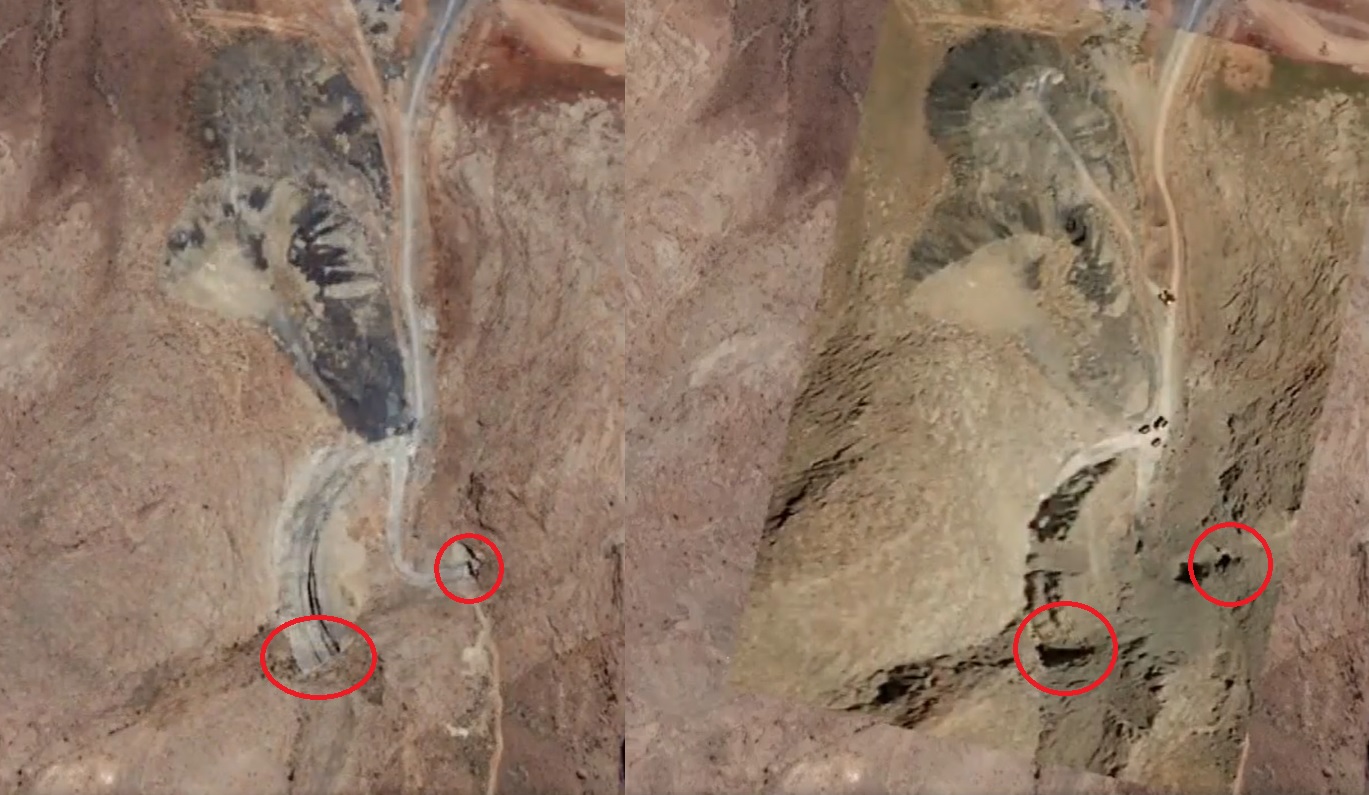
WASHINGTON, — April 15, 2026 : Commercial satellite imagery captured on April 10, 2026, indicates that Iran has begun clearing debris from tunnel entrances at an underground ballistic missile base near the city of Khomein in Markazi Province, following recent United States and Israeli airstrikes. The imagery, analyzed and reported by CNN, shows engineering teams using heavy construction equipment to restore access to the site during an ongoing ceasefire.
The images depict front-end loaders, excavators, and dump trucks operating at the entrances of tunnel complexes that were struck during a month-long campaign of coordinated U.S. and Israeli airstrikes. The strikes focused on sealing access points rather than penetrating the deeper underground infrastructure, which remains intact inside the mountainous terrain.
Targeting Strategy Focused on Tunnel Entrances
The Khomein facility is part of Iran’s network of hardened underground installations, commonly referred to as “missile cities,” designed to protect ballistic missile launchers and associated systems. During the conflict, U.S. and Israeli forces targeted tunnel entrances and ventilation shafts with the objective of blocking access and restricting the movement of mobile launchers.
This approach resulted in the collapse or obstruction of entry points, effectively trapping missile launchers within the tunnel networks without destroying the internal infrastructure. Prior satellite imagery from the conflict period showed multiple sites with blocked or collapsed entrances, consistent with this operational strategy.
Satellite Evidence Confirms Active Excavation
Analysis of the April 10 imagery shows Iranian personnel actively removing rubble from tunnel entrances. Heavy machinery is positioned on debris piles, scooping material and transferring it into a line of dump trucks stationed nearby. The activity indicates a coordinated engineering effort to reopen access routes and restore operational mobility within the underground complex.
Similar recovery operations have also been observed at other locations, including the Tabriz South Missile Base, suggesting a broader effort to reconstitute access across Iran’s missile infrastructure.
Intelligence Assessments on Remaining Capabilities
Recent U.S. intelligence assessments, shared with CNN on April 2 and April 3, 2026, estimate that approximately half of Iran’s missile launchers remain intact despite more than a month of sustained airstrikes. This figure includes launchers that were rendered temporarily inaccessible after being buried under debris at tunnel entrances but were not destroyed.
Israeli officials have provided lower estimates of intact systems, citing differences in methodology, particularly regarding whether buried or inaccessible launchers are counted as operational assets.
Ceasefire Provides Window for Recovery Operations
The excavation efforts are taking place during a two-week ceasefire agreed upon by the United States and Iran on April 7, 2026. The pause in hostilities has enabled Iranian forces to deploy engineering teams and heavy equipment to affected sites without the immediate risk of additional strikes.
Defense analysts note that the speed of these recovery operations reflects the structural design of Iran’s underground missile facilities. Built into mountainous terrain, the complexes are intended to withstand surface-level attacks while preserving internal systems, allowing access to be restored relatively quickly once debris is cleared.
Sam Lair, a researcher at the James Martin Center for Nonproliferation Studies, stated that such activity is consistent with expectations during a ceasefire. He noted that pauses in conflict typically provide opportunities for affected parties to repair or recover military capabilities targeted during active operations.
Broader Context of Iran’s Missile Infrastructure
The Khomein site, along with similar facilities across Iran, forms part of a dispersed and fortified ballistic missile architecture designed for survivability and rapid deployment. These underground bases enable storage, protection, and launch preparation within tunnel systems embedded in mountainous regions.
U.S. intelligence reporting indicates that Iran maintains thousands of ballistic missiles in underground storage and retains the capacity to retrieve or repair launchers that were not directly destroyed during the strikes.
As of April 15, 2026, neither U.S. nor Iranian officials have issued formal statements specifically addressing the satellite imagery or the recovery operations observed at the Khomein facility and other sites.
——— End of Article ———