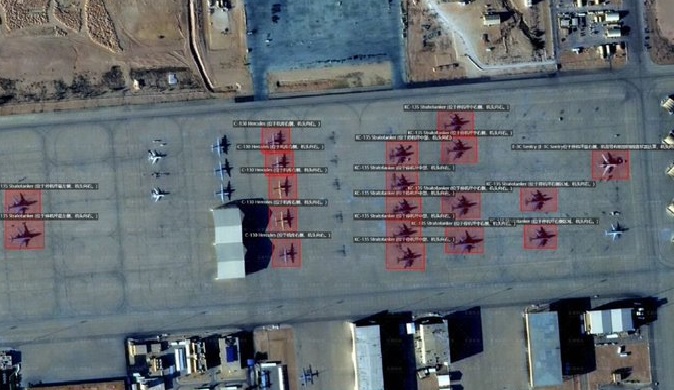
Riyadh / Washington : High-resolution satellite imagery has identified an expanded deployment of United States Air Force aircraft at Prince Sultan Air Base in Saudi Arabia, indicating a significant increase in logistical and airborne command capabilities amid continued tensions between Washington and Tehran.
The imagery, reportedly obtained through Chinese commercial satellite monitoring networks, documents a concentrated grouping of refueling, surveillance, and transport aircraft positioned at the Saudi installation. Defense analysts reviewing the data state that the scale and composition of the aircraft reflect preparations consistent with sustained air operations rather than short-term deterrence patrols.
Aircraft Deployment and Operational Profile
According to the satellite data, the current deployment at Prince Sultan Air Base includes 13 Boeing KC-135 Stratotanker aerial refueling aircraft, one Boeing E-3G Sentry (AWACS) aircraft, and five Lockheed C-130 Hercules tactical transport aircraft.
The KC-135 Stratotanker fleet forms the central element of the deployment. These aircraft are designed to provide mid-air refueling to fighters, bombers, reconnaissance platforms, and other support aircraft, enabling extended mission durations and expanding operational reach without requiring forward basing inside contested airspace. A tanker fleet of this size typically supports high sortie generation rates and sustained regional air operations.
The presence of a Boeing E-3G Sentry enhances command-and-control capabilities. Equipped with a rotating radar dome, the aircraft provides long-range airspace surveillance, tracks multiple aerial targets, and coordinates multi-aircraft missions. Its integration alongside a large tanker fleet allows for coordinated operations over extended distances.
The five Lockheed C-130 Hercules aircraft provide tactical airlift and logistical support functions. The C-130 platform is commonly used for personnel transport, resupply missions, and coordination of ground support activities. Its inclusion in the deployment suggests logistical reinforcement and sustainment planning in support of air operations.
Analysts note that the combination of refueling, surveillance, and transport assets enables U.S. aircraft to operate deep into operational theaters without establishing permanent combat bases within those territories. However, the exposure of the deployment through commercial satellite imagery reduces operational discretion traditionally associated with forward military positioning.
Strategic Context and Saudi Arabia’s Position
Prince Sultan Air Base has served as a key hub for U.S. operations in the region since American forces returned to the facility in 2019 to enhance regional air defense and deterrence capabilities. The current imagery indicates an expansion beyond baseline defensive posture.
Earlier this year, Saudi Arabia formally communicated to Iran that it would not permit its territory or airspace to be used for U.S. military strikes against Iranian targets. The message was aimed at reducing the risk of direct involvement in potential confrontation between Washington and Tehran.
The scale of the newly observed deployment has led some regional observers to assess that Riyadh may have granted logistical or operational access to U.S. forces beyond previously stated limitations. Diplomatic assessments cited by regional sources indicate that Saudi officials have conveyed concerns to Washington regarding Iran’s regional activities and the potential impact of insufficient military deterrence.
Saudi authorities have not publicly confirmed any policy shift regarding the use of their territory for offensive operations. No official statement has been issued addressing the specific aircraft identified in the satellite imagery.
Regional Implications
The disclosure of the deployment occurs ahead of the Islamic holy month of Ramadan, a period during which regional stability carries heightened political and social sensitivity. Any military operation launched from Saudi territory could have direct implications for Riyadh’s security posture.
Iran has previously communicated a conditional deterrence position, stating that U.S. military installations and associated infrastructure located in Gulf states would be considered potential targets if those facilities are used in operations against Iranian territory. This policy framework places host nations in a complex strategic position in the event of escalation.
The satellite findings add a new layer of transparency to military movements in the Gulf region. While such deployments are not uncommon during periods of heightened tension, the detailed identification of aircraft types and quantities provides insight into operational planning and capability scaling.
At present, there has been no public indication of imminent military action. However, the concentration of refueling and airborne command assets at Prince Sultan Air Base reflects a posture consistent with readiness for sustained regional air operations, pending political authorization.
——— End of Article ———