DOHA, Qatar — February 22, 2026 : Recent satellite imagery indicates a shift in the composition of United States military aircraft stationed at Al Udeid Air Base in Qatar, a primary hub for US operations in the Middle East and the forward headquarters of US Central Command.
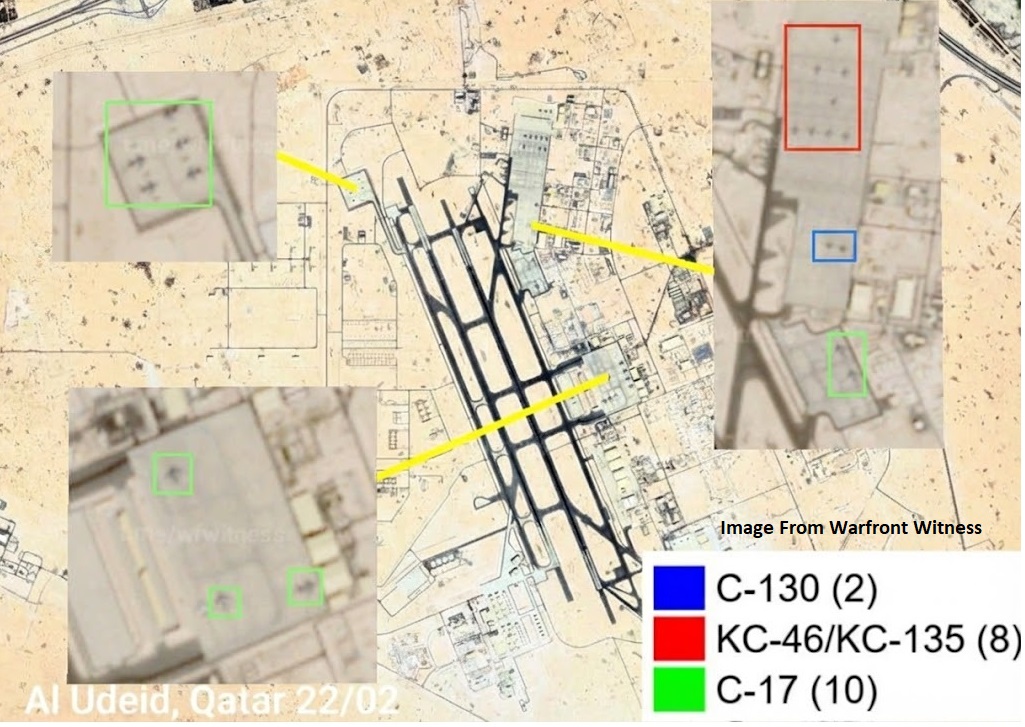
As of February 21–22, imagery shows two C-130 transport aircraft, eight aerial refueling tankers—primarily KC-135 models—and ten C-17 Globemaster III strategic airlifters at the base. A Qatari-operated C-17 is also present but is not included in the US aircraft count. While the total number of aircraft remains broadly consistent with recent observations, the distribution between refueling and cargo aircraft has changed.
On February 17, the ratio of tankers to C-17 aircraft stood at 11 to 8. The latest imagery shows eight tankers and ten C-17 aircraft. The reduction in tanker aircraft corresponds with a reported decrease in refueling sorties from Al Udeid to Iraq. At the same time, the higher number of C-17 aircraft suggests increased material or personnel transport activity. C-17 airlifters typically spend only a few hours at regional bases to unload cargo and refuel, which can result in fewer aircraft being visible in satellite imagery at any given time.
Deployment Trends Earlier in February
Satellite data from earlier in February provides additional context. Imagery from February 1 showed one RC-135 reconnaissance aircraft, three C-130 aircraft, 18 KC-135 tankers, and seven C-17 aircraft. On January 17, imagery indicated 14 tankers and two C-17 aircraft at the base.
By February 9, reports noted 15 KC-135 tankers stationed at Al Udeid. On February 11, at least 16 KC-135 tankers and one RC-135 reconnaissance aircraft were observed. Imagery dated February 19 showed a reduction in refueling aircraft and the relocation of electronic reconnaissance and special transport aircraft. By February 21, the number of KC-135 tankers had declined to eight.
These changes coincide with broader US Air Force activity across the US Central Command area of responsibility. Since mid-January, more than 265 C-17 and C-5 flights have been conducted into the region, including at least 120 C-17 missions. Additional aerial refueling aircraft—up to 100 in total— have been deployed, with some positioned in Europe or en route to regional bases. Flight tracking data has recorded movements of E-3 airborne early warning aircraft, C-17 transports, KC-135 tankers, and HC-130 aircraft toward Al Udeid and other regional installations.
Air Defense Enhancements at Al Udeid
Satellite imagery also indicates the deployment of additional air defense systems at Al Udeid. Between mid-January and early February, multiple MIM-104 Patriot surface-to-air missile components were installed. On January 26, imagery showed approximately seven launchers, along with a command post, radar unit, and generator. These systems were mounted on mobile truck launchers.
The deployments occurred amid heightened tensions with Iran. Open-source satellite analysis, including imagery attributed to Chinese commercial satellites, has highlighted the presence of Patriot and THAAD air defense systems in Qatar and Jordan.
Relocation of Personnel and Aircraft
Reports indicate that hundreds of US personnel have been withdrawn from Al Udeid and from facilities in Bahrain. Satellite imagery reflects a reduction in certain aircraft types at Al Udeid, particularly refueling tankers. At the same time, an increase in tanker aircraft has been observed at Prince Sultan Air Base in Saudi Arabia.
As of February 20, a combined total of 29 refueling aircraft were stationed at Prince Sultan Air Base and Al Udeid. The redistribution suggests adjustments in basing arrangements rather than an overall decrease in aerial refueling capacity in the region.
Flight origin data for air defense and support aircraft since mid-January includes Robert Gray Army Airfield (45 flights), Biggs Army Airfield (20), Kadena Air Base (6), Anniston (2), and Pope Army Airfield (2). Destination bases include Muwaffaq Salti Air Base in Jordan (31), Prince Sultan (15), Ali Al Salem in Kuwait (8), Al Udeid (4), and Isa in Bahrain (3).
Broader US Military Posture in the Region
The developments at Al Udeid form part of a wider US military presence in the Middle East since mid-January. Airlift operations include more than 80 C-17 flights, three C-5M flights, and multiple C-130 missions transporting troops and equipment. Up to 20 aerial refueling aircraft (KC-135 and KC-46) have been deployed, alongside HC-130J search-and-rescue aircraft, E-11A battlefield communications aircraft, and RC-135 reconnaissance platforms.
Fighter aircraft movements include 12 F-22 Raptors, 36 F-16 aircraft, and 30 F-35A fighters. Six EA-18G Growler electronic warfare aircraft and five E-11A aircraft are operating from bases in Jordan and Saudi Arabia.
Naval deployments include the USS Abraham Lincoln carrier strike group in the Arabian Sea and the USS Gerald R. Ford moving toward the Mediterranean. Five Arleigh Burke-class destroyers are positioned across the Mediterranean, Gulf of Oman, Persian Gulf, and Red Sea. The nuclear-powered submarine USS Georgia is operating in the Mediterranean.
These deployments are occurring amid ongoing tensions with Iran, including public statements from Iranian officials regarding readiness to respond to potential threats. US officials have not issued public comments on the specific aircraft composition changes at Al Udeid Air Base.
——— End of Article ———