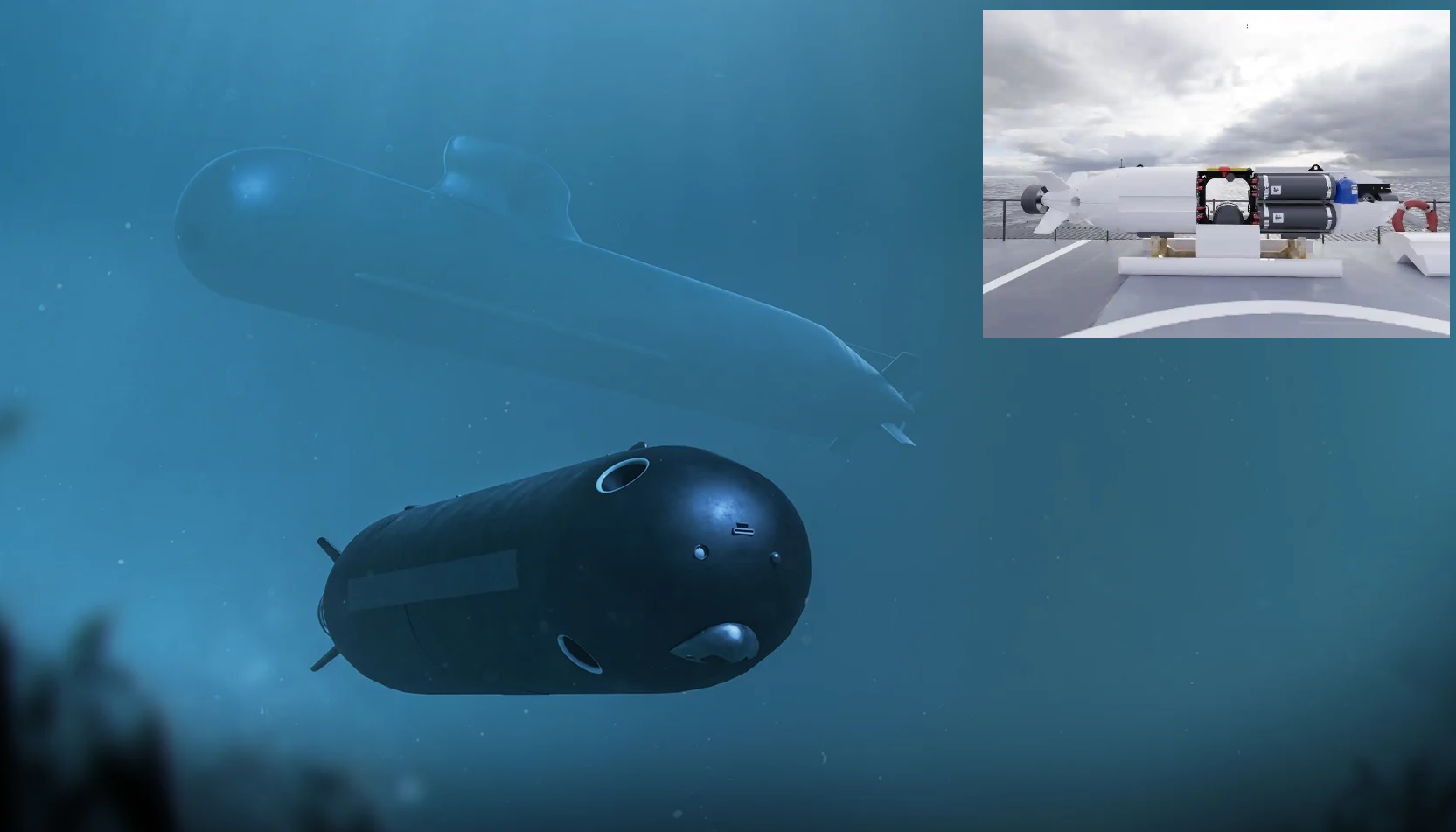
STOCKHOLM — March 15, 2026 : Swedish defense company Saab AB has confirmed that its Large Uncrewed Underwater Vehicle (LUUV) demonstrator, developed for the Swedish Defence Materiel Administration (FMV), remains on schedule to begin sea trials with the Swedish Navy during the summer of 2026.
The program originates from a contract awarded in August 2025 valued at SEK 60 million (approximately $6.9 million or €5.5 million) to Saab’s naval shipbuilding division Saab Kockums. The contract covers the design, construction, and testing of an advanced undersea autonomous platform, which Saab has designated as the Autonomous Ocean Drone (AOD).
The LUUV demonstrator is intended to explore the operational role of large autonomous underwater vehicles in future naval operations while also validating industrial production timelines and integration with existing naval platforms.
Demonstrator Designed to Evaluate Operational Roles
The AOD project has been structured as a technology and operational demonstrator. According to Rear Admiral Fredrik Lindén, FMV’s Director Naval Systems, the program aims to support two parallel objectives: verifying that Saab can deliver the platform within schedule while simultaneously evaluating how such vehicles perform in operational conditions.
The system will initially operate without weapons, focusing instead on intelligence gathering and undersea monitoring missions. Planned mission roles include:
-
Intelligence, Surveillance and Reconnaissance (ISR) in contested maritime environments
-
Seabed security missions, including monitoring of subsea communications cables and power infrastructure
-
Anti-Submarine Warfare (ASW) tasks using passive acoustic sensors to detect and classify underwater vessels
These missions reflect a growing focus among European navies on protecting critical underwater infrastructure, particularly communications cables and energy networks located on the seabed.
Platform Dimensions, Endurance and Propulsion
The Autonomous Ocean Drone is categorized as a Large Uncrewed Underwater Vehicle rather than an extra-large UUV, balancing endurance and payload capacity with deployability from submarines.
Key specifications include:
-
Length: 7 meters
-
Diameter: 1.4 meters
-
Displacement: approximately 6.5 tonnes
-
Propulsion: high-density lithium-ion battery system
-
Range: more than 600 nautical miles
-
Patrol speed: approximately 4 knots
The propulsion system is designed for long-endurance underwater patrol missions, enabling the vehicle to remain submerged for extended periods while conducting surveillance or seabed mapping operations.
For maneuverability, the AOD incorporates tunnel thrusters positioned at both the bow and stern, allowing precise low-speed navigation and station-keeping. This capability is intended to support payload placement operations on the seabed or close-range inspection tasks.
Communication with operators occurs through a deployable mast equipped with satellite communications, enabling the drone to transmit mission data and receive instructions when surfaced.
Autonomous Ocean Core AI Control System
A central component of the AOD is Saab’s Autonomous Ocean Core, an artificial intelligence-driven autonomy engine designed to manage navigation, mission planning, and platform control.
According to Peter Karlström, the software functions as both the autopilot and AI control system for the vehicle. The architecture is designed to be platform-agnostic, allowing it to integrate with various propulsion systems and control mechanisms.
The system is built on an open architecture framework, enabling operators to add mission modules, autonomy features, and navigation algorithms through standardized interfaces. Saab describes the structure as similar to an “app-store model,” allowing capabilities to be added or updated as new software becomes available.
While Autonomous Ocean Core has previously been used on surface vessels such as the CB90 fast assault craft, the AOD project represents its first integration into a fully underwater autonomous platform.
Modular Payload Bay and Sensor Configuration
The vehicle includes a modular internal payload bay, accessed through an amidships hatch. Saab has described the configuration as a “pickup-truck style” payload space, designed to accommodate a range of mission-specific equipment.
The payload bay incorporates a weight-compensation system, allowing the drone to deploy hardware onto the seabed while maintaining stability and buoyancy control. This capability enables the placement of equipment such as remote sensor nodes or specialized payloads used in surveillance or special operations.
The baseline ISR sensor suite includes several integrated sonar and navigation systems:
-
Multi-aperture sidescan sonar for seabed imaging
-
Intercept pulse sonar for detection of sonar emissions
-
Forward-looking collision-avoidance sonar
-
Flank array passive sonar primarily for anti-submarine detection
-
Multibeam echo sounder for seabed mapping
-
Doppler Velocity Log integrated with an Inertial Measurement Unit (DVL/IMU) for navigation
The suppliers of these sensors have not been publicly disclosed.
Integration with Future Swedish Submarines
A major objective of the demonstrator is to test how LUUVs could operate alongside crewed submarines in future naval operations. The AOD’s dimensions and weight were specifically designed to fit the multi-mission portal of the Swedish Navy’s upcoming Blekinge-class submarine, also known as the A26 submarine program.
These submarines are scheduled to enter service around 2030, and their design includes a large mission hatch that enables the deployment and recovery of underwater vehicles.
This configuration would allow submarines to launch and recover LUUVs while remaining submerged, extending the reach of underwater surveillance missions without exposing the host submarine.
Development Roadmap and Future Product Line
Following initial sea trials in Swedish waters in mid-2026, Saab and the Swedish Navy plan to integrate the demonstrator into naval exercises over the next several years. These exercises will focus on refining concepts of operation (CONOPS) and establishing procedures for operating large autonomous underwater vehicles alongside conventional naval assets.
The demonstrator will also serve as a platform for continuous software development, allowing Saab to gradually increase the level of autonomy and operational capability of the system.
Saab has not yet announced a timeline for launching a full production version of the Autonomous Ocean Drone. According to company officials, the decision will depend on the results of the demonstration program as well as operational requirements identified by naval customers.
The LUUV project is part of a broader effort by FMV and the Swedish Navy to explore larger autonomous undersea systems capable of operating in coordination with submarines and other naval platforms, reflecting a growing global focus on uncrewed maritime systems.
——— End of Article ———