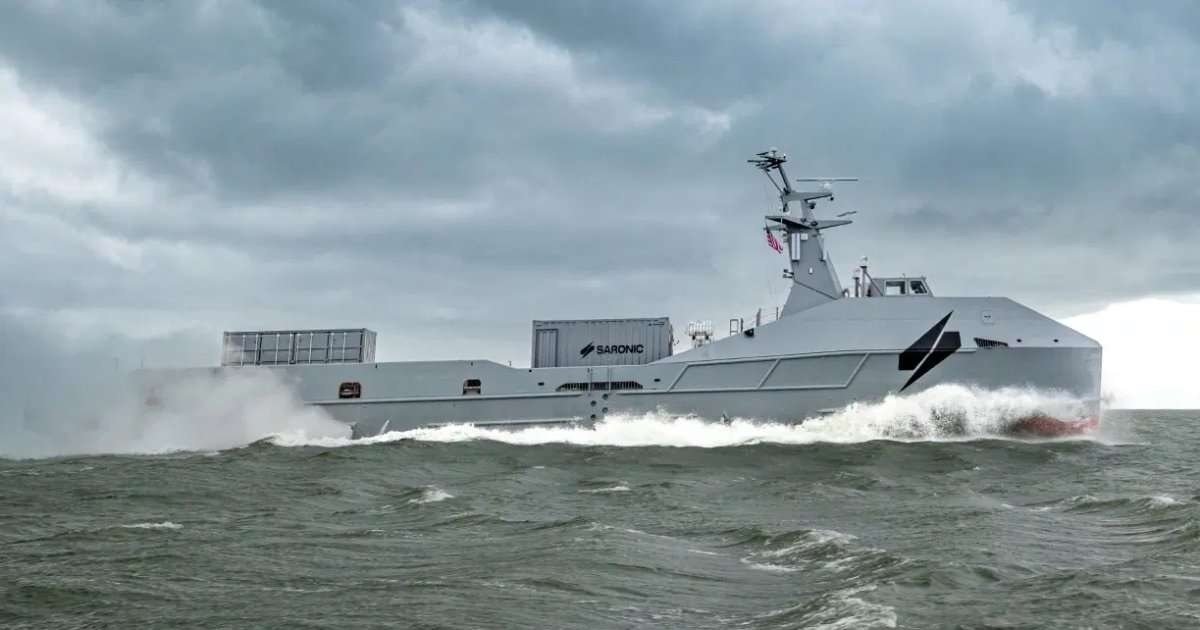
BOSTON : Marine autonomy developer Sea Machines Robotics has formally introduced its STEAMRACER-class unmanned surface vessel (USV), confirming that the platform is currently in the final competitive evaluation phase of the U.S. Navy’s Modular Attack Surface Craft (MASC) program.
The unveiling comes as the Navy advances its transition toward scalable, uncrewed maritime systems intended to expand distributed operational capacity, particularly across the Indo-Pacific region.
Platform Overview
The STEAMRACER-class USV is a purpose-built autonomous surface vessel engineered to meet the operational and technical requirements outlined under the MASC framework. The vessel operates on Sea Machines’ proprietary AI-enabled remote command and autonomy architecture, developed and refined over the past decade.
According to the company, the autonomy stack integrates vessel control, navigation, sensor fusion, and remote supervisory capabilities within a hardened software-hardware framework designed for fleet-scale deployment. The system supports both fully remote and supervisory control modes, allowing distributed operations from shore-based or afloat command nodes.
Operational Capabilities
The STEAMRACER platform incorporates the following key characteristics aligned with MASC program requirements:
Performance: The vessel is configured for high-speed transit and extended operational endurance to support distributed maritime missions.
Payload Architecture: The USV features a modular, open-deck configuration capable of accommodating containerized payloads specified under the MASC concept. The open architecture allows integration of mission packages without structural redesign, supporting rapid reconfiguration.
Data Security: The platform includes a secure onboard data environment designed to protect mission systems and enable resilient, distributed command-and-control operations.
Manned Flexibility: While designed as an “unmanned-first” platform, STEAMRACER retains structural and mechanical provisions for limited-duration crewed operations if mission parameters require temporary human presence onboard.
Domestic Manufacturing and Industrial Base Integration
To support scalable production and align with U.S. Navy requirements for domestic sourcing, Sea Machines has established a localized manufacturing network under what it describes as a “Florida-forged” production model.
The STEAMRACER integrates Sea Machines’ autonomy software with established U.S. shipbuilding and maritime industrial capabilities. Manufacturing and integration partners include:
- St. Johns Ship Building
- TOTE Services
- Ring Power
- Incat Crowther
- EMI-W&O
Sea Machines stated that this consortium structure is designed to reinforce recent executive directives aimed at strengthening the domestic maritime industrial base and increasing shipbuilding capacity within the United States.
Communications and Cybersecurity Integration
The vessel’s communications infrastructure is supported by Sierra Nevada Company (SNC), which is integrating its Maritime Advanced Secure Transmission (MAST) solution into the platform.
The MAST system is intended to provide an open, scalable communications architecture with cybersecurity features that meet Navy standards for resilient, secure maritime operations. The integration supports distributed command-and-control, secure data transmission, and interoperability within broader fleet networks.
MASC Program Background
The Navy’s Modular Attack Surface Craft (MASC) program was established in 2025 through the consolidation of earlier Large Unmanned Surface Vessel (LUSV) and Medium Unmanned Surface Vessel (MUSV) development efforts. The restructuring was aimed at accelerating fielding timelines while reducing prolonged development cycles.
The MASC program emphasizes modularity, containerized mission payloads, rapid production scalability, and operational mass. The initiative seeks to expand the Navy’s distributed maritime capabilities and address pacing challenges in contested environments, including those posed by China.
Company Background and Investment
Founded in 2015, Sea Machines Robotics has focused on the development of autonomous control systems for commercial and defense maritime applications. The company reports that it has secured more than $50 million in venture-backed capital to develop and mature its fully integrated autonomy stack.
Sea Machines stated that this investment was directed toward solving a central challenge associated with the MASC program: achieving reliable integration between autonomy software, vessel hardware, and scalable manufacturing processes.
By leveraging mature and field-tested autonomy systems rather than initiating a new prototype development cycle, the company asserts that the STEAMRACER platform offers a production-ready capability aligned with the Navy’s near-term and future distributed fleet requirements.
The final competitive evaluation phase of the MASC program will determine the selection of platforms for subsequent production and deployment.
——— End of Article ———