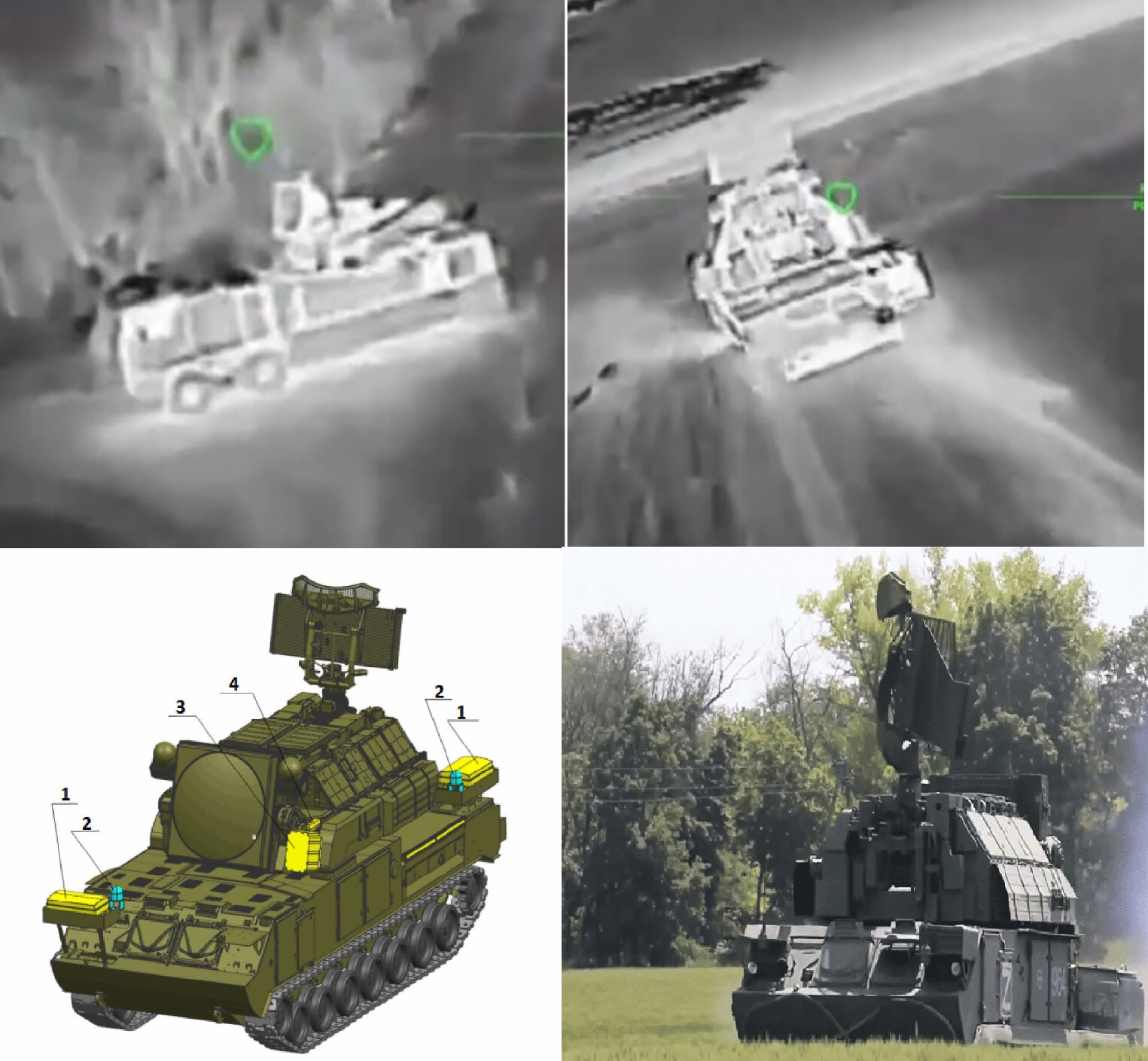
MOSCOW — March 20, 2026 : The Izhevsk Electromechanical Plant Kupol has introduced a new integrated electronic warfare (EW) protection concept designed to enhance the survivability of its Tor short-range air defense systems against increasing drone threats.
The development, reported by armored vehicle researcher Andrii Tarasenko based on technical materials released by the company, integrates drone detection and jamming capabilities directly onto the combat vehicle chassis. The system is intended to replace the current reliance on improvised countermeasures used by crews in operational environments.
Operational Context: Rising Drone Threats to Air Defense Systems
Russian ground-based air defense systems, including the Tor, Buk, and Pantsir families, have increasingly become targets for Ukrainian unmanned aerial systems. These include tactical reconnaissance drones, operational-level strike platforms, and First-Person View (FPV) kamikaze drones.
Recent battlefield reports from early March 2026 indicate that Ukrainian forces destroyed two Buk-M1 systems and four Tor-M2 systems across multiple sectors within a short timeframe. The growing scale of drone deployment, particularly low-cost FPV systems, has contributed to higher attrition rates among air defense assets.
This evolving threat environment has driven the need for integrated and automated protection systems, reducing dependence on manual detection tools and small arms engagement by vehicle crews.
System Architecture and Integration Approach
The Kupol EW concept combines signal detection sensors, electronic warfare modules, and both omnidirectional and directional jamming antennas into a unified onboard system.
The signal detection units are mounted diagonally on the front and rear sections of the vehicle’s hull, providing wide-area coverage. These sensors are connected to a centralized control unit and power supply system, enabling coordinated detection and response.
The system has been developed under several engineering constraints to ensure compatibility with the Tor platform’s primary combat functions:
-
Radar clearance: EW components do not obstruct the operational field of view of tracking and guidance radars
-
Form factor preservation: No increase in overall vehicle dimensions
-
Electromagnetic compatibility: Jamming emissions do not interfere with onboard communications, telemetry, or missile system operations
Dual-Mode Electronic Warfare Operation
The integrated system operates in two distinct modes, each designed to counter different categories of drone threats.
- Omnidirectional Mode (Short Range): This mode is optimized for countering FPV drones and other close-range threats. It generates a hemispherical jamming field providing 360-degree coverage in azimuth and up to 90 degrees in elevation. The system can disrupt drone control links at distances of up to 500 meters. The jamming function can operate continuously or be automatically activated upon detection of incoming drone video transmission signals.
- Sector-Based Mode (Long Range): The second mode targets reconnaissance and higher-altitude drones at ranges of up to 5 kilometers. It uses a set of directional antennas mounted directly on the Tor system’s tracking radar. These antennas are synchronized with radar movement, allowing the jamming beam to align automatically with the tracked target. This configuration enables focused electronic suppression over extended distances.
Technical Characteristics
According to released specifications, the directional jamming module operates across a broad frequency range of 415 to 5860 MHz. It uses generators with vertical polarization and delivers a minimum power output of 2 kilowatts.
This frequency coverage allows the system to target both control links and navigation channels used by a wide range of unmanned aerial systems, including commercially derived and military-grade platforms.
Platform Background and Industrial Context
Kupol, part of the Almaz-Antey, is the manufacturer of the Tor-M1 and Tor-M2 air defense systems. These platforms are designed for short-range engagement of aerial threats, providing point defense against aircraft, cruise missiles, and increasingly, unmanned systems.
The introduction of integrated EW protection reflects an adaptation of these systems to the evolving operational environment, where drones have become a persistent and scalable threat.
Operational Considerations and Limitations
While integrated electronic warfare provides an additional layer of protection, analysts note that its long-term effectiveness may be constrained by ongoing developments in drone technology.
Advancements such as frequency-hopping communication systems, autonomous navigation, and terminal guidance algorithms can reduce the effectiveness of traditional radio-frequency jamming.
As a result, military observers assess that electronic warfare systems will likely need to be combined with additional defensive measures. These may include mobile fire groups for close-range protection and passive defensive enhancements, such as add-on armor for critical components.
Outlook
The Kupol system represents a shift toward integrated, automated counter-drone protection embedded within air defense platforms rather than relying on external or improvised solutions.
The approach aligns with broader trends in modern conflict, where layered defense combining electronic, kinetic, and passive measures is increasingly required to counter the expanding use of unmanned systems on the battlefield.
——— End of Article ———