KYIV, — March 31, 2026 : Russian forces have begun deploying Shahed-type attack drones fitted with mock-ups of R-60 short-range air-to-air missiles, introducing a new layer of complexity to Ukraine’s air defense operations. Ukrainian officials state that the adaptation is intended to mislead interceptor units, divert defensive resources, and create uncertainty during aerial engagements.
The development was disclosed by Serhii “Flash” Beskrestnov, an advisor to Ukraine’s Defense Minister, who said the replicas are designed to appear as high-value aerial threats. According to him, the visual similarity of these mock-ups to actual missile-equipped drones increases the likelihood that Ukrainian interceptor units will prioritize and engage them.
Beskrestnov noted that Ukrainian army aviation units are familiar with such tactics, but emphasized that the presence of multiple interceptor units across different branches means that any drone perceived as carrying air-to-air weapons will likely be targeted. He added that identifying reliable criteria to distinguish between drones carrying real missiles and those equipped with replicas has become an operational priority.
Recovered Drone Variant and Structural Modifications
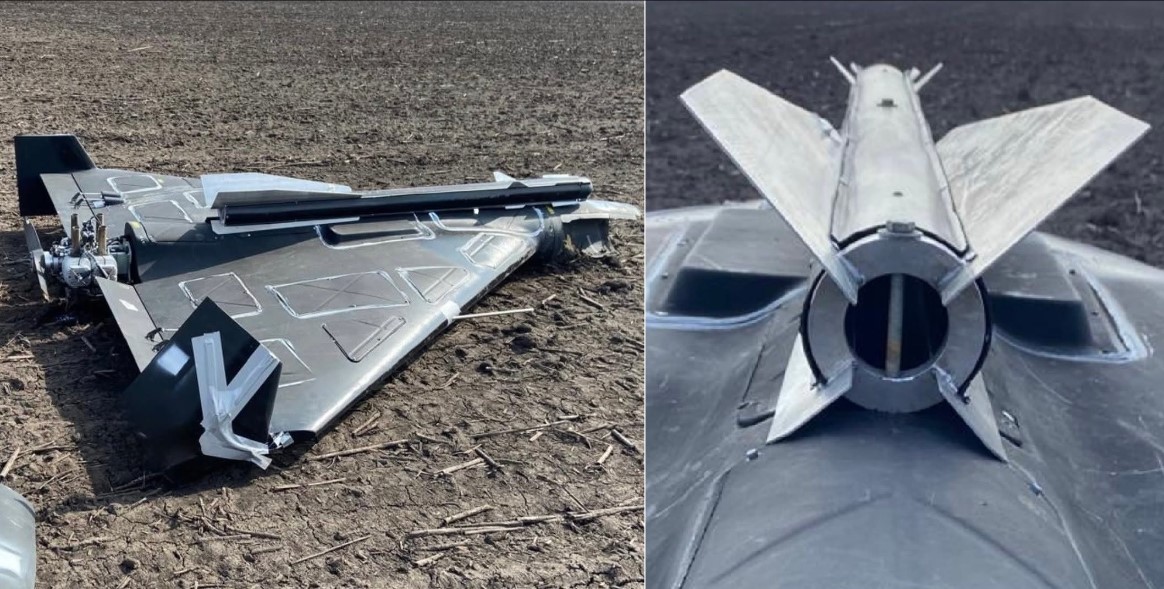
One of the recovered drones carrying a mock missile was identified as a Gerbera-2 variant, reportedly produced at Russia’s Alabuga facility in February 2026. Analysis of the wreckage showed that the replica missile included realistic aerodynamic control surfaces, closely resembling the Soviet-era R-60 design.
However, the mock-up was not mounted using a standard functional pylon. Instead, the drone’s structure had been modified to accommodate the replica alongside its primary strike payload. These modifications included trimmed lower fins and adjusted mounting points, allowing the drone to retain its standard warhead while carrying the decoy.
Evolution from Functional Missile Integration
The use of mock missile configurations follows earlier deployments of functional R-60 missiles on Shahed-type drones. The first confirmed use of operational R-60 missiles in this role was recorded in early December 2025. Since then, Ukrainian forces have repeatedly recovered fragments of such missiles from downed drones, including newer variants equipped with jet propulsion.
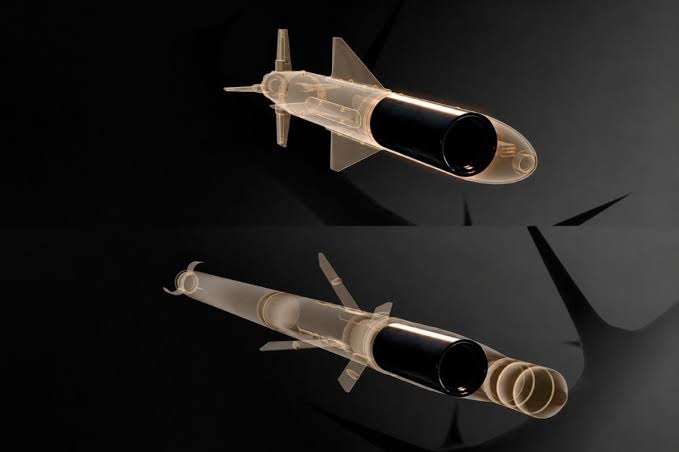
In operational configurations, the R-60 missile is mounted together with an APU-60-1MD launcher on a specialized bracket positioned at the upper forward section of the UAV fuselage. This arrangement enables the drone to carry out its primary strike mission while also presenting a potential threat to aircraft operating nearby.
The R-60 itself is a Soviet-era infrared-guided, short-range air-to-air missile originally designed for fighter aircraft. Its recognizable shape and mounting configuration contribute to the effectiveness of the mock-up as a decoy.
Onboard Systems and Targeting Mechanism
According to Ukraine’s Defense Intelligence (HUR), missile-equipped variants of these drones incorporate several additional onboard systems. These include two cameras—one located in the nose and another positioned behind the missile launcher—to support visual targeting.
Video transmission and control signals are handled through a Chinese-made mesh communication device, identified as the Xingkay Tech XK-F358 modem. This system enables real-time video streaming from the drone to a remote operator.
The targeting process is believed to rely on manual operator input. Once a Ukrainian aircraft or helicopter is visually identified through the live video feed, the operator can issue a launch command.
Navigation and flight control systems remain consistent with standard Shahed/Geran-2 configurations. However, satellite navigation is reinforced by a 12-channel anti-jamming module known as “Kometa”, which is designed to maintain operational capability in environments affected by electronic warfare.
Some modified drones are assessed to retain their full strike payload, including warheads such as thermobaric charges, while simultaneously carrying air-to-air missiles or their replicas.
Broader Pattern of UAV Adaptation
The integration of both functional missiles and mock-ups reflects a broader pattern of ongoing modifications to Russian loitering munitions. Intelligence assessments indicate that Russian forces have also experimented with integrating other air defense-related systems into UAV platforms, including the 9K333 Verba man-portable air-defense system (MANPADS).
Additionally, newer jet-powered variants, such as the Geran-5, are reported to have the capacity to carry heavier air-to-air missiles, including the R-73.
These developments are aimed at complicating Ukraine’s layered air defense network, particularly during large-scale drone attacks where multiple targets must be assessed and prioritized in real time.
Operational Implications for Ukrainian Defenses
The introduction of missile mock-ups presents a specific challenge for Ukrainian air defense units. Operators must now evaluate not only the presence of external payloads but also mounting structures, symmetry, and in-flight behavior to determine whether a drone carries a functional weapon.
This added layer of uncertainty increases the risk of expending interceptor resources on non-functional decoys while potentially allowing genuinely armed drones to pose a threat to aircraft.
Ukrainian officials indicate that efforts are ongoing to refine identification methods and improve response protocols, as both real and mock-equipped drones continue to be intercepted and analyzed following engagements.
The adaptation underscores the continuing evolution of unmanned aerial systems in the conflict, with both sides adjusting tactics and technologies to influence the effectiveness of air defense operations.
——— End of Article ———