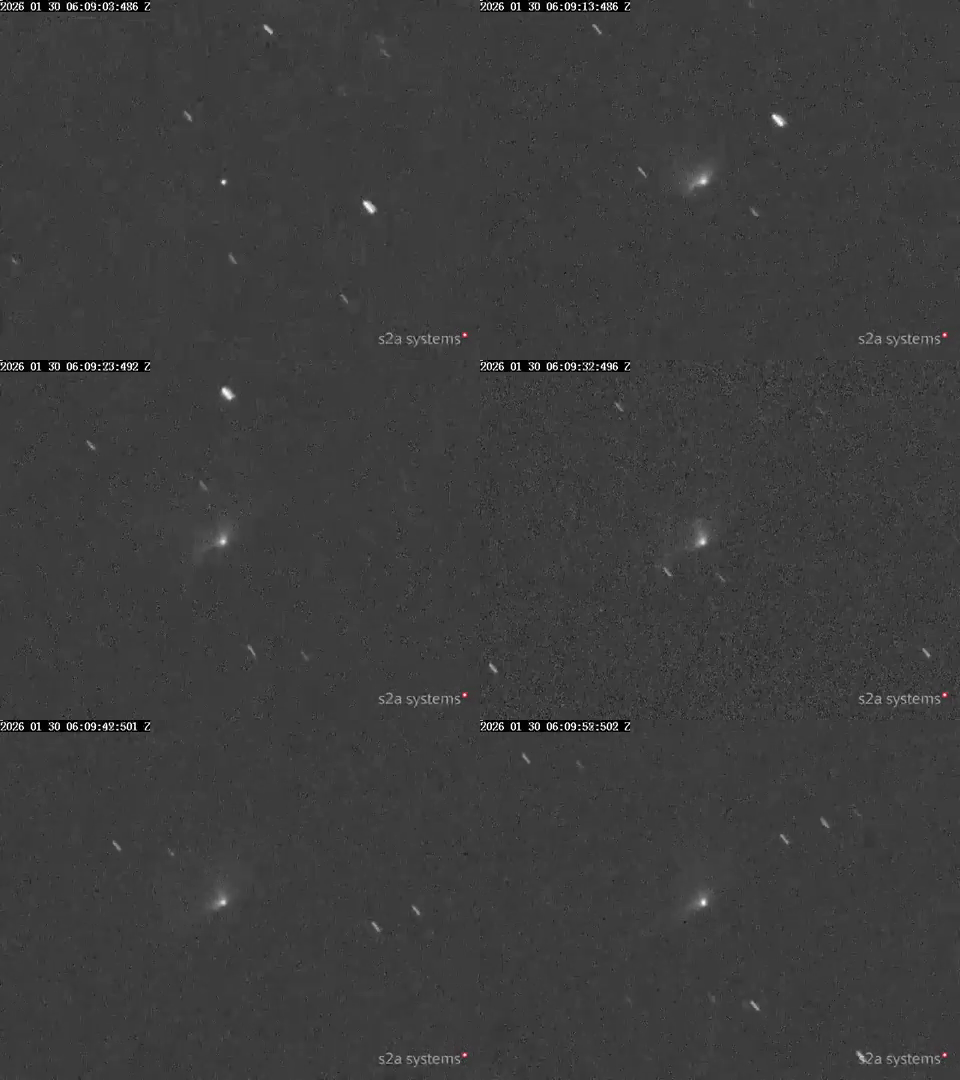
Moscow / Geneva : A Russian reconnaissance satellite known as Luch, also referred to as Olymp and catalogued as NORAD object 40258, has been completely destroyed after fragmenting in a so-called graveyard orbit, according to independent space-tracking assessments.
The breakup was first reported by the Swiss space-monitoring firm S2A Systems, which detected a large debris cloud consistent with a catastrophic fragmentation event. Analysts tracking geostationary space traffic assess that the satellite likely collided with orbital debris on January 30, 2026, leading to its total loss.
Graveyard or burial orbits are regions several hundred kilometers above the geostationary belt, reserved for decommissioned satellites at the end of their operational life. Satellites placed there are expected to remain inert and pose minimal risk to active spacecraft. The destruction of Luch within this zone has therefore raised questions among space-security analysts about the precise cause of the incident.
At present, it remains unclear whether the fragmentation was accidental—resulting from an impact with untracked debris—or whether it involved deliberate destruction. No evidence confirming intentional action has been publicly presented. Russian authorities have not issued any official statement regarding the incident as of the time of publication.
A Satellite with a Controversial Operational History
The spacecraft was launched into orbit in September 2014. Although formally designated as part of the Luch satellite series, it did not belong to the commercial Luch-5 line, which is intended for civilian communications relay services.
From early in its mission, the satellite attracted sustained attention from Western space agencies and independent observers due to its unusual behavior. Unlike typical geostationary satellites, which remain fixed over a single longitude, Luch repeatedly maneuvered along the geostationary belt and maintained prolonged close proximity to foreign communications satellites.
According to space-security analysts, such maneuvers were consistent with radio-technical reconnaissance and signal interception activities, rather than commercial or civil operations.
In 2015, the satellite positioned itself between two commercial Intelsat spacecraft, prompting a formal diplomatic protest from the United States over concerns related to interference and proximity operations.
Three years later, in 2018, then French Minister of the Armed Forces Florence Parly publicly accused Russia of “space espionage” after Luch maneuvered close to the Franco-Italian military communications satellite Athena-Fidus, which is used for secure government and defense communications.
Intelligence Links and Ownership Allegations
Multiple reports over the past decade have linked the satellite to Russia’s Federal Security Service, suggesting that it operated primarily in support of national intelligence missions rather than civilian or commercial objectives. Russian officials have never publicly confirmed these claims.
Despite its transfer to a graveyard orbit, the satellite continued to be closely tracked due to its historical role and potential relevance to broader assessments of Russian space capabilities.
Broader Context of Orbital Security Concerns
The destruction of Luch comes amid growing international concern over orbital congestion, space debris accumulation, and military activity in Earth orbit. Analysts note that even in graveyard orbits, fragmentation events can increase long-term risks by generating debris that may eventually drift toward operational regions.
The incident also occurs against the backdrop of reports that Russia is pursuing counter-space technologies. According to earlier reporting by Militarnyi, Russian developers are working on anti-satellite systems designed to affect large satellite constellations, including Starlink, owned by Elon Musk.
One concept described in those reports involves “area-effect” weapons intended to disperse large numbers of dense spherical objects into targeted orbital regions. Experts warn that such approaches could disable multiple satellites simultaneously but also carry a high risk of uncontrolled debris generation with consequences for unrelated orbital systems.
Ongoing Monitoring
International space-tracking networks continue to monitor the debris cloud generated by the Luch fragmentation to assess its evolution and any potential threat to other spacecraft. Without confirmation from Russian authorities, the precise circumstances surrounding the satellite’s destruction remain unresolved.
What is clear, analysts say, is that the loss of Luch marks the end of one of the most closely watched and controversial satellites in geostationary orbit over the past decade, while underscoring persistent challenges in managing safety and security in an increasingly contested orbital environment.
——— End of Article ———