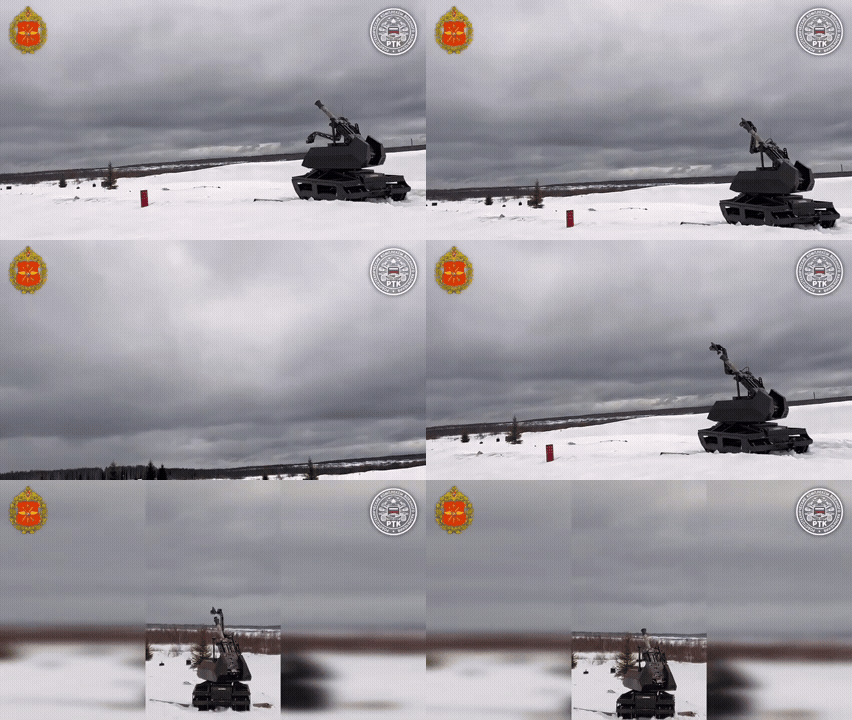
MOSCOW, — April 6, 2026 : The Russian military has released the first video footage showing field trials of the Bagulnik-82 automated mortar module integrated onto the Kurier unmanned ground vehicle (UGV), marking a further step in the development of robotic fire-support systems.
The trial footage, distributed through official channels associated with Russian ground robotics programs, depicts the tracked Kurier platform navigating a training range and engaging designated targets using 82 mm mortar rounds. The system is configured as an unmanned, remotely operated self-propelled mortar designed to deliver indirect fire while keeping personnel at a distance from the battlefield.
Automated Mortar Module
The Bagulnik-82 combat module consists of an 82 mm mortar mounted within a rotating turret. A key feature of the system is its integrated robotic loading mechanism, which enables fully automated ammunition handling. A mechanical arm retrieves mortar rounds and inserts them into the barrel without human intervention.
According to data observed during the trials, the loading cycle takes approximately five seconds between shots, allowing the system to maintain sustained fire. The mortar configuration is understood to be derived from, or closely aligned with, existing Russian lightweight systems such as the 2B14 Podnos and 2B24.
The module is also equipped with recoil mitigation components designed to stabilize the relatively lightweight unmanned platform during firing. These dampening systems reduce the impact of mortar discharge on the chassis, supporting accuracy and operational continuity during repeated firing sequences.
Initial trial data indicates that the mortar system is capable of engaging targets at distances of up to approximately four kilometers using standard high-explosive ammunition. However, detailed specifications such as sustained rate of fire, onboard ammunition capacity, and full performance parameters in the robotic configuration have not been officially disclosed.
Kurier Robotic Platform
The Bagulnik-82 module is mounted on the Kurier UGV, a compact tracked robotic system developed between 2022 and 2023. The platform measures approximately 1.4 meters in length, 1.2 meters in width, and 0.58 meters in height, with a total weight of about 250 kilograms.
The vehicle is powered by two electric motors rated at 6 kW each and can reach speeds of up to 35 km/h. Depending on mission configuration and payload, the Kurier has an operational endurance ranging from 12 to 72 hours.
Control of the platform is conducted remotely via radio link at distances between 3 and 10 kilometers. In certain operational scenarios, the system can also be operated using a fibre-optic cable connection. The vehicle is equipped with onboard cameras that provide navigation and targeting data to remote operators.
The modular design of the Kurier allows it to be adapted for multiple roles. In addition to the mortar configuration, previous variants have been fitted with AGS-17 and AGS-30 automatic grenade launchers, machine guns, and reactive flamethrowers. The platform has also been used for logistics support, reconnaissance missions, engineering tasks, and as a mobile drone control station. An air-defense variant equipped with a PKT machine gun has been demonstrated for countering low-flying aerial threats.
Operational Context and Development Timeline
The Kurier platform was first publicly displayed in early 2024 and underwent initial field testing in the Avdiivka area during the same year. Deliveries to Russian forces began in 2024, with approximately 50 units reported in service by October 2024. Production has continued since that time, with the system undergoing operational testing across multiple sectors.
According to Russian military sources, the Bagulnik-82 mortar configuration has entered initial use within the zone of the special military operation, although no official confirmation has been provided by the Russian Ministry of Defence regarding deployment scale, production volumes, or timelines.
Role of External Targeting
Military analysts note that the effectiveness of unmanned indirect-fire systems such as the Bagulnik-82 is dependent on external targeting inputs. In current operational environments, such systems typically rely on unmanned aerial vehicles (UAVs) to identify targets, determine firing coordinates, and provide real-time correction for improved accuracy.
The integration of an automated mortar onto the Kurier platform represents a shift in the evolution of Russian unmanned ground systems, expanding their role from direct-fire support to include indirect artillery capabilities.
No additional official statements have been released regarding the full technical performance, procurement plans, or future deployment strategy of the Bagulnik-82 module. The system remains one of several modular weapon configurations under development for the Kurier robotic platform.
——— End of Article ———