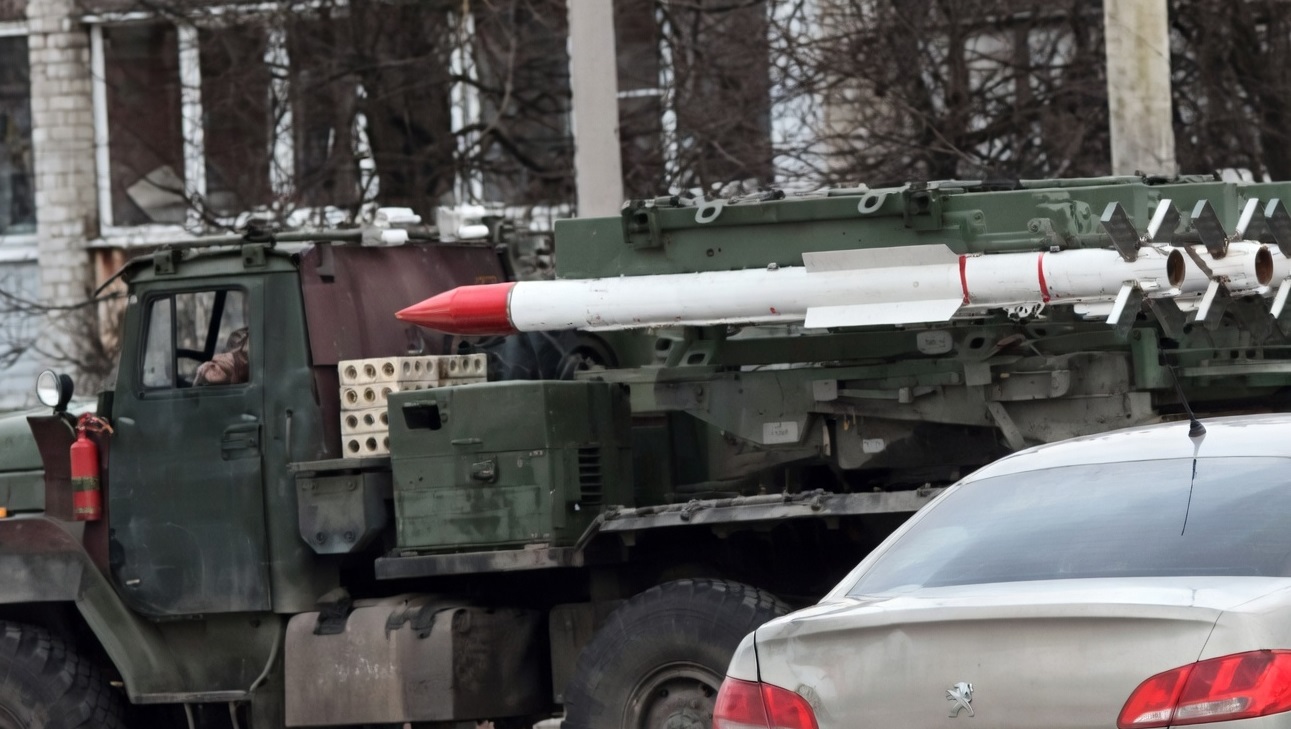
ORYOL, Russia — April 12, 2026 : A ground-based air defense launcher equipped with medium-range R-77-1 air-to-air missiles has been identified in the Russian city of Oryol, approximately 160 kilometers from the Ukrainian border, marking the first confirmed operational deployment of this specific improvised configuration in the region.
Photographic evidence of the system was published on April 12, 2026, by the Russian military-focused Telegram channel Voenny Osvedomitel. The images show a launcher carrying four R-77-1 missiles mounted on aircraft-style pylons adapted onto a ground-based guide rail, indicating a non-standard, improvised engineering approach rather than a fully industrialized system.
System Configuration and Design Approach
Analysis of the imagery indicates that the launcher integrates standard aviation pylons with a rail-based ground platform, enabling the use of air-to-air missiles in a surface-to-air role. Defense analysts have described such systems as “FrankenSAMs,” reflecting their hybrid construction and rapid adaptation for operational use.
The design concept parallels several established Western air defense systems that employ air-to-air missiles for ground launch. These include the Norwegian-US NASAMS system, which uses AIM-9 Sidewinder and AIM-120 AMRAAM missiles; Germany’s IRIS-T SLM system; and France’s MICA-VL system. In each case, aviation missiles are adapted to fulfill short- to medium-range air defense roles with varying degrees of integration maturity.
The R-77 missile family, developed by Russia’s Vympel design bureau, is known by the NATO designation AA-12 Adder and export names RVV-AE and RVV-SD for later variants. The R-77-1 (RVV-SD), which entered Russian service in 2015, is an active radar-guided beyond-visual-range missile with an air-launched range of up to 110 kilometers. The missile measures approximately 3.71 meters in length, weighs around 190 kilograms, and features lattice grid fins designed to improve maneuverability.
Performance Parameters and Expected Capabilities
Manufacturer specifications for earlier ground-launched R-77 variants indicate an engagement range between 1.2 and 12 kilometers, with altitude coverage from approximately 20 meters to 9 kilometers and a lateral intercept parameter of up to 8 kilometers. These figures were based on earlier versions of the missile with an air-launched range of about 80 kilometers.
Given the extended range of the R-77-1, analysts assess that ground-launched performance parameters for the newer variant are likely to be higher, although no official data has been released for this specific configuration. The adaptation to a ground-based role may also affect kinematic performance due to the absence of initial launch altitude and speed advantages provided by aircraft.
Historical Development Background
The concept of deploying R-77 missiles from ground-based platforms dates back to the Soviet Union in the 1980s. Early development efforts explored integrating the missile into existing air defense systems, including Kvadrat-type surface-to-air missile systems and launcher concepts derived from the AZP-57 gun used in the S-60 anti-aircraft artillery system.
Following the start of Russia’s full-scale invasion of Ukraine in 2022, work on ground-based adaptations of the R-77 resumed. In 2024, a prototype system using a different launcher configuration—reportedly based on a modified BM-21 Grad multiple launch rocket system—underwent testing at the Kapustin Yar training range. The system observed in Oryol represents a distinct configuration, suggesting continued iterative development.
Operational Context in Oryol
Oryol has experienced repeated Ukrainian drone and missile strikes during the autumn and winter period of 2025–2026. The deployment of the R-77-1-based launcher in this area indicates that the system has likely reached at least limited operational status and is being used to augment local air defense coverage.
Military analysts assess that the deployment reflects efforts to compensate for shortages in conventional surface-to-air missile systems and interceptor stocks, which have been reduced through sustained operational use and targeted strikes.
Impact on Russian Aerospace Operations
The use of R-77-1 missiles in a ground-based role has implications for Russian aviation operations. Ukrainian aviation sources have reported a reduction in R-77-1 usage by Russian fighter aircraft in recent months.
Footage released by the Russian Ministry of Defense in early 2026 showed Su-35S fighter jets operating with older R-27 missiles instead of the more modern R-77-1. The increased reliance on legacy munitions for aerial interception missions and escort roles suggests a reallocation of available R-77-1 stocks to meet immediate ground-based air defense requirements.
Strategic Implications
The deployment in Oryol reflects a localized adaptation to evolving operational demands, particularly the increasing frequency of unmanned aerial vehicle (UAV) and missile threats targeting infrastructure and military assets within Russian territory.
By adapting existing air-to-air missile inventories for ground-based use, Russian forces appear to be seeking a flexible and rapidly deployable solution to reinforce air defense coverage in high-risk areas. The continued development and fielding of such systems indicate an ongoing effort to mitigate capability gaps under current operational conditions.
——— End of Article ———