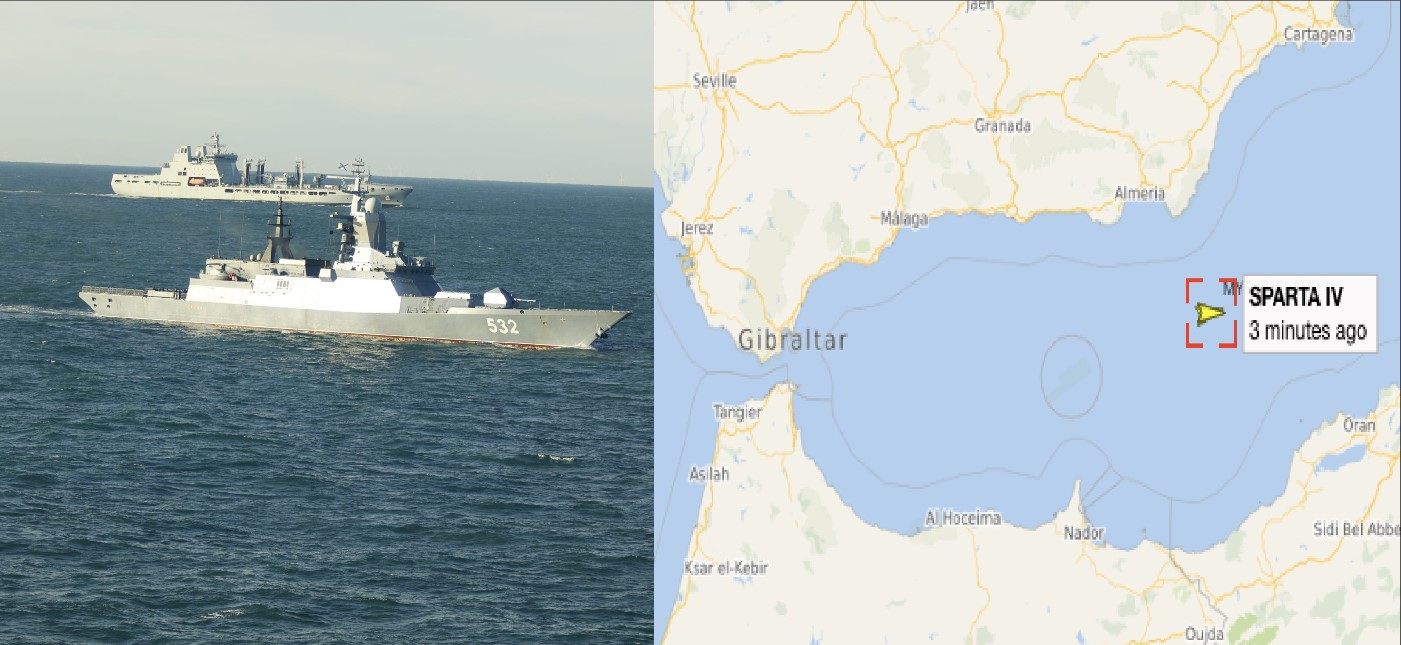
Lisbon / Moscow : A Russian maritime convoy escorted by a frontline warship was tracked moving south of the Portuguese coast on January 9, drawing renewed attention from open-source intelligence (OSINT) analysts and maritime security observers amid heightened scrutiny of Moscow’s global logistics operations.
The convoy consists of two Russian cargo vessels, SPARTA IV and MYS ZHELANIYA, sailing under the protection of the Russian Navy’s Severomorsk. According to tracking data and assessments shared by OSINT analyst Russian Forces Spotter, the ships have officially declared the Egyptian port of Port Said as their destination. However, analysts caution that the declared endpoint may not reflect their final routes.
Ambiguous Routing and Concealment Tactics
Automatic Identification System (AIS) data and trajectory analysis suggest a pattern of deliberate ambiguity. The SPARTA IV has a documented history of declaring Egyptian ports while ultimately proceeding to Tartus, home to a major Russian naval logistics hub and long-term military facility. This pattern has been observed repeatedly since Russia expanded its Mediterranean supply lines following the war in Ukraine.
The MYS ZHELANIYA, by contrast, is attracting attention for possible interest in North Africa. Analysts monitoring its recent movements note indicators consistent with a potential stop in Libya, a state where Moscow maintains expanding political, military and logistical interests. While no port call has been formally declared, deviations in course and speed have raised speculation about alternative destinations.
Maritime analysts say such practices — including vague destination declarations and mid-voyage route adjustments — are increasingly used by sanctioned Russian shipping to reduce scrutiny, complicate tracking, and obscure the nature of cargoes being transported.
Military Escort Signals High-Value Mission
The presence of the Severomorsk, a heavily armed Project 1155 destroyer, underscores the perceived importance of the convoy. Naval escorts are uncommon for routine commercial shipments, and their use typically signals either sensitive cargo, elevated threat assessments, or both.
“This level of protection suggests Moscow is unwilling to take risks with these shipments,” one European maritime security official said. “A destroyer escort points to cargo that is strategically or militarily significant.”
The escort also highlights Russia’s readiness to deploy naval assets far from home waters to safeguard critical logistics routes linking its territory with the Mediterranean, Middle East, and North Africa.
Sanctioned Ownership Networks
Both cargo vessels are linked to companies under Western sanctions, reinforcing suspicions about the nature of their missions.
The SPARTA IV is owned by SK-Yug LLC, a subsidiary of Oboronlogistika LLC, a sanctioned shipping firm that operates as part of the Russian Ministry of Defence’s military construction and logistics complex. Oboronlogistika’s core role is the transportation, storage, and production support of military and special-purpose goods for the Russian armed forces.
The MYS ZHELANIYA is owned by Transstroy LLC, a sanctioned Russian construction company involved in strategic infrastructure projects, particularly in the Arctic and northern regions. The vessel is also affiliated with Eco Shipping LLC, which supports large-scale Arctic infrastructure, including logistics tied to Novatek’s Arctic LNG-2 project — itself subject to international sanctions.
The Severomorsk: A Cold War–Era Warship Still in Service
The Severomorsk is a Project 1155 (Udaloy-class) destroyer assigned to the Northern Fleet of the Russian Navy. Laid down at the Yantar shipyard in Kaliningrad in July 1984, the vessel underwent several name changes before entering service in 1988.
Despite its age, the ship remains a capable escort platform. It is armed with AK-100 naval guns, torpedo systems, the Rastrub anti-submarine missile complex, and the Kinzhal air-defense missile system. The destroyer can also operate two Ka-27PL anti-submarine helicopters, significantly extending its surveillance and strike capabilities.
Strategic Implications
The convoy’s movement comes as Russia continues to adapt its global logistics network under the pressure of sanctions, relying on military protection, opaque routing, and state-linked shipping firms to sustain overseas operations. Whether the ships ultimately dock in Egypt, Syria, Libya, or elsewhere, analysts say the voyage highlights Moscow’s determination to preserve strategic supply lines despite international restrictions.
For European and NATO observers, the sight of a Russian destroyer escorting sanctioned cargo vessels past Western Europe serves as a reminder that the maritime dimension of Russia’s geopolitical posture remains active — and increasingly complex — well beyond the Black Sea.
——— End of Article ———