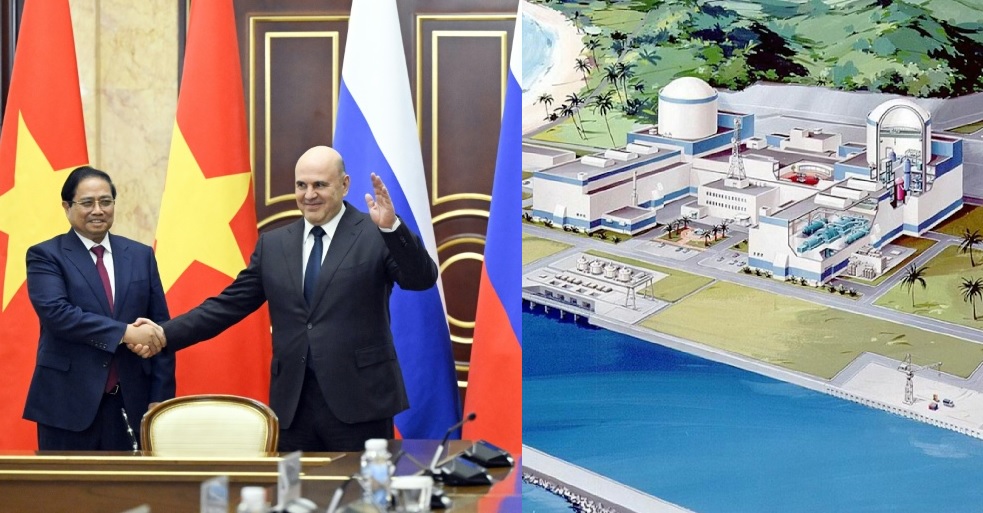
MOSCOW — March 23, 2026 : Russia and Vietnam have signed an intergovernmental agreement establishing the legal framework for the construction of Vietnam’s first nuclear power plant, marking a significant step in Hanoi’s revived nuclear energy programme.
The agreement was signed in Moscow during an official visit by Vietnamese Prime Minister Pham Minh Chinh, in the presence of Russian Prime Minister Mikhail Mishustin. The document was formally signed by Alexey Likhachev, Director General of Russia’s state nuclear corporation Rosatom, and Tran Van Son, Minister and Head of the Office of the Government of Vietnam.
The agreement defines the key conditions, structure, and areas of cooperation for the implementation of the project, which will be developed as the Ninh Thuan 1 Nuclear Power Plant in central Vietnam.
Project Scope and Technical Configuration
The Ninh Thuan 1 project will consist of two nuclear power units based on Russian-designed VVER-1200 reactors, with a combined installed capacity of 2,400 megawatts (2.4 gigawatts). The plant’s design will be based on the Leningrad Nuclear Power Plant-2 in Russia, which serves as the reference model for the project.
The VVER-1200 is a Generation III+ pressurized water reactor, designed with enhanced safety systems and extended operational life. The adoption of this design reflects Vietnam’s intention to deploy established reactor technology with proven operational performance.
The agreement also provides a framework for broader cooperation in nuclear science, applied research, and high-technology sectors, alongside the core construction programme.
Background and Programme Revival
Vietnam initially approved its nuclear power development programme in 2009, with plans to construct two plants in Ninh Thuan province:
- Ninh Thuan 1, assigned to Russia
- Ninh Thuan 2, assigned to Japan
The two facilities were intended to deliver a combined capacity of approximately 4 gigawatts.
However, the programme was suspended in 2016, with the government citing budget constraints and safety concerns following the Fukushima Daiichi nuclear accident in 2011.
In late 2024, Vietnam formally revived its nuclear energy programme through a National Assembly resolution and updated national power development plans. The decision was driven by long-term energy security requirements, rapid industrial growth, and commitments to achieve net-zero emissions by 2050.
Following the revival, Vietnam re-engaged both Russia and Japan regarding the original projects. While Russia agreed to proceed with Ninh Thuan 1, Japan declined participation in Ninh Thuan 2, citing the tight construction timelines set by the Vietnamese government.
Vietnam is targeting the commissioning of its first nuclear units between 2030 and 2035, with an overall objective of bringing initial capacity online by 2030–2031, depending on project execution.
Energy Context and Strategic Drivers
The nuclear agreement comes amid increasing energy demand in Vietnam, driven by industrial expansion and rising electricity consumption. The country has also faced power supply challenges, including disruptions linked to extreme weather events and constraints in existing generation capacity.
In addition, global fuel supply disruptions, partly linked to ongoing conflicts in the Middle East, have affected Vietnam’s energy costs. Recent data indicates that 95-octane petrol prices have increased by approximately 50 percent, while diesel prices have risen by around 70 percent, placing additional pressure on the country’s manufacturing sector.
To address these challenges, Vietnam is pursuing a diversified energy strategy, combining nuclear power development with expanded cooperation in oil, gas, and liquefied natural gas (LNG).
During the Moscow visit, Vietnam also signed bilateral agreements on oil and gas exploration and production, and Russian LNG producer Novatek confirmed a preliminary supply agreement with a Vietnamese partner following extended negotiations.
Existing Cooperation and Institutional Framework
Russia and Vietnam maintain longstanding cooperation in nuclear technology. This includes the operation of the Dalat research reactor, which uses Russian-supplied fuel, and ongoing discussions on establishing a Center for Nuclear Science and Technology in Vietnam.
The current agreement builds on earlier engagements, including a memorandum of understanding signed in January 2025 between Rosatom and Vietnam Electricity (EVN), which laid the groundwork for renewed project development.
Implementation Outlook
The newly signed intergovernmental agreement formalizes the transition from planning to implementation, with Rosatom designated as the primary technology provider for Vietnam’s first commercial nuclear power facility.
Further steps will include detailed engineering design, regulatory approvals, financing arrangements, and construction planning. The project is expected to play a central role in Vietnam’s future energy mix, contributing to base-load power generation, reduced reliance on fossil fuels, and long-term energy stability.
——— End of Article ———