Russia has developed a new electronic warfare (EW) system named “Multik”, designed to safeguard its helicopters and ground vehicles from Ukraine’s expanding fleet of first-person view (FPV) drones. Created by the Gradient Research Institute, this advanced system underscores Moscow’s continued focus on countering one of the most transformative weapons of the modern battlefield — low-cost, high-impact FPV drones that have inflicted significant losses on Russian forces throughout the conflict.
Design and Technical Capabilities
The Multik system operates across a broad frequency spectrum, ranging from 700 MHz to 6,000 MHz, allowing it to detect and jam virtually all commonly used drone control and video transmission links. According to reports from Defense Express, the system can detect targets up to 1,000 meters (3,280 feet) away and jam drone signals within a 500-meter (1,640-foot) radius.
The device provides 360-degree protection and can operate three jamming channels simultaneously, allowing it to disrupt multiple drones or frequencies at once — a key advantage against Ukraine’s growing use of swarm drone tactics. Despite its robust functionality, Multik remains compact and lightweight, weighing less than 9.5 kilograms (20 pounds), and it draws power directly from a helicopter’s onboard systems, minimizing logistical complexity and energy demand.
How the Multik System Works
The Multik functions as an electronic “shield” that protects helicopters and vehicles by neutralizing drone communication. It constantly scans the surrounding electromagnetic environment for signals that resemble FPV drone control or video transmission links. Once detected, its onboard processors identify the nature of the signal, determining whether it originates from an enemy source.
When a hostile drone link is confirmed, Multik emits powerful interference pulses precisely tuned to that frequency. This jamming effect severs the connection between the drone and its operator, rendering the drone uncontrollable and causing it to crash or lose its targeting capability. The system’s omnidirectional antenna array ensures total coverage, meaning it can detect and jam drones approaching from any direction, even while a helicopter is in motion or maneuvering at low altitudes.
Integration on Helicopters and Ground Vehicles
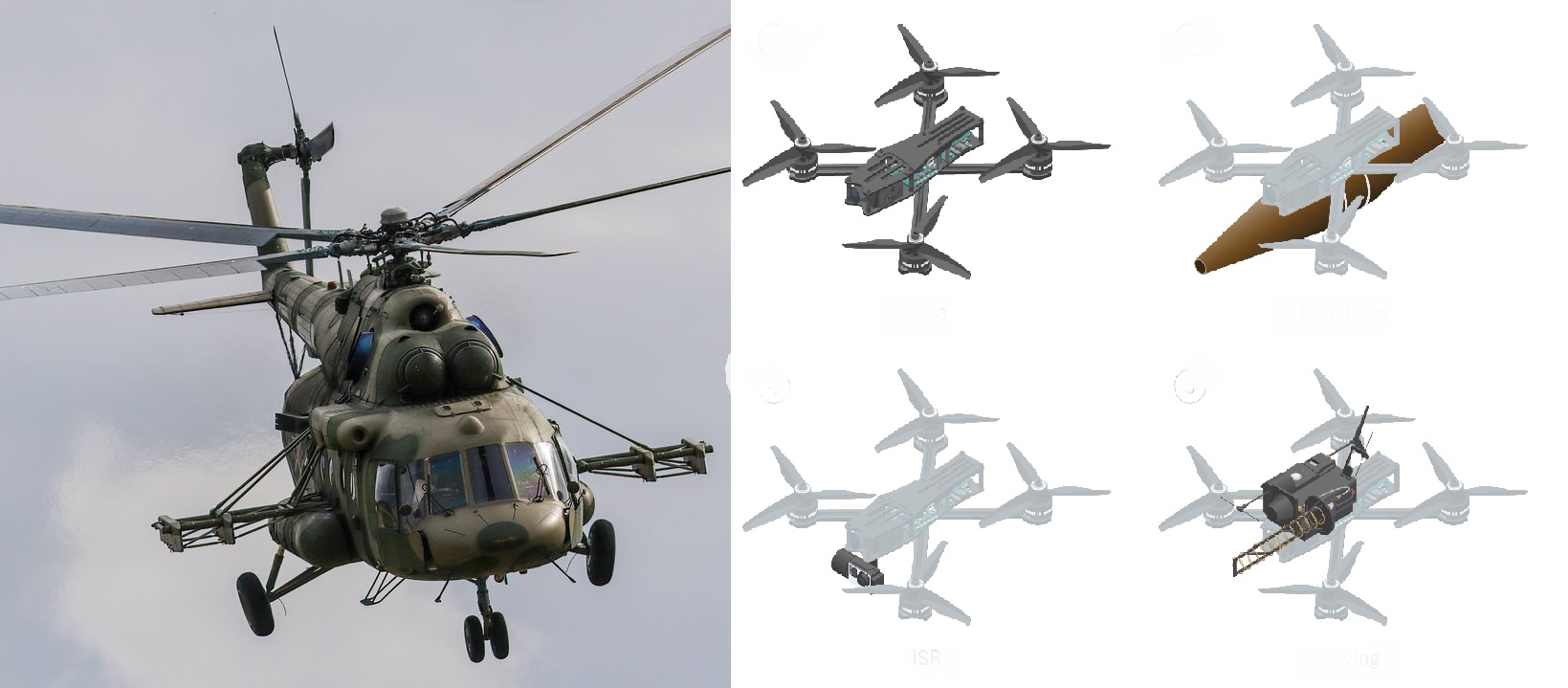
The Russian defense industry has begun integrating the Multik EW system onto frontline helicopters, including the Mi-8, Ka-52, and Mi-28 variants. These aircraft have been frequent targets of Ukrainian FPV drone strikes, making onboard protection systems increasingly essential. The lightweight and modular design of Multik enables seamless installation without affecting flight performance or mission payloads.
Additionally, modified versions of the Multik are being tested for use on armored vehicles, military trucks, and stationary defense posts. When deployed on the ground, the system can create a localized electronic jamming zone, protecting convoys, artillery positions, and command centers from incoming drone swarms. This multi-platform flexibility aligns with Russia’s broader strategy to deploy EW coverage across every operational layer of its forces.
Part of Russia’s Expanding Counter-Drone Network
The introduction of Multik complements a range of existing Russian EW systems designed to combat various aerial and electronic threats. High-powered platforms such as the 1L269 Krasukha-2 and Krasukha-4 remain vital for jamming enemy radar, reconnaissance, and satellite communications, often positioned near strategic command centers. Meanwhile, systems like the Repellent-1 and Silok-01 handle medium-range drone suppression, capable of tracking and disrupting multiple UAVs simultaneously.
At the tactical level, Russia has distributed portable EW devices such as the Volnorez and Rubezh to infantry and vehicle crews for localized defense. These smaller jamming domes provide an immediate layer of protection against FPV drones operating within a few hundred meters, illustrating how Russia has developed a layered electronic defense structure spanning from strategic-level systems down to squad-level tools.
Doctrinal Shift and Tactical Integration
The Russian Ministry of Defence (MoD) has formalized a new counter-UAV doctrine, making electronic warfare a core component of all combat units. The doctrine mandates that every battalion and platoon must possess at least one electronic countermeasure system. It also calls for rapid operator training and the integration of EW measures directly into combined-arms operations, ensuring that jamming and drone suppression are coordinated with air defense, artillery, and infantry maneuvers.
This reflects a major shift in Russian military doctrine — electronic warfare is no longer treated as a specialized support role but as a central element of modern combat strategy. The emphasis now lies in combining detection, interference, and destruction capabilities into a single, multi-layered operational framework.
Ukraine’s Drone Dominance
Ukraine’s widespread deployment of FPV drones has proven to be one of the most effective asymmetrical tactics in modern warfare. These small, inexpensive drones are often guided manually using live video feeds, allowing operators to deliver explosive payloads with remarkable precision. Their effectiveness has forced Russia to adapt rapidly, as even heavily armored tanks and sophisticated helicopters have fallen victim to these nimble aerial weapons.
The FPV threat has changed battlefield dynamics, making electronic protection as vital as armor or air defense missiles. By neutralizing drone communication links before impact, systems like Multik provide Russian forces with a critical layer of survivability against these persistent and inexpensive threats.
A New Phase in Electronic Warfare
The Multik electronic warfare system represents a significant evolution in Russia’s approach to counter-drone defense. Compact, versatile, and capable of multi-channel interference, it embodies the shift toward modular and mobile EW technologies that can be deployed across various platforms.
As the war in Ukraine continues to demonstrate the devastating effectiveness of drones, the ability to detect, jam, and neutralize them in real time will increasingly determine battlefield outcomes. For Russia, the Multik system not only strengthens immediate defense against FPV drone attacks but also signals a deeper transformation — one where electronic dominance becomes as decisive as firepower in 21st-century warfare.
——— End of Article ———