MOSCOW / WASHINGTON — Russia has elevated an alleged Ukrainian drone attack on President Vladimir Putin’s residence into a high-visibility diplomatic episode, publicly briefing U.S. military attachés and releasing video footage that analysts say is designed to establish a formal justification framework for future retaliation under a claimed “right to respond.”
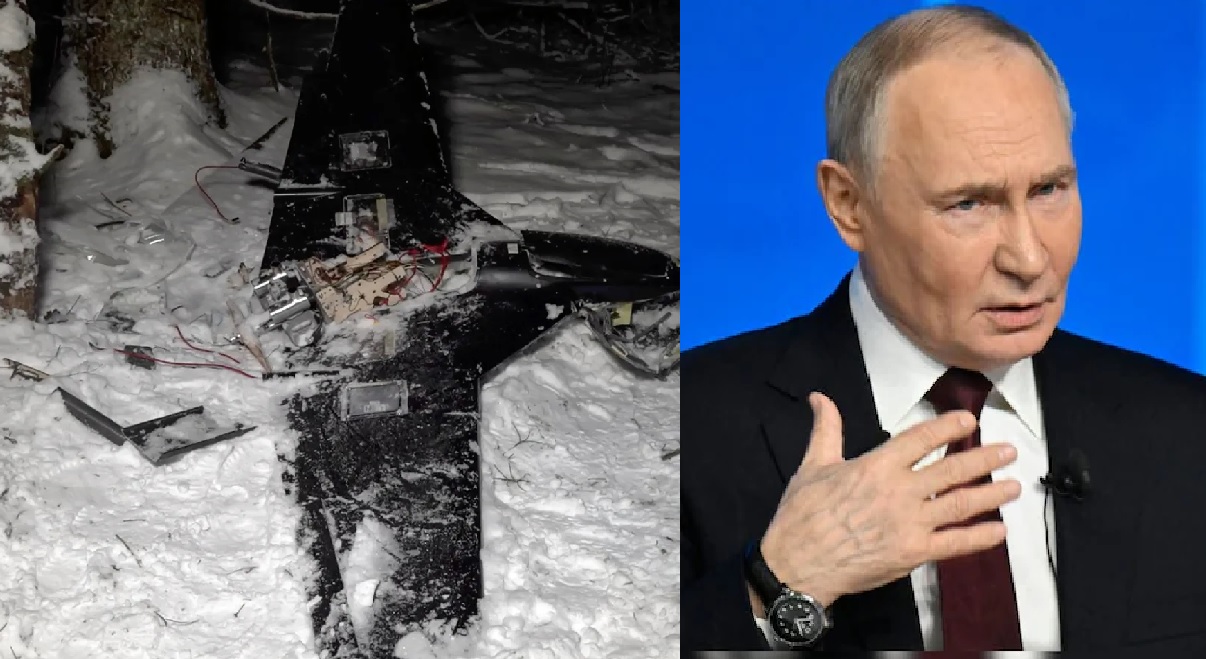
The briefing was led by Igor Kostyukov, Chief of Russia’s Main Intelligence Directorate (GRU)—an organization broadly comparable in role to India’s Defence Intelligence Agency (DIA). In a move described as highly unorthodox, the interaction was conducted on camera, with Russian officials handing over what they claim is recovered drone hardware linked to the alleged attack.
The Alleged Attack And Russia’s Claims
According to Russian authorities, the incident involved a coordinated drone operation targeting a presidential residence complex used by Vladimir Putin. Moscow claims that 91 long-range drones were launched during the operation, most of which were intercepted by Russian air defenses.
Russian military sources allege that debris recovered from the downed drones included a navigation controller, which Russian specialists say was digitally analyzed. Based on stored flight data, Moscow asserts that the drones’ intended endpoint corresponded to the presidential site. One recovered munition was described by Russian media as carrying an explosive payload of approximately 6 kilograms, though these technical claims remain unverified by independent observers.
Public Briefing As Strategic Signaling
Defense analysts note that the decision to stage the briefing publicly, rather than through closed diplomatic or intelligence channels, is central to the message. By documenting the exchange, Russia appears to be locking in a narrative that can be cited later to justify retaliatory escalation, should it choose to do so.
This approach allows Moscow to maintain strategic flexibility—keeping the option of response open while avoiding immediate escalation. The framing suggests the incident may serve less as an operational turning point and more as a stored political trigger.
Kyiv And Washington Push Back
Ukraine has categorically denied any attempt to target the Russian president or his residences, dismissing the allegation as information warfare designed to undermine Kyiv’s standing with Western partners.
Western intelligence assessments cited by U.S. officials indicate that Washington has seen no conclusive evidence supporting Russia’s claim that Ukraine directly targeted Putin. American officials have emphasized that the incident, as presented by Moscow, cannot be independently confirmed.
Peace Talks, Trump, And Rising Pressure On Kyiv
The timing of the episode is significant. It unfolds as Donald Trump intensifies efforts to push both sides toward a negotiated settlement. Diplomatic sources say Trump’s team is applying substantial pressure on Kyiv to show flexibility, raising concerns in Ukraine that Russia is seeking to manufacture leverage ahead of key negotiating moments.
For Ukrainian President Volodymyr Zelenskyy, the alleged incident introduces an additional political and diplomatic vulnerability, one that Moscow can activate selectively to complicate talks or justify hardened positions.
The Chinese-Made Controller Claim
Russian officials and affiliated media have pointed out that the recovered drone controller shown during the briefing was Chinese-manufactured. While no independent verification of the specific device has been provided, analysts note that Chinese-origin components and commercial drone electronics are widespread across the conflict, appearing in systems used by both Russia and Ukraine due to globalized supply chains.
Beijing has not commented on the allegation, and no evidence has emerged to suggest state involvement by China in the incident.
A Calculated Move, Not An Immediate Escalation
Whether the alleged attack occurred as Moscow describes remains contested, but its political utility is already evident. By formalizing the claim in front of U.S. military representatives, Russia has created a documented grievance that can be referenced at a future time of its choosing.
For now, the episode stands less as a confirmed act of war and more as a carefully positioned pressure point—one that could influence diplomacy, justify escalation, or be quietly shelved depending on how negotiations evolve.
As peace efforts intensify and strategic narratives harden, the world may indeed be watching not an explosion, but a trigger being deliberately set aside—ready to be pulled later.
——— End of Article ———