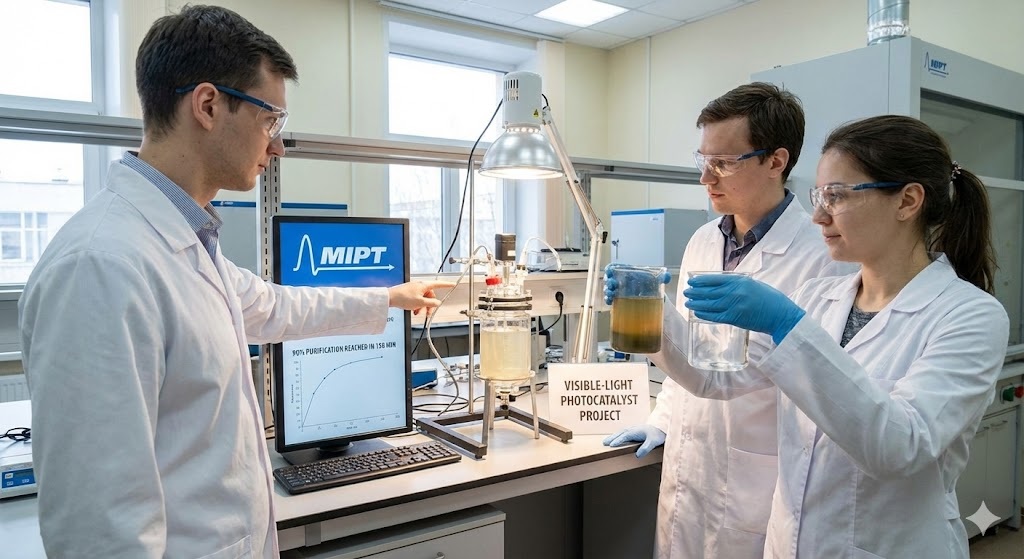
MOSCOW : Researchers at the Moscow Institute of Physics and Technology have developed a new class of visible-light-activated photocatalysts capable of purifying contaminated water using natural sunlight, achieving up to 90 percent purification within 150 minutes under laboratory conditions.
The work was carried out by specialists at MIPT’s Centre for Photonics and Two-Dimensional Materials in collaboration with international research partners. The study focuses on overcoming long-standing efficiency limitations in conventional photocatalytic water treatment systems, which largely depend on ultraviolet radiation.
Addressing Solar Spectrum Limitations
Photocatalysis is widely used to remove organic contaminants from water, including industrial dyes, agricultural pesticides, pharmaceutical residues and oil traces. In conventional systems, semiconductor photocatalysts are activated primarily by ultraviolet (UV) light. However, UV radiation accounts for only about 5 percent of the total solar spectrum reaching the Earth’s surface.
Visible light, by contrast, represents approximately 50 percent of solar radiation. The limited UV fraction significantly reduces the efficiency of traditional photocatalysts when operated under natural sunlight. The MIPT research team therefore concentrated on designing materials capable of absorbing and utilizing visible light more effectively, with the aim of improving scalability and reducing energy requirements in water treatment applications.
Femtosecond Laser Ablation Synthesis
To engineer photocatalysts with enhanced visible-light absorption, the researchers employed femtosecond laser ablation in liquids, a synthesis technique that uses ultra-short, high-energy laser pulses.
The process involves directing femtosecond laser pulses onto the surface of a solid target material submerged in liquid. The intense pulses vaporize the material at the target surface, forming a plasma plume. As the vapor cools, it condenses into nanoparticles with modified electronic and structural properties. These nanoparticles are directly dispersed in the liquid, producing stable colloidal solutions without the need for additional chemical stabilizers.
According to the research team, the method is environmentally compatible because it eliminates the requirement for chemical surfactants or reducing agents typically used in nanoparticle fabrication. The technique also enables precise control over defect formation and structural characteristics that influence photocatalytic behavior.
Evaluation of Niobium-Based Materials
The team examined two niobium-based compounds to determine their performance under visible-light irradiation: niobium pentoxide (Nb₂O₅) and lithium niobate (LiNbO₃).
Laser processing affected the structural properties of the two materials differently. In the case of Nb₂O₅, exposure to femtosecond laser pulses caused the crystalline structure to collapse, resulting in a fully amorphous material. This structural change reduced photocatalytic efficiency because the amorphous state promotes rapid recombination of photo-generated charge carriers, limiting the formation of reactive species needed for pollutant degradation.
By contrast, LiNbO₃ retained its crystalline framework after laser treatment but developed controlled point defects within its structure. These defects enhanced visible-light absorption and extended the lifetime of charge carriers generated during illumination. The prolonged charge carrier lifetime increased the formation of reactive oxygen species responsible for breaking down organic pollutants in water.
Laboratory Performance Results
Under visible-light exposure in laboratory tests, the lithium niobate-based nanocatalyst demonstrated significantly improved degradation rates for organic dyes. The degradation rate was measured to be 2.3 times higher than that of the amorphous niobium pentoxide nanoparticles.
This sustained photocatalytic activity enabled the system to achieve 90 percent purification within 150 minutes. The extended charge carrier lifetime in LiNbO₃ nanoparticles supported continuous formation of reactive species, allowing for steady decomposition of organic contaminants throughout the testing period.
Future Development Plans
The researchers stated that further work will focus on optimizing femtosecond laser ablation parameters to improve material performance and reproducibility. Efforts are also underway to explore scaling strategies for integrating the visible-light photocatalysts into practical water treatment systems powered by natural sunlight.
The team indicated that continued refinement of the synthesis process and material engineering could support the development of energy-efficient, solar-driven purification technologies suitable for large-scale deployment.
——— End of Article ———