KYIV, — March 24, 2026 : Russia is expanding its operational infrastructure for long-range unmanned aerial vehicles (UAVs) by establishing additional ground control stations in occupied areas of Ukraine and within Belarus, according to Ukrainian officials and intelligence findings released this week.
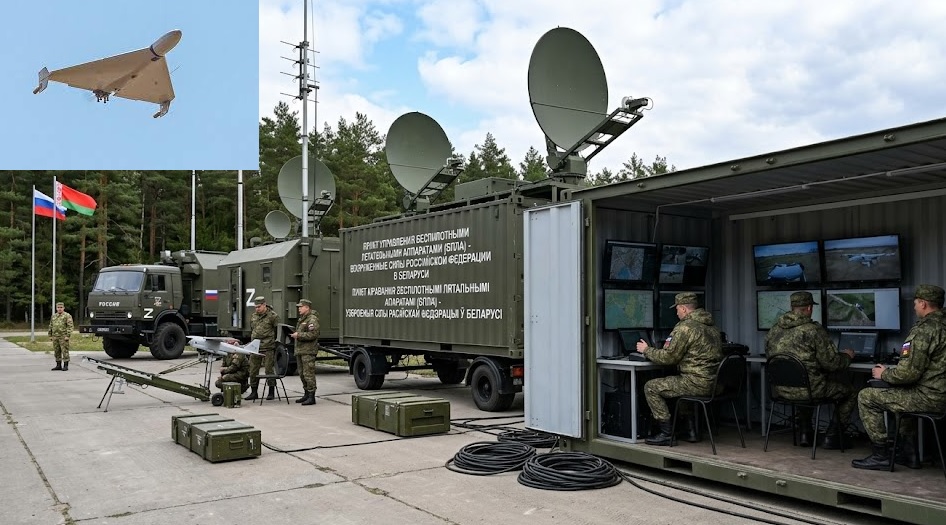
Ukrainian President Volodymyr Zelensky disclosed the development following a briefing from Lieutenant General Oleh Ivashchenko, head of Ukraine’s Main Directorate of Intelligence (HUR). Ivashchenko, who assumed the role on January 2, 2026, reported that at least four Russian drone control stations have been identified on Belarusian territory.
Zelensky stated that Ukraine would respond to the development and confirmed that intelligence findings have been directed for dissemination among international partners and media outlets. Ukrainian authorities indicated that further technical details will be shared through official intelligence channels.
Expansion of Drone Command Infrastructure
According to the HUR assessment, the newly identified installations are part of a broader Russian effort to extend command-and-control capabilities for long-range strike drones, including Shahed-type systems—referred to in Russian service as Geranium-2. These systems rely on ground-based infrastructure for navigation, communication relay, and route planning.
The establishment of control nodes in Belarus extends operational reach toward Ukraine’s northern and western regions, allowing Russian operators to maintain stable communications with UAVs over extended distances.
Use of Belarusian Civilian Networks
Evidence of Belarus being used as a platform for drone operations first emerged in late January 2026. Additional technical insight became available following a cyber operation conducted in February 2026 by the international intelligence group InformNapalm in cooperation with the Ukrainian cyber analytics center Fenix.
The operation, which lasted more than six months, provided access to accounts belonging to dozens of Russian military personnel. Ukrainian analysts were able to observe drone control interfaces and monitoring systems used by operators.
Intercepted data and internal communications indicate that, since at least mid-2025, Russian forces have integrated Belarusian civilian telecommunications infrastructure into UAV operations. Specifically, drones were equipped with modems and SIM cards configured to operate on Belarusian mobile roaming networks. This approach enabled the use of local cellular towers to maintain continuous data links during flight.
The system allowed operators to map precise flight routes and sustain signal integrity across distances extending tens of kilometers into Ukrainian territory, particularly along the northern and western borders.
Airspace Probing and NATO Concerns
The intelligence data also indicates that these capabilities were tested beyond Ukrainian airspace. Ukrainian analysts reported that a series of drone incursions into Poland on the night of September 9–10, 2025—estimated at between 19 and 23 UAVs—were deliberate.
Information shared with NATO partners concluded that the incident was intended to evaluate both a new routing method and the performance of Belarusian cellular infrastructure in supporting cross-border UAV operations. The findings suggest that the test was designed to assess the feasibility of future strikes targeting logistics routes and military supply corridors in Ukraine and neighboring NATO member states.
Intelligence Sharing with Iran
In parallel with developments in Eastern Europe, Ukrainian officials reported continued intelligence cooperation between Russia and Iran. Zelensky stated that Ukrainian intelligence possesses what he described as irrefutable evidence that Moscow is transferring sensitive intelligence data to Tehran.
According to Ukrainian sources, the exchange involves information derived from Russia’s electronic warfare (EW) and signals intelligence (SIGINT) capabilities, as well as data collected through partnerships in the Middle East.
Diplomatic Context
Ukrainian officials also indicated that Russia recently attempted to leverage its intelligence-sharing relationship with Iran in discussions with the United States. Moscow reportedly proposed halting intelligence transfers to Iran in exchange for Washington ending intelligence support to Ukraine.
The United States rejected the proposal, according to officials familiar with the discussions.
Operational Implications
The deployment of additional drone control stations in Belarus and occupied Ukrainian territory reflects an ongoing effort by Russia to enhance the reliability and range of its UAV operations. The use of civilian telecommunications infrastructure provides a method to extend communication coverage without relying solely on military systems.
Ukrainian authorities assess that these developments will continue to influence operational dynamics along Ukraine’s northern and western regions, while also raising broader security concerns among neighboring countries and NATO partners.
——— End of Article ———