EOUL / MOSCOW : NATO’s electronic warfare (EW) countermeasures are increasingly ill-suited to counter Russia’s latest generation of unmanned aerial systems, according to a detailed assessment published by South Korean defense analysts. The analysis focuses on a new Russian drone platform known as the Knyaz Veshiy Oleg (KVO) and concludes that its communications architecture significantly reduces the effectiveness of standard radio-electronic suppression methods currently fielded by NATO-aligned forces.
The findings, reported by the South Korean defense outlet Daily Defense, outline how Russia has moved beyond standalone drone operations toward an integrated, multi-layered unmanned system designed to maintain operational continuity even under heavy electronic attack.
Adaptive Communications and EW Resistance
At the center of the assessment is the KVO’s communications suite. Unlike earlier Russian and Western unmanned systems that relied on fixed or predictable radio frequencies, the KVO employs adaptive frequency-hopping and dynamic channel selection. This allows the drone to continuously shift its communication pathways between operators, relay nodes, and strike platforms.
According to the analysis, this adaptive tuning sharply degrades the effectiveness of traditional jamming systems, which are optimized to block known or narrow frequency bands. As a result, the KVO can maintain control and data transmission in environments that NATO doctrine would typically classify as electronically denied airspace for unmanned aircraft.
South Korean analysts note that this does not make the drone immune to electronic attack, but it raises the threshold required to disrupt operations, demanding faster signal detection, broader-spectrum jamming, and more precise targeting than many current systems can provide.
Role as an Aerial Command Node
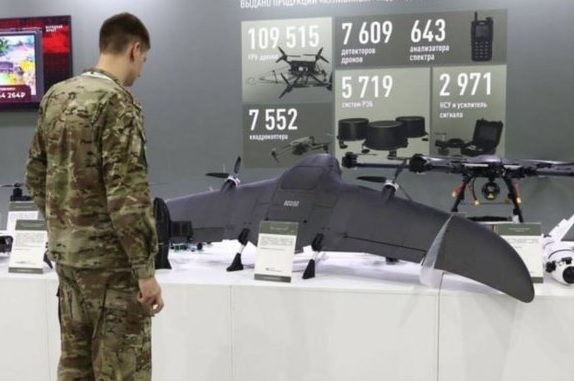
The KVO is not assessed as a direct strike platform. Instead, it functions primarily as an airborne command-and-control (C2) asset within a broader unmanned network. Operating at higher altitudes than most attack drones, the KVO carries stabilized electro-optical and infrared (EO/IR) sensor packages designed for persistent wide-area surveillance.
Once targets are detected and classified, the drone transmits targeting data and control signals to subordinate unmanned systems, particularly short-range first-person-view (FPV) loitering munitions. This structure allows the KVO to remain outside the immediate engagement zone while coordinating attacks conducted by lower-cost, expendable drones.
The report highlights the KVO’s role as a secure relay for fiber-optic guided FPV drones, including systems such as the “Prince Vandal of Novgorod.” Because these attack drones transmit control signals through physical fiber-optic cables rather than radio links, they are effectively immune to conventional jamming once deployed. The KVO extends their operational reach by providing initial guidance, target updates, and real-time situational awareness.
Integrated Reconnaissance-Strike Chain
South Korean defense analysts describe the KVO-centered architecture as a continuous reconnaissance-strike-assessment chain. The system integrates detection, targeting, engagement, and post-strike verification into a single operational loop.
The KVO’s sensors conduct persistent surveillance and identify potential targets. Targeting data is then distributed to attack drones operating closer to the ground, either via secure radio links or through coordination with fiber-optic platforms. During and after the strike, the KVO remains on station to record impact footage and assess battle damage, enabling rapid follow-up decisions.
This approach reduces the sensor-to-shooter timeline and limits the exposure of high-value assets. By keeping the primary command node at altitude and outside most short-range air defenses, the system prioritizes survivability while maintaining continuous battlefield awareness.
Manufacturing, Survivability, and Identification
The assessment also addresses the practical characteristics of the KVO platform. Analysts note that the drone is designed for ease of repair and rapid regeneration. Many structural and non-critical components can reportedly be produced using field-level additive manufacturing, including 3D printing, allowing damaged units to be returned to service with minimal logistical delay.
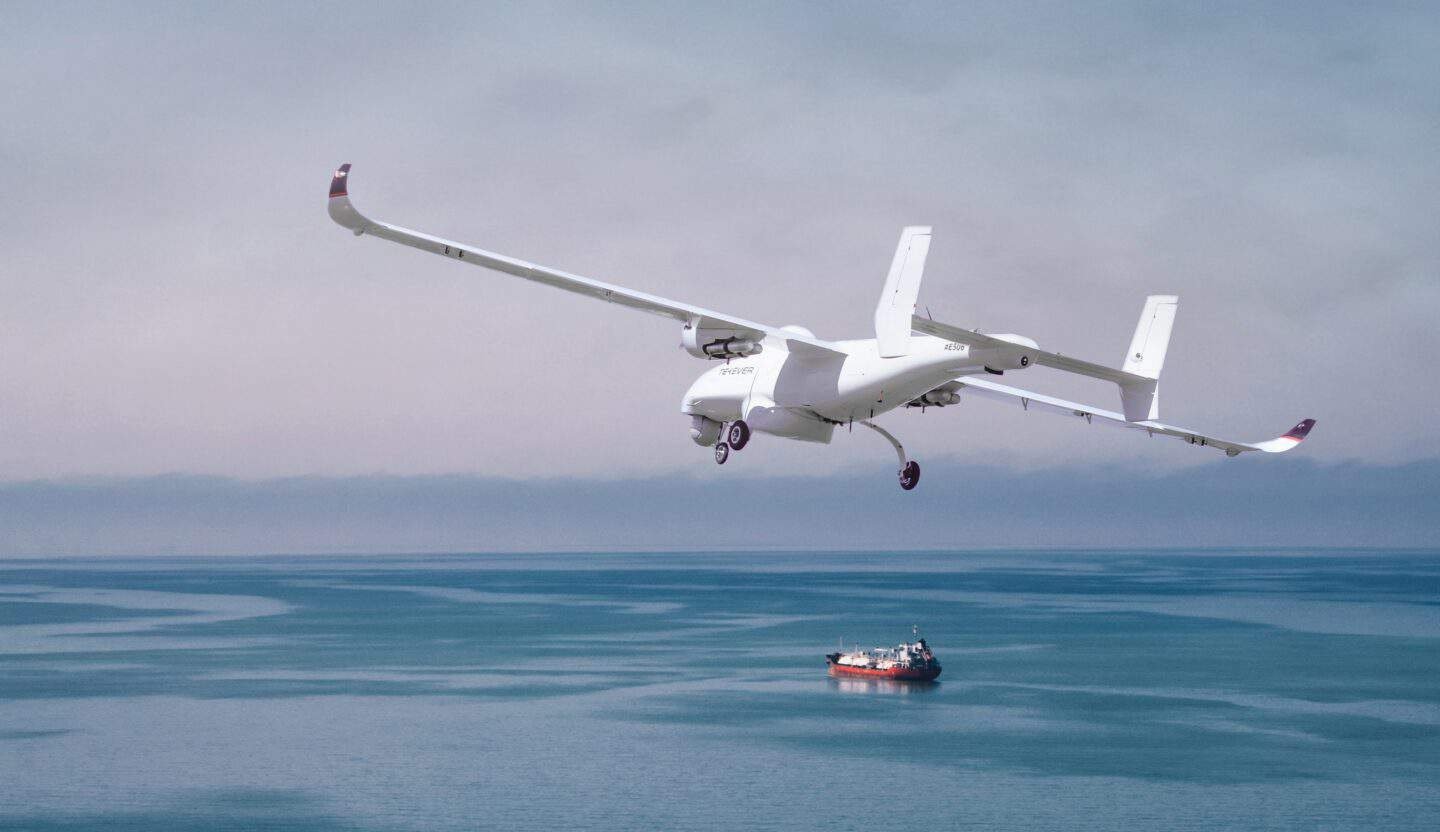
Visually, the KVO does not present a distinctive silhouette, resembling other medium-altitude reconnaissance UAVs. This complicates visual identification and increases the burden on air defense units tasked with distinguishing it from lower-priority unmanned aircraft.
While the drone can be targeted by kinetic air defense systems if detected and tracked, its operating altitude, reduced radar signature, and non-striking role reduce the frequency with which it exposes itself to direct fire.
Operational Impact and Frontline Observations
The introduction of the KVO coincides with battlefield reporting indicating that Russian forces are increasingly able to operate unmanned systems despite Ukrainian electronic warfare efforts. South Korean analysts reference operational patterns observed in sectors such as Sumy and Kharkov, where Russian units have combined fiber-optic attack drones with frequency-hopping aerial relays to maintain strike capability under intense electronic pressure.
This layered operational approach allows Russian forces to absorb losses among expendable FPV drones while preserving higher-value command platforms that enable coordination and targeting.
Implications for NATO Electronic Warfare Doctrine
The report concludes that the KVO does not represent a single technological breakthrough but rather an evolution in unmanned systems integration. Its significance lies in the fusion of adaptive communications, aerial command nodes, and jamming-resistant strike assets into a cohesive operational system.
South Korean defense analysts assess that without substantial upgrades in signal detection speed, electromagnetic spectrum coverage, and counter-UAS integration, NATO-standard EW systems will continue to face structural limitations against this tiered drone architecture. The findings suggest that future countermeasures will need to focus not only on jamming individual drones, but on disrupting the wider network that links reconnaissance, command, and strike elements into a unified operational framework.
——— End of Article ———