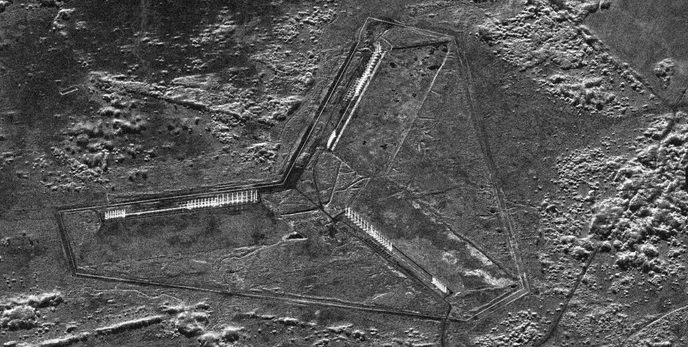
KALININGRAD, Russia, — Russia is constructing a large over-the-horizon (OTH) radar facility in its Kaliningrad exclave that could detect aircraft and missiles at distances of up to approximately 3,000 kilometres, according to satellite imagery analysed by Finnish synthetic aperture radar company ICEYE. The potential detection range covers much of northern and western Europe, including Germany, France and the United Kingdom.
The facility is located near Gvardeysk, approximately 20–37 kilometres from the Polish border and around 40 miles from Lithuania. Satellite images taken in late August 2026 show three antenna arrays, each more than 500 metres long, arranged in a star-like pattern and protected by a double fence. Construction appears to have begun around March 2023. The German newspaper Frankfurter Allgemeine Zeitung and The Times reported on the findings on October 19, 2026.
Radar Capabilities and Technical Details
Analysts believe the installation belongs to Russia's 29B6 Container radar family, which uses high-frequency radio waves that interact with the ionosphere to detect targets beyond the line of sight of conventional radar. Depending on its final specifications, the facility could monitor aircraft, missiles and ships at distances of approximately 900–3,000 kilometres.
Russian defence claims state that a fully operational Container radar can track up to 10,000 aerial objects simultaneously. The technology may contribute to detecting stealth aircraft, including the F-35, but its ability to detect a target does not necessarily mean it can provide the precise tracking required for a weapon engagement. The new facility's operational status and actual capabilities remain unconfirmed.
Wider Russian Military Expansion in the Baltic
ICEYE's analysis identified more than 20 new or expanding signals-intelligence and electronic-warfare sites across Kaliningrad, including a large circular antenna complex near Chernyakhovsk. Lithuania's intelligence assessment, released in March 2026, also highlighted the multi-site radar development.
Lithuanian reporting indicates that GPS-spoofing antennas in Kaliningrad have increased from a handful in early 2025 to at least 36 additional installations more recently. GPS spoofing involves transmitting misleading positioning signals to cause receivers to calculate incorrect locations.
Satellite imagery has also revealed new or restored barracks, storage and training facilities in Karelia and the Leningrad military district, including an equipment depot north of Petrozavodsk. At a mobile S-400 air-defence site near Baltiysk, launchers were observed raised into firing position, indicating readiness at the time of observation.
Strategic Importance
Kaliningrad is a strategically positioned Russian territory on the Baltic Sea, bordered by NATO members Poland and Lithuania. It already hosts elements of Russia's Baltic Fleet, air-defence systems and missile units.
Russia currently has one fully operational Container radar system, which was reportedly targeted by Ukrainian drone strikes in April 2024. A second facility in Kaliningrad could provide additional surveillance coverage and redundancy while improving monitoring of military movements and maritime and aerial traffic across northern Europe.
ICEYE's synthetic aperture radar satellites can image the ground during the day and night and through cloud cover. Although the imagery confirms substantial construction at the Gvardeysk site, it does not establish that the facility is operational or verify its final technical specifications.
——— End of Article ———