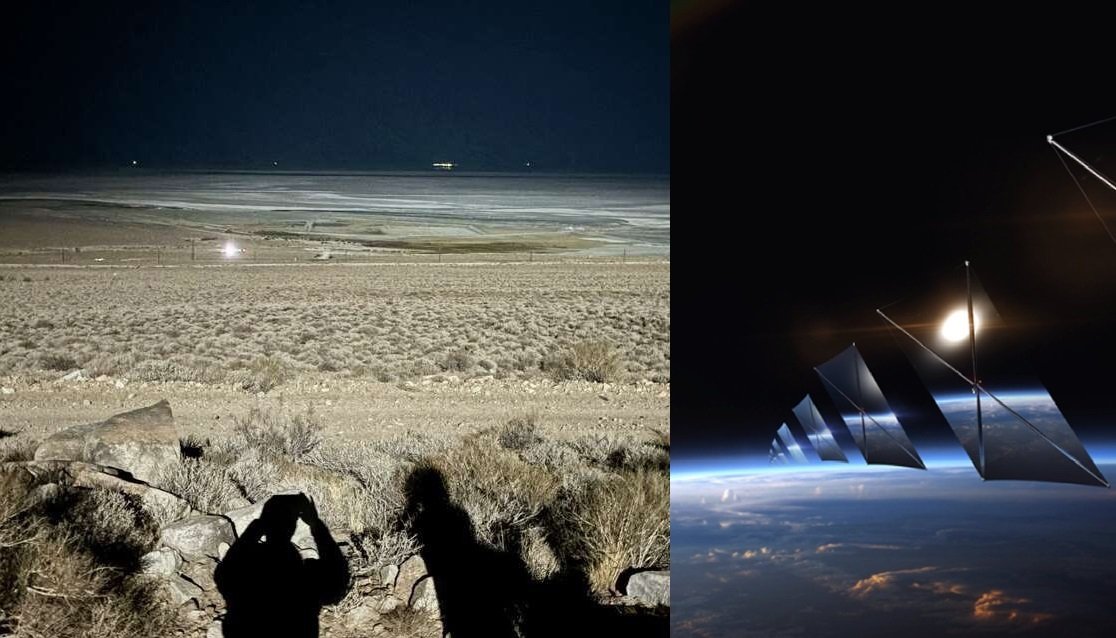
LONE PINE, Calif., — California-based space startup Reflect Orbital has conducted a ground-based lighting test near Mount Whitney to demonstrate how future satellites equipped with large mirrors could redirect sunlight to Earth after sunset. The October 10 exercise took place along Horseshoe Meadows Road near Lone Pine, using powerful spotlights to simulate illumination from space.
The company worked with China Lake Mountain Rescue Group, a volunteer search-and-rescue organisation from Kern County, and other rescue volunteers. The test provided artificial lighting from 7 p.m. to midnight, illuminating roughly three miles of terrain in every direction at a brightness slightly higher than a full moon.
Search-and-Rescue Teams Test Artificial Illumination
Reflect Orbital positioned generator-powered, high-wattage spotlights on elevated terrain, directing the beams downward across the desert landscape. Teams first practised using headlamps in darkness before conducting grid-pattern ground searches, equipment rigging and stretcher carries under the artificial lighting.
Phillip Cash, operations leader for China Lake Mountain Rescue, said the illumination made navigating the rugged terrain easier. However, he noted that the technology could be more useful in mass-casualty incidents and large-scale disaster rescue operations than during routine missions.
Company spokesman Christopher Buscombe said the setup was designed to recreate the expected light spot from an orbital reflector, allowing rescue teams to evaluate the concept under practical conditions.
The bright beams also attracted attention from local residents in Lone Pine. Some people initially suspected that a vehicle had left the road and drove towards the light source to investigate.
Eärendil-1: Technical Details of the Planned Space Mirror
Reflect Orbital plans to use satellites fitted with motorised, steerable thin-film reflectors to capture sunlight and direct it towards selected locations on Earth after sunset. The proposed system could support emergency response operations, disaster relief and solar farms seeking to extend electricity generation during evening demand. The company has also received inquiries about lighting for construction, public events and military operations.
In July 2026, the Federal Communications Commission (FCC) authorised Reflect Orbital's Eärendil-1 demonstration satellite to deploy and operate in low Earth orbit. The spacecraft is expected to launch later in 2026 on a SpaceX Falcon 9 rideshare mission.
The planned satellite has the following technical specifications:
-
Reflector size: 18 × 18 metres (approximately 59 × 59 feet).
-
Spacecraft mass: Approximately 142 kilograms.
-
Operating altitude: Approximately 625 kilometres (388 miles).
-
Illuminated area: A ground spot approximately 5 kilometres (3 miles) wide.
-
Illumination duration: Several minutes during a satellite pass, according to the proposed mission design.
The reflector is designed to direct sunlight onto a targeted area with brightness comparable to or slightly greater than a full moon. Eärendil-1 will test whether the concept can work from orbit. The FCC authorisation covers a single demonstration mission, not the deployment of a larger constellation.
Expansion Plans and Astronomical Concerns
Founded in 2021, Reflect Orbital has raised more than $35 million and has outlined a long-term plan to deploy up to 50,000 reflector satellites by 2035. Achieving this target would require further technological development, funding and regulatory approvals.
The proposal has drawn opposition from the American Astronomical Society (AAS) and other scientific organisations. Their concerns include light pollution, disruption to optical astronomy and potential effects on the natural nighttime environment. The FCC's approval of the demonstration satellite does not amount to approval for the proposed larger constellation.
The October 10 exercise tested the practical use of directed artificial lighting for search-and-rescue operations, but it did not involve an orbital mirror. Eärendil-1 has yet to demonstrate the proposed sunlight-reflection capability in space. Its future tests will need to establish whether the technology can provide useful nighttime illumination while addressing concerns about its environmental and astronomical effects.
——— End of Article ———