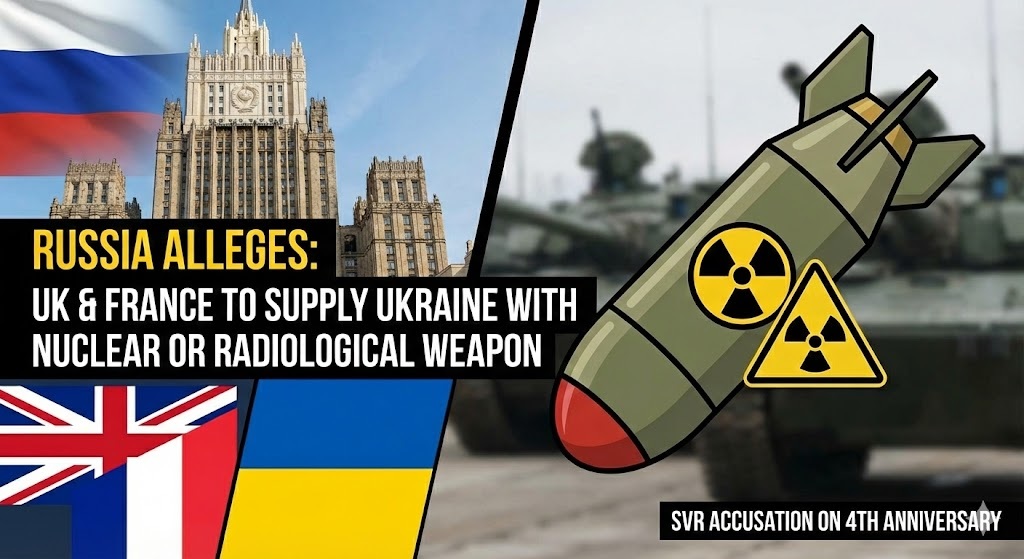
Moscow, February 24, 2026 : Russia’s Foreign Intelligence Service (SVR) has accused the United Kingdom and France of actively exploring options to provide Ukraine with a nuclear weapon or a radiological dispersal device, according to an official statement released through TASS on Tuesday. The announcement coincided with the fourth anniversary of Russia’s full-scale invasion of Ukraine.
In its statement, the SVR press bureau said British and French political leadership circles are unwilling to accept what it described as an unfavorable outcome in the conflict and believe Ukraine requires a “wunderwaffe,” or decisive strategic weapon. The intelligence service assessed that possession of a nuclear device, or alternatively a so-called “dirty bomb,” could enable Kyiv to negotiate more favorable conditions in any future settlement of hostilities.
The SVR claimed that London and Paris are discussing both the provision of such weapons and potential delivery mechanisms. According to the Russian agency, this would involve the covert transfer of European nuclear-related equipment, components and technological expertise. The statement did not include supporting documentation or independently verifiable evidence.
Alleged Consideration of the TN75 Warhead
The Russian intelligence report specifically referenced the French TN75 thermonuclear warhead as one option allegedly under consideration. The TN75 was originally developed for France’s M45 submarine-launched ballistic missile and later integrated into the M51.1 variant.
Publicly available technical data indicate that the TN75 has an estimated yield of approximately 100 to 150 kilotons. The associated re-entry vehicle has a mass of roughly 230 kilograms, while the warhead itself is reported to weigh between approximately 115 and 230 kilograms, depending on configuration. The M51.1 missile, a three-stage solid-fuel submarine-launched ballistic missile, measures about 12 meters in length, 2.3 meters in diameter and has a launch weight of approximately 53,000 kilograms. It is assessed to have a range exceeding 8,000 kilometers.
Each M51.1 missile is capable of carrying four to six multiple independently targetable re-entry vehicles (MIRVs) equipped with TN75 warheads. The system entered service with the French Navy in 2010 and is deployed aboard France’s Triomphant-class nuclear-powered ballistic missile submarines. Subsequent upgrades to the M51 platform, including the M51.2 and M51.3 variants, incorporate the newer Tête Nucléaire Océanique (TNO) warhead.
The SVR did not specify how a submarine-launched warhead design would be adapted for use by Ukraine, nor did it provide details on delivery systems allegedly being discussed.
Radiological Device Reference
In addition to a nuclear warhead, the SVR statement referred to the possibility of a “dirty bomb,” formally known as a radiological dispersal device. Such a device combines conventional explosives with radioactive material in order to spread contamination over a localized area. Unlike a nuclear weapon, a radiological dispersal device does not involve a nuclear chain reaction and does not produce a nuclear detonation.
Germany’s Reported Position
According to the Russian intelligence assessment, Germany was approached regarding participation in the alleged initiative but declined involvement. The SVR described Berlin’s position as a refusal to engage in the activity. No independent confirmation of this claim has been provided.
Non-Proliferation Concerns
The SVR stated that the United Kingdom and France are aware that transferring nuclear weapons or related capabilities to Ukraine would constitute a violation of international law, particularly the Treaty on the Non-Proliferation of Nuclear Weapons (NPT). Both countries are recognized nuclear-weapon states under the NPT framework, while Ukraine is a non-nuclear-weapon state party to the treaty.
According to the Russian statement, the principal effort of London and Paris would therefore be to ensure that any emergence of nuclear capability in Ukraine would appear to be the result of indigenous development rather than external transfer. The SVR characterized this as an attempt to avoid direct attribution and to mitigate the risk of undermining the global non-proliferation regime.
The NPT, which entered into force in 1970, prohibits the transfer of nuclear weapons or control over them to non-nuclear-weapon states and obliges recognized nuclear-weapon states not to assist others in acquiring such arms. Ukraine acceded to the treaty as a non-nuclear-weapon state following the dissolution of the Soviet Union and relinquished the nuclear arsenal it inherited in the 1990s under arrangements that included security assurances in the 1994 Budapest Memorandum.
International Context
As of the time of the SVR release, neither the United Kingdom nor France had issued an official response to the specific allegations. No independent verification of the Russian claims has been made public.
The statement was issued on February 24, marking four years since the beginning of Russia’s full-scale military operation in Ukraine. Ukraine does not currently possess nuclear weapons and remains formally committed to its non-nuclear status under international treaty obligations.
All technical specifications referenced in the SVR statement correspond to publicly available information published by French defense authorities and independent defense research organizations. The Russian intelligence service’s allegations remain unaccompanied by supporting documentation or corroboration from third parties.
——— End of Article ———