DEN HELDER, Netherlands — March 18, 2026 : The Royal Netherlands Navy has formally introduced a new layer of maritime surveillance capability with the operational deployment of MQ-35A V-BAT uncrewed aerial systems, following a fast-tracked procurement of 12 platforms from U.S.-based defense technology company Shield AI.
The acquisition, confirmed by the Dutch Ministry of Defence, is intended to enhance the Navy’s Intelligence, Surveillance, and Reconnaissance (ISR) capacity by enabling real-time data collection and improved situational awareness across maritime operations. The systems are being integrated across multiple vessels to support distributed and flexible deployment at sea.
Operational Testing and Shipborne Integration
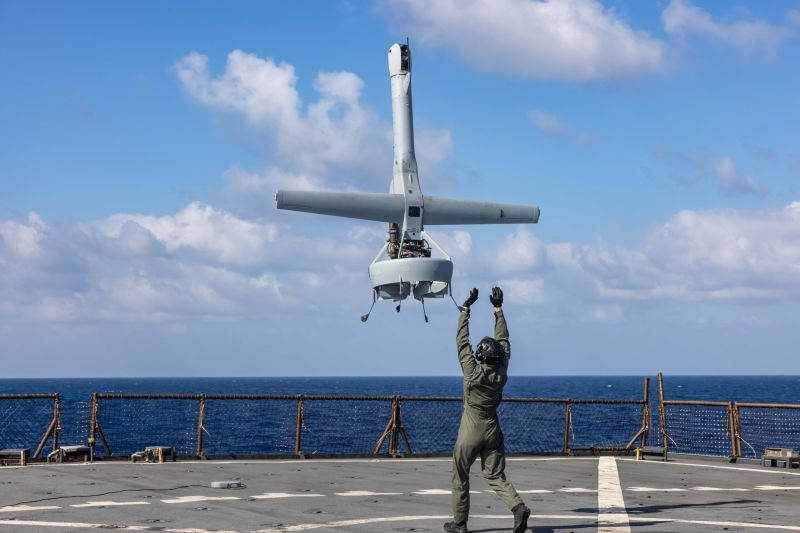
Initial operational trials of the V-BAT system were conducted aboard the amphibious transport ship HNLMS Johan de Witt during the NATO-led Cold Response exercise off the coast of Norway. The trials focused on validating shipborne deployment procedures, environmental constraints, and real-time operational utility.
During testing, naval operators successfully received live video feeds from the airborne systems, enabling monitoring of surface contacts and analysis of maritime traffic routes. The trials also emphasized safe launch and recovery procedures, particularly addressing the variability of air turbulence across different helicopter decks. As a result, standardized protocols now require precise environmental measurements prior to each deployment.
Following successful trials, control stations and support equipment for the 12 drones are being installed across eight Royal Netherlands Navy vessels, allowing broader fleet-level integration.
Accelerated Procurement via NATO Framework
The procurement process was completed on an accelerated timeline through the NATO acquisition framework, which enabled direct purchasing from the manufacturer without extended tender procedures. This approach reduced delivery timelines compared to conventional defense procurement cycles and allowed rapid fielding of the capability.
System Design and Technical Characteristics
The MQ-35A V-BAT is a vertical take-off and landing (VTOL) uncrewed aerial system powered by a single-engine, ducted-fan propulsion system using heavy fuel. Its design combines endurance with a compact logistical footprint, making it suitable for deployment from naval platforms with limited space.
The system requires a launch and recovery area of approximately 5 by 5 meters and can be stored in a small number of transportable crates on a ship’s helicopter deck. After vertical takeoff, the aircraft transitions into horizontal flight for sustained operations.
The V-BAT has a maximum takeoff weight of approximately 73 kilograms and can carry payloads of up to 18 kilograms. It supports a range of mission systems, including electro-optical and infrared sensors, radar systems, and synthetic aperture radar (SAR) payloads.
Operational endurance exceeds 12 to 13 hours, with the ability to operate at altitudes of up to approximately 18,000 feet. This endurance allows extended surveillance missions without frequent recovery cycles.
Autonomous Capabilities and Electronic Warfare Resilience
A defining feature of the V-BAT system is its integration of Shield AI’s autonomous software, which enables operation in environments where GPS signals are denied or communications are disrupted. This capability allows the drone to continue executing missions without reliance on continuous satellite connectivity.
The platform has been operationally deployed in Ukraine, where it demonstrated resilience against electronic warfare (EW) measures that typically degrade or disable conventional drone systems. Its ability to maintain functionality in contested environments was a key factor influencing the Dutch Ministry of Defence’s procurement decision.
Role in Maritime Operations
The V-BAT systems are equipped with radar and high-resolution camera payloads designed to support reconnaissance, target identification, and maritime domain awareness. Data collected during missions is transmitted to naval operators, improving decision-making processes and operational planning.
By extending surveillance coverage beyond the horizon and reducing reliance on crewed aviation assets, the system supports a broader shift toward unmanned and distributed ISR capabilities within naval operations.
Ongoing Development and Future Integration
Shield AI is continuing to work with the Royal Netherlands Navy and the Materiel and IT Command (COMMIT / JIVC) to further develop both software and hardware components of the system. The collaboration is focused on maintaining system relevance through updates that address evolving operational requirements and emerging threats.
The deployment of the V-BAT fleet forms part of the Netherlands’ broader effort to modernize its naval capabilities and strengthen ISR coverage across its maritime forces.
——— End of Article ———