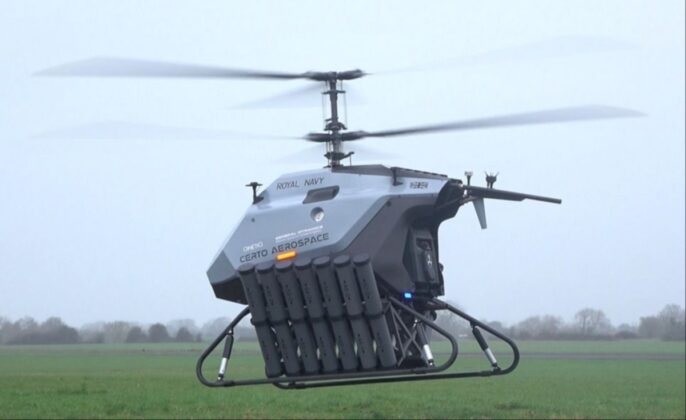
FROME, UNITED KINGDOM — April 14, 2026 : British aviation firm Certo Aerospace has demonstrated its CAPSTONE unmanned helicopter as a platform for anti-submarine warfare (ASW) during trials conducted for the Royal Navy under the ATLANTIC BASTION technology demonstration program.
The flight trials took place in February 23, 2026 at Keevil Airfield in southwest England, a Civil Aviation Authority-approved test facility operated by Certo Aerospace. The demonstration focused on evaluating the platform’s ability to detect, locate, and track underwater targets using sonobuoys. Simulated sonobuoy signals for the exercise were provided by QinetiQ.
During the test on February 23, the CAPSTONE aircraft conducted missions exceeding two hours while carrying a representative payload of sonobuoys. These floating acoustic sensors collected underwater data, which was transmitted from the unmanned aircraft to its ground control station via Starlink satellite communications.
The system was integrated with the UYS-506 acoustic processor developed by General Dynamics Mission Systems (UK) Ltd.. Once received at the ground station, the sonobuoy data was routed to the processor, enabling operators to monitor underwater conditions in real time. The system provided acoustic signatures, target coordinates, and movement and tracking parameters, supporting continuous situational awareness. The demonstration also included transatlantic command and control of the UYS-506 system.
CAPSTONE is a 600 kg-class vertical take-off and landing (VTOL) unmanned aircraft system featuring a coaxial rotor configuration. The platform has an approximate dry weight of 300 kg and can carry payloads of up to 300 kg. It is capable of autonomous operation for up to 10 hours and has a range of up to 300 miles. The aircraft incorporates an air-certified engine, reinforced steel airframe, modular undercarriage, and an all-folding rotor head, enabling operations from single-spot naval ship decks in maritime conditions.
The trials form part of the Royal Navy’s ATLANTIC BASTION initiative, which aims to enhance anti-submarine warfare capabilities in the North Atlantic through the integration of uncrewed systems alongside crewed platforms. The CAPSTONE demonstration highlighted the use of modular payloads and autonomous operations to extend maritime surveillance and reduce reliance on manned helicopters.
Justin Tooth, chief executive of Certo Aerospace and a former Royal Navy Lynx pilot, stated that the trial confirmed the platform’s ability to operate from single-spot naval vessels while carrying operationally significant payloads at useful ranges. He added that the system is intended to support a future mix of crewed and uncrewed surface, underwater, and air capabilities for ASW missions.
The program aligns with broader UK defence efforts to advance unmanned aviation. In 2025, the UK division of Leonardo presented the Proteus maritime unmanned system concept for the Royal Navy. The Proteus platform is being used as a technology demonstrator to validate modularity, autonomy, and payload integration, with lessons from both initiatives expected to inform the development of future rotorcraft systems.
——— End of Article ———