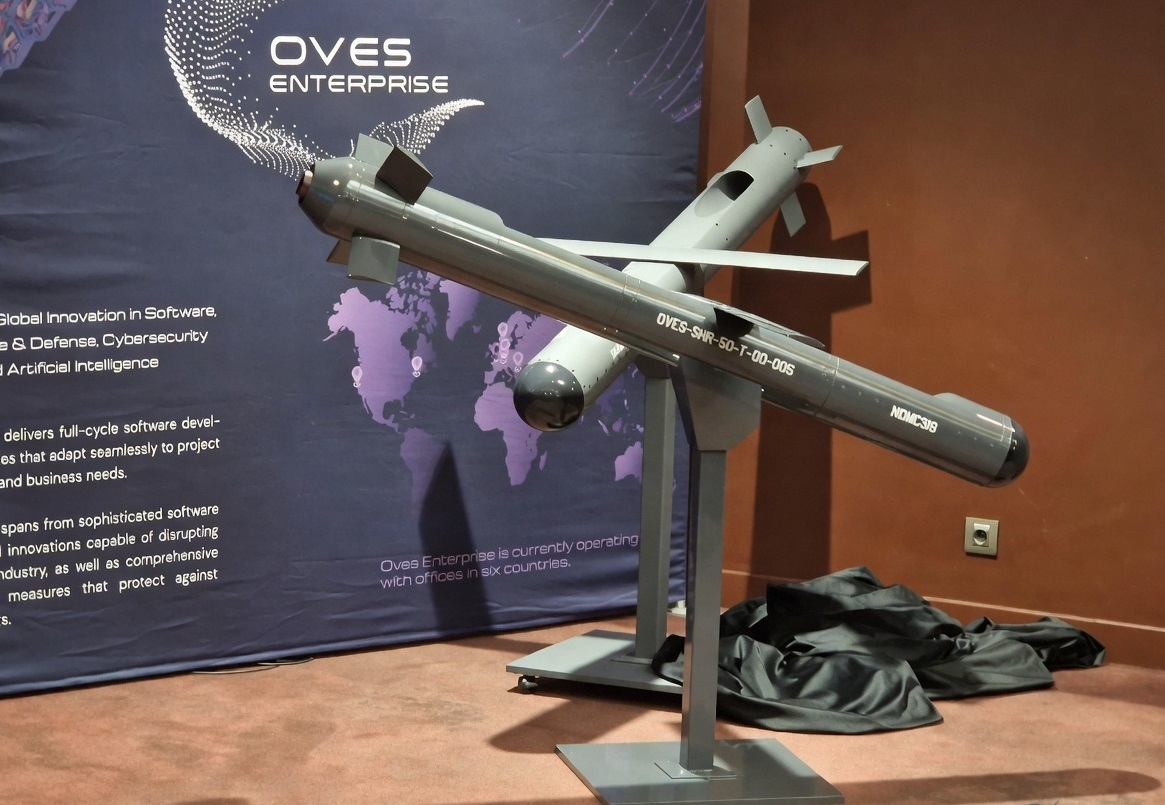
BUCHAREST — May 15, 2026 : Romanian technology company Oves Enterprise officially unveiled its Sahara Autonomous System, an AI-enabled low-cost cruise missile, during the Black Sea Defense, Aerospace and Security (BSDA) 2026 exhibition held at the ROMAERO facility in Bucharest from May 13 to 15.
The Sahara is being presented as the first cruise missile developed entirely within Romania’s private sector, reflecting the growing role of smaller national defense industries in developing affordable long-range precision strike systems.
The debut attracted high-level political attention, with Romanian Senate President Mircea Abrudean, Senate Vice President Mihai Coteț and Economy Minister Irineu Darău visiting the company’s exhibition stand during the event. The presence of senior officials highlighted government interest in domestic autonomous strike and defense technologies.
Compact Cruise Missile Design
According to specifications released by Oves Enterprise, the Sahara has a launch weight of 55 kilograms and can carry a payload of up to 10 kilograms. The missile is powered by a miniature turbojet engine producing 310 newtons of thrust and carries approximately 20 kilograms of fuel.
The current configuration provides an operational radius of 200 kilometres and a projected maximum speed of Mach 0.85, depending on the final aerodynamic configuration. From Romanian territory, the missile’s range would provide coverage across significant sections of the Black Sea region.
The system is designed to operate at very low altitude using a terrain-following flight profile. Sahara cruises at approximately 50 metres above ground level, autonomously adjusting its flight path to follow terrain contours. The low-altitude profile is intended to reduce radar detectability by exploiting terrain masking and ground clutter, complicating interception by integrated air defense systems.
AI-Based Guidance and Autonomy
Oves Enterprise stated that Sahara was designed as an AI-enabled autonomous weapon system rather than a conventionally guided munition. The missile integrates the company’s proprietary Nemesis AI platform, which manages onboard data processing, target identification, route adaptation, mission configuration and terminal guidance functions.
The company said the missile’s software, avionics, electronics and flight-control systems were developed together as part of a fully integrated architecture. Nemesis AI operates in an on-premise mode, allowing operators to configure mission parameters and AI models locally before launch.
The system is also intended to operate in electronically contested environments. If satellite navigation signals are jammed or spoofed, the missile can transition to an inertial navigation mode using onboard motion and orientation measurement systems to maintain stability and continue toward its assigned target.
“We built this project as a complete system, because real autonomy cannot be achieved otherwise,” said Mihai Filip. “Everything is made in Romania, including the AI processing board; practically, the brain of the Sahara missile is built by us 100% in Romania.”
Development Program and Future Plans
Oves Enterprise invested more than 1 million euros in the research and development of the Sahara program. The project was developed by a team of 25 engineers and specialists in artificial intelligence, avionics and flight systems.
The company plans to invest an additional 2 million euros in future testing, optimization and refinement phases. Oves Enterprise, which recently reached a reported valuation of 298 million euros, is also seeking to raise an additional 55 million euros to support future expansion and development activities.
The Sahara project was first announced in November 2025 and reached an advanced stage of development by February 2026, when the system was initially presented publicly in Bucharest. Its appearance at BSDA 2026 marked the missile’s official exhibition debut.
Initial live flight demonstrations are scheduled for May 2026, while a broader presentation of the missile’s operational capabilities is planned for the end of 2027.
Follow-On Variants Planned
Oves Enterprise stated that additional Sahara variants are planned with significantly extended operational ranges. Future versions are expected to achieve ranges between 500 and 600 kilometres, while larger variants could reach between 900 and 1,100 kilometres.
The company estimates that the smallest Sahara configuration could be produced for approximately 150,000 euros per unit, positioning the system as a comparatively lower-cost precision strike platform.
Despite the public unveiling, the Sahara remains in the testing and demonstration phase. Oves Enterprise has not announced completed flight qualification trials, procurement agreements with the Romanian armed forces or confirmed export customers.
The program nevertheless reflects broader efforts among smaller defense industries to develop affordable precision strike capabilities shaped by operational lessons observed in recent conflicts, including the war in Ukraine.
——— End of Article ———