COBLENZ / FRIEDRICHSHAFEN, Germany — March 12, 2026 : Germany’s Federal Office of Bundeswehr Equipment, Information Technology and In-Service Support, BAAINBw, has awarded a development contract to Rolls‑Royce Power Systems and the German technology group ZF Friedrichshafen AG to design a hybrid propulsion system for the next-generation European armored platform known as the Main Ground Combat System (MGCS).
The companies confirmed that the project will deliver the world’s first parallel-hybrid drive system specifically designed for heavy tracked military vehicles. The propulsion package is intended for the MGCS family of combat vehicles that will eventually replace the Leopard 2 and Leclerc currently operated by several European armed forces.
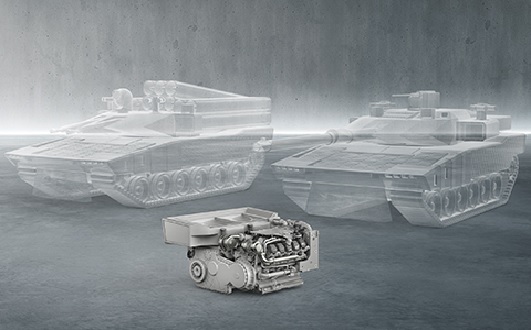
Rolls-Royce Power Systems will act as the general contractor for the complete powerpack, while ZF will develop the electrified transmission and hybrid mobility architecture.
MGCS Programme and System Concept
The Main Ground Combat System is a joint European defense programme led by Germany and France, aimed at creating the next generation of armored combat capabilities for European forces. Instead of a single replacement tank, the project is being developed as a networked combat system integrating a central vehicle platform with advanced weapon systems, sensors, digital command-and-control networks, and new communication architectures.
The concept is intended to deliver improved mobility, survivability, automation, and battlefield networking compared with current main battle tanks. The MGCS platform is also designed to provide significantly greater electrical power generation capacity to support sensors, electronic warfare equipment, active protection systems, and other future digital combat technologies.
Development timelines indicate that prototype systems will be tested before the end of the 2020s, with potential series production expected during the early 2030s.
Hybrid Powerpack Developed by Rolls-Royce
Under the BAAINBw contract, Rolls-Royce Power Systems will design and supply the complete hybrid powerpack for the MGCS platform.
The propulsion package will produce more than 1,400 kilowatts (kW) of total system output. The core mechanical component is a newly developed 10-cylinder engine based on the mtu Series 199 platform, designated the 10V 199.
The engine provides approximately 1,100 kW of mechanical output and functions as the primary power source within the parallel-hybrid architecture. The design incorporates optimized combustion processes, improved thermal efficiency, and increased power density compared with earlier variants.
Engine development also focuses on meeting the high electrical power demands of modern combat platforms. A hybridized cooling system has been integrated to maintain stable performance while supporting additional onboard electrical consumers.
The engine is engineered to handle extreme load changes and demanding operational conditions typical of military vehicles. It incorporates modern electronic control systems designed to remain reliable in battlefield environments.
Fuel flexibility is another major design requirement. The power unit uses a robust pump-line-nozzle (PLD) injection system that allows operation with multiple fuel types, including lower-quality fuels often encountered during deployed operations.
Rolls-Royce stated that the engine follows a Military-Off-The-Shelf (MOTS) development approach to ensure supply chain resilience and scalability. The mtu Series 199 engine family already has more than 4,500 units deployed globally, and the MGCS engine shares technical commonality with existing variants such as the 8V 199, simplifying logistics and maintenance support.
ZF Electrified Transmission System
The hybrid drivetrain architecture is centered on ZF’s eLSG 5000 electrified powershift steering transmission, which integrates several vehicle mobility functions within a single system.
The transmission combines drive, braking, and steering control through by-wire technologies, enabling precise vehicle handling and simplified mechanical complexity. The system features a continuously variable superimposed steering mechanism with an electromechanical design, which improves maneuverability and operational efficiency.
A key feature of the eLSG 5000 is its energy recuperation capability, allowing the drivetrain to recover energy during operation and redistribute it within the hybrid system. The design also supports boosting and energy management functions that enhance acceleration and vehicle agility.
ZF has also introduced a high-efficiency fan drive concept intended to reduce auxiliary power consumption. This improvement can increase operational range and overall drivetrain efficiency.
The transmission’s integrated generator capacity allows the vehicle to power high-voltage onboard systems without relying solely on the combustion engine. This capability supports extended “silent watch” operations, in which sensors, communications systems, and other electronics can remain active while the main engine is shut down to reduce acoustic and thermal signatures.
Industrial and Strategic Significance
Executives from both companies emphasized the broader industrial and strategic implications of the MGCS propulsion programme for European defense manufacturing.
Dr. Jörg Stratmann, Chief Executive Officer of Rolls-Royce Power Systems AG, stated that the propulsion system is designed to support Europe’s long-term defense capabilities and strengthen the technological base of the continent’s defense industry.
Andreas Moser, a member of the management board of ZF Friedrichshafen AG, said the MGCS programme represents a long-term investment in advanced defense technology and mobility systems for future European combat platforms.
Development Timeline
According to the companies involved, the hybrid propulsion system will undergo prototype testing before the end of the decade, supporting the broader MGCS development schedule.
If development proceeds as planned, initial production systems could become available in the early 2030s, aligning with the expected timeline for the introduction of the MGCS combat platform intended to succeed current European main battle tanks.
——— End of Article ———