BREMEN, Germany : Rheinmetall has secured a comprehensive contract from General Dynamics European Land Systems (GDELS) to deliver key combat and training systems for the German Army’s next-generation Luchs 2 reconnaissance vehicles. The agreement, signed in Kaiserslautern in early February 2026, is valued in the mid-three-digit million-euro range and forms part of Germany’s broader €3 billion Luchs 2 procurement program covering 274 vehicles.
Under the contract, Rheinmetall will supply modular unmanned turrets, primary armament systems, and advanced simulation and training equipment. Initial deliveries are aligned with the planned introduction of the Luchs 2 fleet beginning in 2029, with turret deliveries scheduled through 2031.
Program Background and Platform Overview
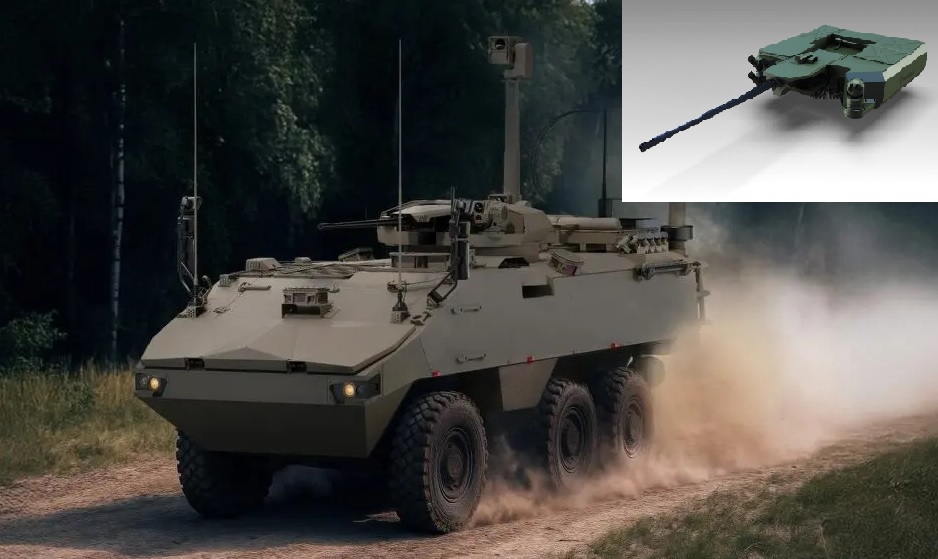
The Luchs 2 reconnaissance vehicle is intended to replace the Bundeswehr’s aging Fennek 4x4 reconnaissance fleet. The new vehicle is based on GDELS’ amphibious Piranha 6x6 wheeled platform and is designed to combine high operational mobility with reduced acoustic and thermal signatures.
The overall procurement program, valued at approximately €3 billion, includes 274 vehicles and aims to modernize Germany’s intelligence, surveillance, and reconnaissance capabilities. The platform integrates advanced sensor suites supplied by Hensoldt, enhancing battlefield awareness and long-range detection capabilities.
CT-025 Modular Unmanned Turret
The largest portion of the newly awarded contract will be executed by Rheinmetall Electronics GmbH in Bremen, which will manufacture and deliver 274 units of the newly developed CT-025 modular unmanned turret. This represents the first major production order for the CT-025 system, which has been specifically adapted to meet Bundeswehr operational requirements.
The CT-025 turret incorporates a fully digitalized fire control system with an inertial weapon stabilization unit, ballistic computer, and stabilized electro-optical vision system. These systems enable accurate engagement of ground and aerial targets, including unmanned aerial vehicles (UAVs), while the vehicle is in motion.
The turret architecture is compliant with GVA/NGVA standards and integrates into Rheinmetall’s Battlesuite digital framework. This open-system design enables future software-based capability upgrades, including AI-supported target tracking and mission-specific enhancements, without requiring structural hardware modifications.
Crew survivability has been addressed through a dedicated turret hatch with integrated ballistic protection, allowing the commander to maintain an open but protected position during vehicle operations. The turret also features an optimized height profile to ensure compatibility with other vehicle platforms and an adapted ammunition supply system designed to comply with strict vehicle weight limitations.
Oerlikon KBA 25 mm Automatic Cannon
The primary armament of the Luchs 2 will be the Oerlikon KBA 25 mm automatic cannon, manufactured by Rheinmetall Italia S.p.A. in Rome. Chambered in the NATO-standard 25 mm x 137 caliber, the cannon is a widely fielded system with more than 6,000 units produced worldwide.
The weapon offers multiple firing modes, including single shot, rapid single fire (175 rounds per minute), and burst fire (600 rounds per minute — the highest in its category). A dual-belt feed mechanism allows operators to load two distinct ammunition types simultaneously and switch between them depending on operational requirements.
With an effective engagement range of up to 2,500 meters, the cannon is capable of penetrating the armor of most modern armored personnel carriers. The system also integrates new 25 mm proximity-fuse ammunition technology designed to provide effective, multi-purpose countermeasures against drones.
The cannon’s low recoil characteristics enable installation across various vehicle platforms, enabling cross-sectional synergies in training, maintenance, and logistics for the Bundeswehr.
Simulation and Training Systems
In addition to combat systems, Rheinmetall Electronics will supply integrated simulation and training solutions aligned with a strict “train as you fight” concept.
GDELS has contracted Rheinmetall to develop and deliver six Combat Simulation Training Devices (AGFS) specifically designed for vehicle-based reconnaissance troops. The reference AGFS system is scheduled for delivery in mid-2028, with the remaining five units subsequently upgraded to the identical standard.
The AGFS systems precisely replicate vehicle logic, sensor technology, and ballistics. They are network-capable and share a technological base with simulators currently under contract for the Puma infantry fighting vehicle, the heavy weapon carrier, and the Schakal wheeled infantry fighting vehicle.
The Luchs 2 fleet will also fully integrate the laser-based AGDUS combat simulator. Already proven in the Puma and Lynx programs, AGDUS utilizes original display and control elements to facilitate realistic field training exercises, ranging from localized live-fire drills to large-scale operations in combat training centers.
Industrial and Operational Significance
The contract provides substantial production work for Rheinmetall’s Bremen facility and Rheinmetall Italia in Rome. According to Timo Haas, Head of Rheinmetall’s Digital Systems Division, the agreement reflects continued cooperation between Rheinmetall, GDELS, and the Bundeswehr within the framework of European defense programs.
The Luchs 2 contract integrates combat systems, digital architecture, and training infrastructure into a unified modernization effort, supporting the phased replacement of the Bundeswehr’s Fennek reconnaissance vehicles and the scheduled fielding of the new fleet beginning in 2029.
——— End of Article ———