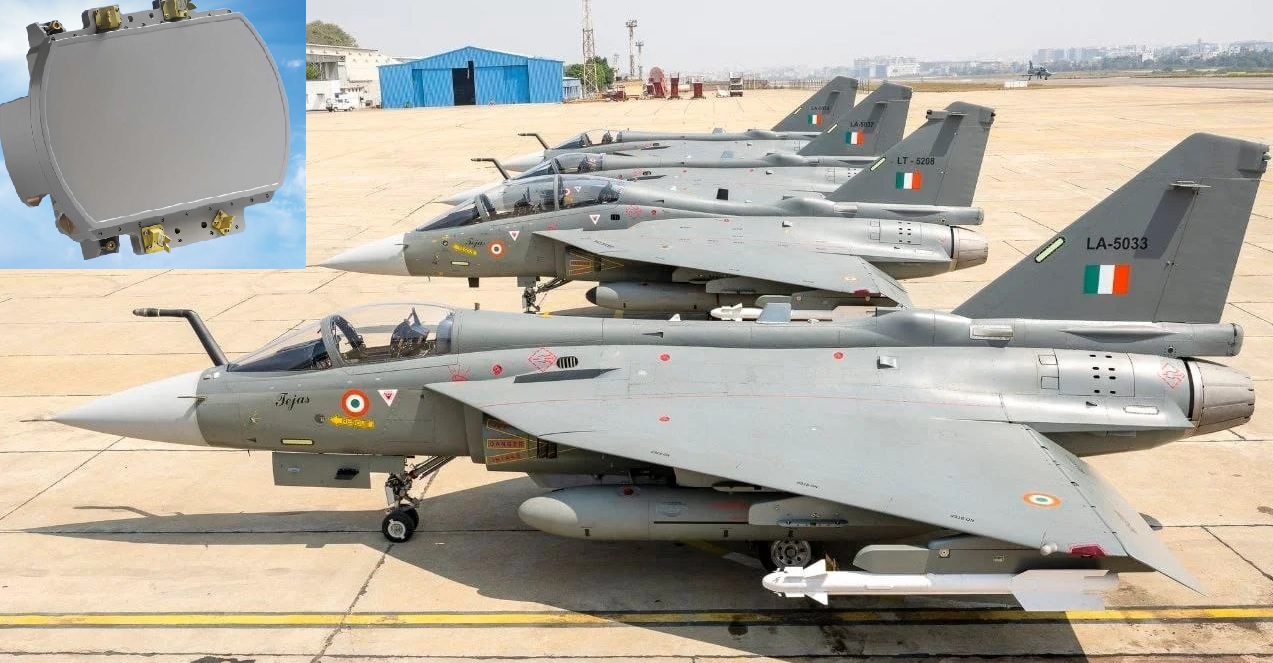
NEW DELHI : Deliveries of the Light Combat Aircraft (LCA) Tejas Mk1A are facing additional delays due to technical incompatibilities between the aircraft’s Active Electronically Scanned Array (AESA) radar and its onboard Electronic Warfare (EW) suite, according to recent reporting by Business Standard India and defense sources familiar with the program.
The integration challenges have prompted Hindustan Aeronautics Limited (HAL) to seek temporary capability concessions from the Indian Air Force (IAF) in order to meet delivery targets for the current financial year.
Integration Challenges Between AESA Radar and EW Suite
At the center of the delay is the integration of the Israeli-origin ELTA EL/M-2052 AESA radar, which is being manufactured in India under license. Defense sources indicate that the radar is experiencing operational issues in cueing and functioning seamlessly alongside the aircraft’s advanced Electronic Warfare suite and other avionics subsystems.
The Mk1A upgrade, compared to the earlier Mk1 configuration, includes a fully integrated AESA radar and enhanced EW suite as primary features. These systems are required to operate in coordination to ensure situational awareness, threat detection, electronic countermeasures, and target-tracking capability during combat operations.
Sources further indicate that software synchronization between the Israeli radar code and indigenous weapons systems remains under refinement. This includes integration work related to the Astra beyond-visual-range air-to-air missile, which requires seamless data exchange between the radar, mission computer, and weapon control systems.
Officials have clarified that the current challenges relate to system interoperability and validation, rather than structural or airframe deficiencies.
HAL Seeks Capability Concessions for Initial Deliveries
In response to the integration hurdles, HAL has approached the IAF seeking relaxations in the agreed Air Staff Quality Requirements (ASQRs) for the first batch of aircraft.
According to defense officials, HAL has proposed delivering the initial five Tejas Mk1A fighters by March 2026 under a “capability concession” framework. Under this arrangement, the aircraft would be handed over without complete integration of all contracted systems, with pending software updates and refinements to be incorporated in subsequent upgrades.
If the IAF insists on full compliance with baseline ASQR standards before acceptance, officials estimate that deliveries of the first batch could shift to May, June, or July 2026.
The IAF is expected to conduct a formal project review to assess whether the aircraft in its current configuration meets acceptance criteria.
Production Status and Engine Deliveries
Despite the integration bottlenecks, HAL has outlined the current production status of the program.
According to the company:
-
Five Tejas Mk1A aircraft have been fully built and are physically ready for handover.
-
Nine additional airframes have been manufactured and have completed initial test flights using reserve engines.
-
HAL has received five F404-IN20 engines from GE Aerospace as of February 2026, covering the requirement for the first batch of five aircraft.
The initial delivery timeline for the Mk1A was February 2024. However, delays in the supply of GE F404-IN20 engines, attributed to global supply chain disruptions, significantly pushed back the schedule. With engines now being delivered, software integration and avionics compatibility have emerged as the primary constraints.
Contract Details and Financial Commitments
The Indian Air Force has placed orders for a total of 180 Tejas Mk1A aircraft under two contracts:
-
83 aircraft ordered in February 2021 at a cost of ₹36,400 crore.
-
97 aircraft ordered in late 2025 at a cost of ₹62,370 crore.
The Tejas Mk1A variant incorporates enhancements including the AESA radar, advanced EW suite, improved maintainability features, and expanded weapon compatibility compared to the earlier Mk1 version.
Operational Implications for the IAF
The induction of the Tejas Mk1A remains central to the IAF’s force structure planning. Following the retirement of legacy MiG-21 squadrons, the IAF’s active fighter strength has reduced to 29 squadrons, against an authorized strength of 42 squadrons.
The service is relying on sustained production of the Mk1A to stabilize fleet numbers before the planned induction of the Tejas Mk2 and the Advanced Medium Combat Aircraft (AMCA) in the coming decade.
The outcome of the upcoming IAF project review will determine whether deliveries proceed under interim capability concessions or are deferred until full system integration compliance is achieved.
——— End of Article ———