ARLINGTON, Va. : Raytheon, a business unit of RTX (NYSE: RTX), has received a strategic contract from the Air Force Research Laboratory (AFRL) to establish a domestic manufacturing capability for thin film lithium niobate (TFLN) wafers, a critical material used in advanced photonics systems. The initiative is intended to reduce U.S. dependence on foreign-dominated supply chains for a material essential to national security systems and high-performance commercial technologies.
The contract focuses on developing a reliable U.S.-based source for TFLN, a specialized crystalline material that enables high-speed conversion of electronic signals into optical signals. This functionality is central to secure military communications, advanced radar architectures, electronic warfare systems, and emerging photonics-based computing technologies.
Addressing Supply Chain Concentration
Global production of TFLN wafers is currently concentrated among a limited number of international suppliers, creating potential vulnerabilities for U.S. defense and commercial sectors. Trade disruptions, export controls, or geopolitical instability could impact availability of the material.
Colin Whelan, president of Advanced Technology at Raytheon, stated that global access to TFLN has become increasingly constrained. Under the AFRL-backed effort, Raytheon will establish an independent U.S. supplier operating under a merchant supplier model. The model is designed to provide open, third-party access to TFLN wafers for a broad range of defense contractors and commercial customers, rather than limiting production to internal Raytheon programs.
The approach is intended to strengthen the U.S. defense industrial base while also supporting private-sector demand for photonics-enabled technologies.
Phased Technology Transfer and Manufacturing Plan
The program outlines a phased transition of manufacturing capability from Raytheon to G&H, a U.S.-based photonics specialist.
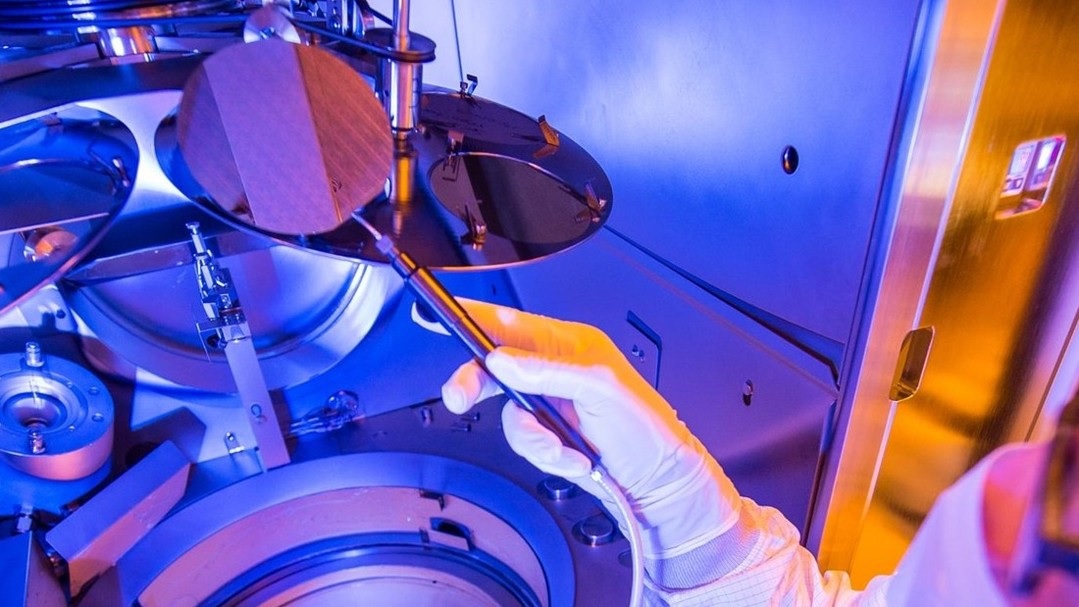
Raytheon’s Advanced Technology team will apply its proprietary “ion slicing” process to enable repeatable production of high-quality thin film lithium niobate layers. Ion slicing is a fabrication technique that separates ultra-thin crystalline layers from a bulk lithium niobate substrate, allowing for consistent wafer-level production suited to advanced photonic device integration.
Following validation of the manufacturing process, production responsibility will transition to G&H. Low-rate initial production (LRIP) is scheduled to begin in early 2026.
G&H will utilize its existing crystal growth and wafer fabrication infrastructure to support full vertical integration. This includes in-house crystal growth, wafer processing, and device-level fabrication capability, ensuring a domestically controlled supply chain from raw material through finished wafer output.
Strategic Importance of TFLN Technology
Thin film lithium niobate has become a foundational material for next-generation photonics applications due to its electro-optic properties, enabling high-speed modulation with low signal loss.
The material supports multiple sectors:
-
Defense: High-speed secure data links, advanced sensing systems, radar architectures, and electronic warfare platforms.
-
Artificial Intelligence: Photonic computing chips designed to process data using light rather than electrical signals, reducing latency and power consumption.
-
Telecommunications: Ultra-fast optical modulators used in 5G, 6G, and satellite communication systems.
-
Data Centers: Energy-efficient optical transmission systems capable of supporting the large data loads required by large language models (LLMs) and cloud computing infrastructure.
By enabling higher bandwidth and lower power optical interconnects, TFLN-based components are increasingly viewed as critical to scaling AI infrastructure and high-performance computing systems.
Broader Industrial and Economic Context
Although funded by the Air Force Research Laboratory, the initiative is structured to support both defense and commercial markets. The merchant supply model is designed to provide open access to U.S.-manufactured TFLN wafers, supporting innovation across multiple technology sectors.
Industry analysts view the establishment of a domestic TFLN manufacturing base as a risk-mitigation measure for the U.S. high-technology sector. Concentration of advanced materials production outside the United States has raised concerns regarding supply continuity for defense systems and commercial telecommunications infrastructure.
RTX Corporate Overview
Raytheon operates as a business unit of RTX, headquartered in Arlington, Virginia. RTX reported fiscal year 2025 sales exceeding $88 billion and employs more than 180,000 people worldwide. The company maintains a diversified aerospace and defense portfolio that includes Pratt & Whitney aircraft engines and Collins Aerospace systems.
The AFRL contract aligns with broader federal efforts to strengthen domestic advanced manufacturing capabilities and reduce supply chain vulnerabilities in strategic materials and semiconductor-adjacent technologies.
Low-rate initial production of domestically manufactured thin film lithium niobate wafers is expected to begin in early 2026 following completion of process validation and technology transfer activities.
——— End of Article ———