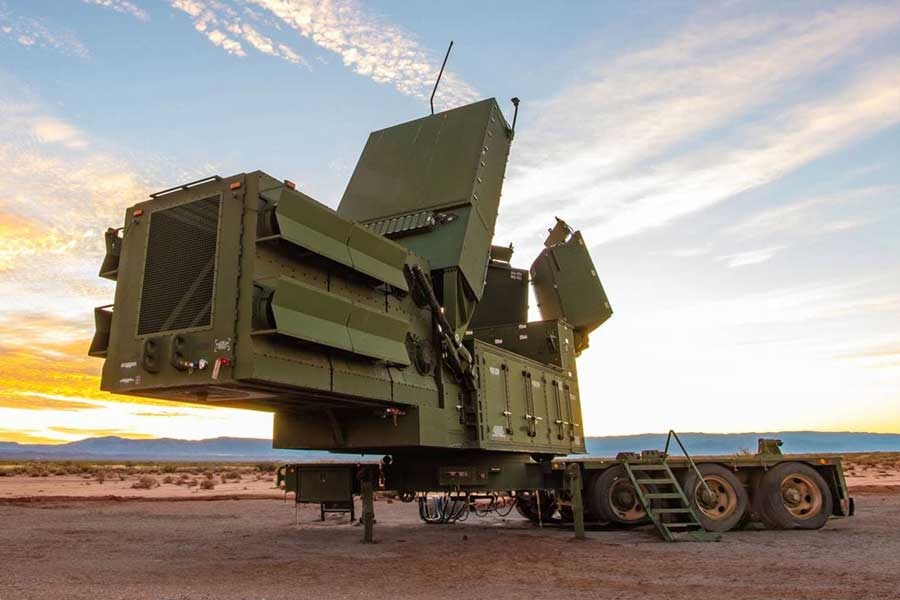
ANDOVER, Massachusetts : Raytheon has secured a $1.025 billion contract modification from the U.S. Army to support year two production of the Lower Tier Air and Missile Defense Sensor (LTAMDS). The award, announced by the Department of Defense, is funded through fiscal year 2026 procurement appropriations and represents a key element of the Army’s effort to modernize its air and missile defense architecture.
Raytheon, which operates as a subsidiary of RTX, will carry out the work primarily at its radar development and manufacturing facility in Andover, Massachusetts. According to the Pentagon, production activities under the modification are expected to continue through March 31, 2030.
Contract Scope and Funding
The latest award modifies an existing contract, identified as W31P4Q-24-C-0024, and brings the total value of the current contractual arrangement for LTAMDS year two production to approximately $1.025 billion. At the time of the modification, the Army Contracting Command at Redstone Arsenal, Alabama, obligated $254.6 million in fiscal 2026 “other procurement” funds to initiate the next phase of work.
This action follows earlier major investments in the program. In July 2024, the Army awarded Raytheon a $2.1 billion base contract to support low-rate initial production. That effort was expanded in August 2025 with a further $1.7 billion modification, reflecting the service’s decision to move the radar toward sustained production after completing key testing and validation milestones.
Replacement for Legacy Patriot Radar
LTAMDS is intended to replace the existing radar component of the Patriot missile system, which has been in service for decades and provides sector-based surveillance. The legacy system scans a limited field of view at any given time, requiring physical repositioning to address threats approaching from different directions.
By contrast, LTAMDS has been designed from the outset to deliver continuous, full-sphere coverage. The radar uses three fixed antenna arrays to provide uninterrupted 360-degree surveillance and tracking, eliminating blind spots that can be exploited by modern, maneuvering threats.
Radar Architecture and Technology
The primary antenna array is mounted on the front of the radar unit and is comparable in size to the current Patriot radar face. However, it delivers more than twice the power output due to its use of Gallium Nitride (GaN) semiconductor technology. GaN enables higher power density, improved thermal performance, and greater efficiency compared with earlier Gallium Arsenide-based designs.
Two additional, smaller arrays are positioned on the rear of the system. These secondary arrays continuously monitor the remaining azimuths, ensuring that the radar can detect and track targets from any direction without the need for mechanical rotation.
LTAMDS is built around an Active Electronically Scanned Array (AESA) architecture, allowing it to rapidly steer radar beams electronically. This capability improves detection range, tracking precision, and target discrimination. According to the Army, the system is designed to address a wide range of threats, including fixed-wing aircraft, helicopters, unmanned aerial systems, cruise missiles, ballistic missiles, and emerging hypersonic weapons.
Integration With Army Command Networks
A central requirement of the LTAMDS program is seamless integration with the Army’s Integrated Air and Missile Defense Battle Command System (IBCS). Through this open-architecture network, LTAMDS can share sensor data with other air and missile defense assets across the force.
This approach enables a sensor-to-shooter model, allowing any compatible interceptor or weapons system to engage a target detected by the radar, even if the launcher is not co-located with the sensor. The Army views this capability as essential for building a layered and resilient air defense network capable of operating in contested environments.
Program Status and International Interest
The LTAMDS program reached Milestone C in 2025, a major acquisition decision point that authorizes full-rate production following successful operational testing and evaluation. The year two production effort supported by the new contract modification is intended to expand the number of radars delivered to operational units and support initial fielding.
While the program is primarily focused on U.S. Army requirements, it has also attracted interest from allied nations. In 2024, Poland became the first international customer to sign a Foreign Military Sales agreement for LTAMDS as part of its broader effort to strengthen national and regional air and missile defense capabilities.
Army officials have stated that LTAMDS will play a central role in the future Patriot force structure, providing improved coverage, greater sensitivity, and enhanced interoperability as the service adapts to evolving aerial and missile threats.
——— End of Article ———