NATIONAL HARBOR, MD — May 28, 2026 : The U.S. Navy is advancing development of the Mark 58 Compact Rapid Attack Weapon (CRAW), a next-generation lightweight torpedo designed for anti-submarine warfare and hard-kill anti-torpedo operations, as Raytheon prepares for Increment 2 (Technology Insertion 2/TI-2) testing later this year.
Speaking at the Sea Air Space 2026 Symposium, Bill Guarini, Director of Requirements for the Naval Systems and Sustainment Business at Raytheon, provided an update on the Navy’s 6.75-inch diameter torpedo programme, confirming that the company remains on schedule with development, integration, and testing activities.
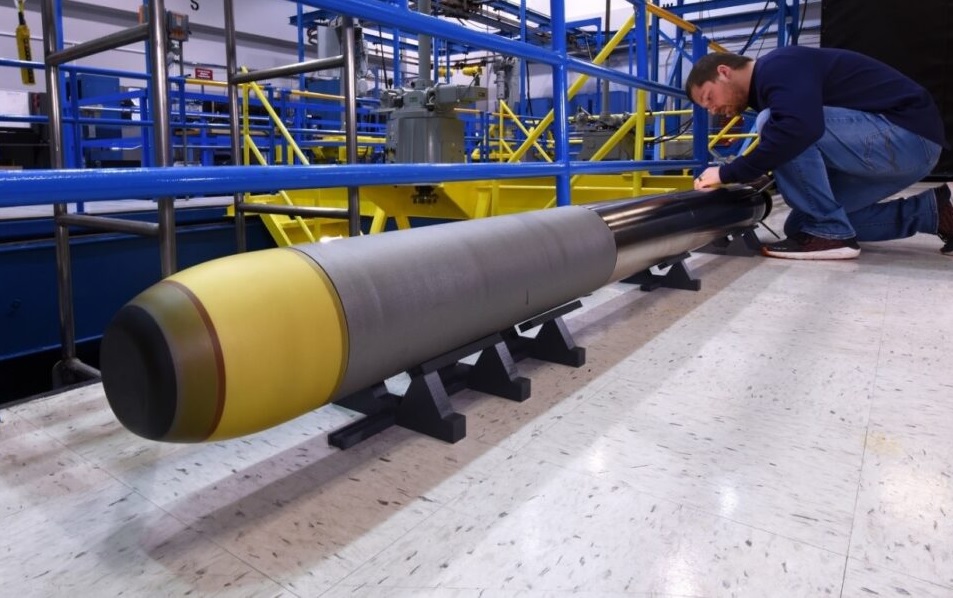
The Mark 58 CRAW is designed as a compact, lightweight torpedo measuring approximately 85–108 inches in length and weighing under 100 kilograms (around 200 pounds). The weapon supports dual operational roles, including offensive anti-submarine warfare and defensive hard-kill interception of incoming torpedoes. The programme builds upon earlier Very Lightweight Torpedo efforts and prototype work conducted by Penn State University’s Applied Research Laboratory.
Penn State University’s Applied Research Laboratory developed the initial Increment 1 (Technology Insertion 1/TI-1) units to rapidly field operational prototypes, while Raytheon was later selected to lead Increment 2 after a Navy down-select process. Under TI-2, Raytheon’s role focuses on transitioning the torpedo toward operational deployment by improving manufacturability, producibility, military hardening, and long-term supportability while addressing component obsolescence for larger-scale production.
Increment 2 Testing Planned
According to Guarini, in-water testing of the Mark 58 CRAW is scheduled to take place at a U.S. Navy range before the end of 2026. The upcoming tests will focus primarily on the weapon’s forebody, specifically the processing systems, guidance architecture, control mechanisms, and sensor arrays responsible for target detection and tracking.
Guarini explained that this phase concentrates on validating the torpedo’s ability to locate, process, and engage threats while refining system integration for future fleet deployment.
Raytheon’s current work scope remains centered on forebody integration and operational readiness, while broader propulsion-related requirements continue to be reviewed separately by the Navy.
Navy Evaluating Electric And Chemical Propulsion Systems
As part of ongoing programme development, the U.S. Navy has expanded requirements for the torpedo’s afterbody and propulsion system following an industry day held in April 2026.
One propulsion option under evaluation involves a 100-horsepower electric propulsion system designed to operate within the weapon’s compact 6.75-inch diameter. Navy planners are studying high-voltage systems exceeding 600Vdc combined with high power-density battery technology to reduce maintenance requirements by as much as 50 percent compared with conventional propulsion systems.
A second propulsion pathway under review is the Stored Chemical Energy Propulsion System (SCEPS), which generates heat to produce steam that drives a turbine-based propulsion mechanism. The system is intended to provide sustained propulsion within the compact torpedo structure.
Guarini noted that these Navy-directed propulsion modifications do not affect Raytheon’s Increment 2 contract timeline or scheduled testing activities. L3Harris is supporting the Raytheon team through contributions to propulsion, integrated afterbody systems, and powerplant development.
Expanding Submarine Magazine Capacity
Alongside torpedo development, the Office of Naval Research (ONR) is progressing the Multi-Vehicle Torpedo Tube Defense System (MVTTDS), also referred to as the Revolver Innovative Naval Prototype or Revolver MP project.
The initiative is intended to increase submarine magazine capacity by allowing a standard 21-inch torpedo tube aboard Virginia-class submarines to carry up to a dozen 6.75-inch Mark 58 CRAW torpedoes or other compact payloads, including unmanned systems. The concept is aimed at increasing the number of stowed effectors available during submarine operations, particularly for Indo-Pacific requirements.
Although Raytheon is not contracted for the Revolver programme, Guarini acknowledged that the Navy is separately funding torpedo launch variants intended to support expanded undersea payload capacity.
The Navy’s Small Business Innovation Research (SBIR) programme is also seeking composite materials to replace stainless-steel launch tubes, which currently account for nearly half of launcher assembly weight. The effort is intended to reduce launcher mass and improve deployment efficiency.
Potential Expansion Beyond Submarines
Raytheon’s present contract focuses on anti-submarine warfare and hard-kill anti-torpedo variants launched from Virginia-class submarine external countermeasure launchers (ECL). However, the Navy is also evaluating opportunities to expand the Mark 58 CRAW across additional operational domains.
Defense contractor Ultra Maritime has proposed launcher systems for surface warships to provide hard-kill torpedo defense capability for major naval combatants. In addition, the torpedo’s compact dimensions and weight make it suitable for possible future deployment from aviation platforms, including the P-8A maritime patrol aircraft and MH-60R helicopter.
While such concepts remain outside current programme funding, Guarini stated that Raytheon is prepared to support future launcher mechanisms and share technical data with Navy-selected partners as additional deployment pathways are pursued.
Programme Timeline And Current Status
Raytheon received the Navy contract to produce 18 Mark 58 CRAW prototypes and 12 turnaround kits based on Penn State’s updated design following a competitive programme down-select. Initial TI-2 deliveries are expected during Fiscal Year 2026, with development testing focused on both anti-submarine and counter-torpedo missions.
Guarini stated that Raytheon remains on schedule with development, integration, and testing milestones, adding that the Navy programme office has expressed satisfaction with the company’s progress as the Mark 58 CRAW advances toward broader fleet integration.
——— End of Article ———