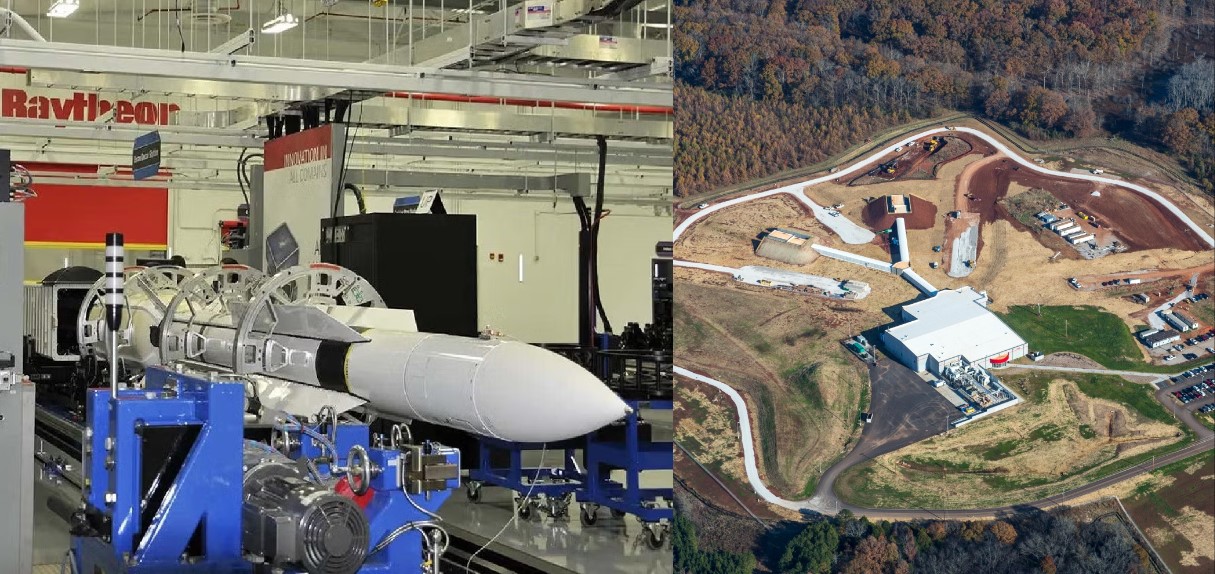
HUNTSVILLE, Alabama — March 13, 2026 : Raytheon, a business unit of RTX Corporation, has completed a $115 million expansion of its missile integration facility located at Redstone Arsenal in Huntsville, Alabama. The project significantly increases the company’s domestic missile integration capacity and is intended to support growing demand from the U.S. Navy, the Missile Defense Agency, and allied defense partners.
The expansion adds 26,000 square feet of manufacturing and integration space to the Redstone Raytheon Missile Integration Facility, increasing the plant’s physical footprint and raising its overall integration and delivery capacity by more than 50 percent. The site plays a key role in the U.S. defense supply chain as the final integration point for several major missile systems before delivery to operational users.
Facility Background and Production Infrastructure
The Redstone Raytheon Missile Integration Facility originally opened in 2012 as a 70,000-square-foot all-up-round missile production center built with a $75 million investment. The plant was designed to serve as the final integration and assembly site for missile systems supporting programs managed by the U.S. Navy and the Missile Defense Agency.
The facility specializes in the assembly of All-Up Rounds (AURs)—fully integrated missiles that include propulsion, guidance, control, and warhead systems and are delivered in ready-to-fire configuration. Production lines at the plant employ advanced robotics, automated handling systems, and specialized testing equipment to streamline assembly of complex weapon systems while maintaining quality control requirements.
With the newly completed expansion, the plant now has additional production space dedicated to final assembly, systems integration, and testing. The increased capacity allows Raytheon to scale manufacturing throughput for current missile programs while also introducing production infrastructure for next-generation interceptor systems.
Standard Missile Production
The Huntsville facility currently handles the final integration of the entire Standard Missile family used by the U.S. Navy. The plant supports nine variants within the program, including the Standard Missile-3 (SM-3) and the Standard Missile-6 (SM-6).
These missile systems perform multiple operational roles. The SM-3 is designed primarily for exo-atmospheric ballistic missile defense and is a key interceptor used within the U.S. Navy’s Aegis Ballistic Missile Defense architecture. The SM-6 provides a broader capability set, supporting fleet air defense, terminal ballistic missile defense, and anti-surface strike missions.
The Redstone facility assembles the final integrated missile rounds before delivery to U.S. naval forces and missile defense units.
Recent framework agreements signed by the U.S. Department of Defense in February 2026 are expected to significantly increase output requirements. Under the agreements, annual production of SM-6 interceptors will rise from approximately 125 missiles per year to more than 500 units. Manufacturing rates for the SM-3 Block IIA and SM-3 Block IB variants are also scheduled to accelerate.
The expanded integration facility provides the physical infrastructure necessary to support these higher production volumes while maintaining ongoing deliveries to operational customers.
Integration of the Glide Phase Interceptor
Another major purpose of the expansion is to support the future integration of the Glide Phase Interceptor (GPI), a next-generation interceptor currently under development.
The Glide Phase Interceptor is designed to counter hypersonic glide vehicles during the glide phase of their flight trajectory. Unlike traditional ballistic missiles, hypersonic glide vehicles maneuver within the atmosphere at extremely high speeds, making them difficult to intercept with existing missile defense systems.
The GPI program aims to provide the ability to track and intercept these weapons during the midcourse glide stage, when they are still outside terminal engagement range but within interceptable flight conditions. The Redstone facility will integrate GPI production alongside ongoing Standard Missile assembly operations once the interceptor completes development and testing.
Workforce and Regional Impact
The expansion is expected to create approximately 185 new jobs at the Huntsville site. Once hiring is completed, RTX’s total workforce in the state of Alabama will exceed 2,200 employees.
Huntsville has become a central hub for U.S. missile defense development and manufacturing due to the presence of Redstone Arsenal, the Missile Defense Agency, and numerous defense contractors. The expanded Raytheon facility strengthens the region’s role in the national missile defense industrial base.
Strategic Production Objectives
Raytheon states that the expansion is intended to address broader bottlenecks in the defense supply chain and enable faster delivery of missile defense systems. The increased manufacturing footprint allows the company to operate simultaneous production lines for multiple Standard Missile variants while preparing infrastructure for emerging interceptor programs.
The facility’s modular manufacturing design also allows production lines to be reconfigured for new missile systems as programs evolve. This approach is intended to support both current stockpile replenishment and the integration of advanced capabilities such as the Glide Phase Interceptor without interrupting existing production schedules.
While the expansion increases overall capacity by more than 50 percent, Raytheon has not disclosed detailed per-line output figures for the expanded facility beyond the overall production increases associated with the Department of Defense framework agreements.
——— End of Article ———