WASHINGTON — March 17, 2026 : Raytheon has been awarded a U.S. Navy contract valued at up to $212.12 million to continue operations and maintenance of the AN/TPS-71 Relocatable Over-the-Horizon Radar (ROTHR) network, a key long-range surveillance system covering the Caribbean, Gulf of Mexico, and southern approaches to the United States.
The contract, announced by the Pentagon on March 16, was issued through the Naval Supply Systems Command Fleet Logistics Center Norfolk as a cost-plus-fixed-fee agreement. It includes a base year worth $40.25 million, with four additional option years that could extend performance through April 2031 if exercised under federal acquisition regulations. Due to the specialized nature of the system, the procurement received a single bid via SAM.gov.
Contract Scope and Work Distribution
The agreement covers sustainment, operations, and maintenance of the ROTHR network across multiple locations tied to the Forces Surveillance Support Center. Work will be distributed geographically, with the largest share—48 percent—allocated to Chesapeake, Virginia, which hosts the operations control center.
Additional work locations include Freer and Premont in Texas, each accounting for 10 percent; New Kent, Virginia at 9 percent; and Juana Diaz and Vieques in Puerto Rico, each also at 9 percent. Smaller portions of the work will be conducted in Dallas, Texas (3 percent), and Fairfax, Virginia (2 percent).
Strategic Role in Southern Surveillance
The ROTHR network serves as the primary persistent, long-range surveillance system for United States Southern Command (SOUTHCOM), providing wide-area detection of air and maritime activity across key trafficking corridors in the Caribbean and surrounding regions.
It functions as a central sensor for Joint Interagency Task Force South (JIATF South), which coordinates multinational efforts to detect and interdict illicit trafficking. The radar system enables early detection and continuous monitoring of targets, allowing patrol aircraft, U.S. Coast Guard cutters, and partner-nation assets to be directed toward high-probability intercept areas.
While the system does not deliver precise targeting data, it significantly reduces the search area for follow-on forces, improving operational efficiency in counter-narcotics and homeland security missions.
Technical Characteristics of AN/TPS-71
The AN/TPS-71 is a land-based, high-frequency skywave radar that operates in the 5 to 28 MHz band. Unlike conventional line-of-sight radar systems, it uses ionospheric refraction to detect objects beyond the horizon.
Each radar sector covers a 64-degree wedge-shaped area with detection ranges between approximately 500 and 1,600 nautical miles. The Virginia sector alone provides surveillance over more than 2.2 million square miles.
The network is composed of an operations control center in Chesapeake and three bistatic radar sectors located in Virginia, Texas, and Puerto Rico. These systems employ separate transmit and receive sites positioned across Chesapeake, New Kent, Freer, Premont, Juana Diaz, and Vieques.
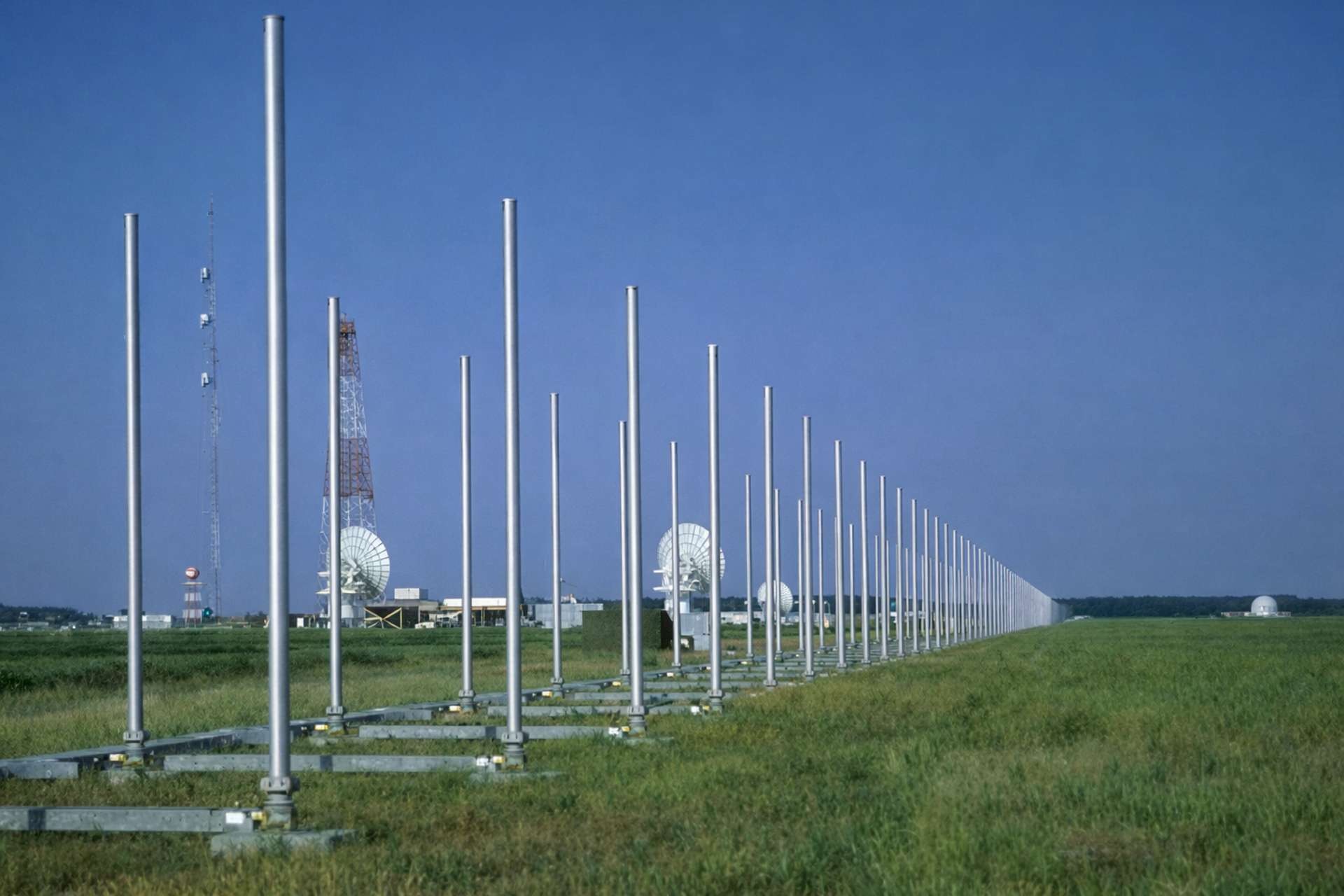
Each receive site features a 2.58-kilometer linear phased array consisting of 372 twin-monopole elements. The system uses digital beamforming to generate 18 simultaneous beams and incorporates Doppler processing to distinguish moving targets from ground and sea clutter.
The radar transmits a 25-kHz continuous frequency-modulated waveform, resulting in a surface resolution cell of approximately 6 kilometers in range and 15 kilometers in azimuth. It is capable of detecting aircraft at various altitudes as well as surface vessels longer than 100 feet.
Operational Limitations and Supporting Role
According to assessments by the Government Accountability Office, the ROTHR system does not provide altitude information or highly precise target location data. As a result, additional sensors and platforms are required for final identification and interception.
Despite these limitations, the system’s strength lies in persistent wide-area detection and cueing. By narrowing the operational search space, it allows limited surveillance and interdiction assets to be deployed more effectively.
Historical Development and Continuity
The ROTHR network has been operational since the 1990s, initially deployed to support counter-drug operations. The Virginia sector became operational in 1993, followed by the Texas sector in 1995, with Puerto Rico later completing the three-site network.
Developed from earlier over-the-horizon radar programs, ROTHR transitioned into a central component of U.S. monitoring efforts across drug trafficking routes spanning the Caribbean and South America.
Raytheon has supported the system since its early development in the 1980s, providing engineering services, sustainment, and upgrades. This includes previous operations and maintenance contracts, such as a five-year agreement awarded in 2021.
Continued Role Through 2031
The newly awarded contract ensures the continued availability and operational readiness of the ROTHR network through at least 2031, subject to option year execution. The system remains a foundational element of SOUTHCOM’s surveillance architecture, supporting ongoing counter-trafficking and homeland security missions across the United States’ southern maritime approaches.
——— End of Article ———