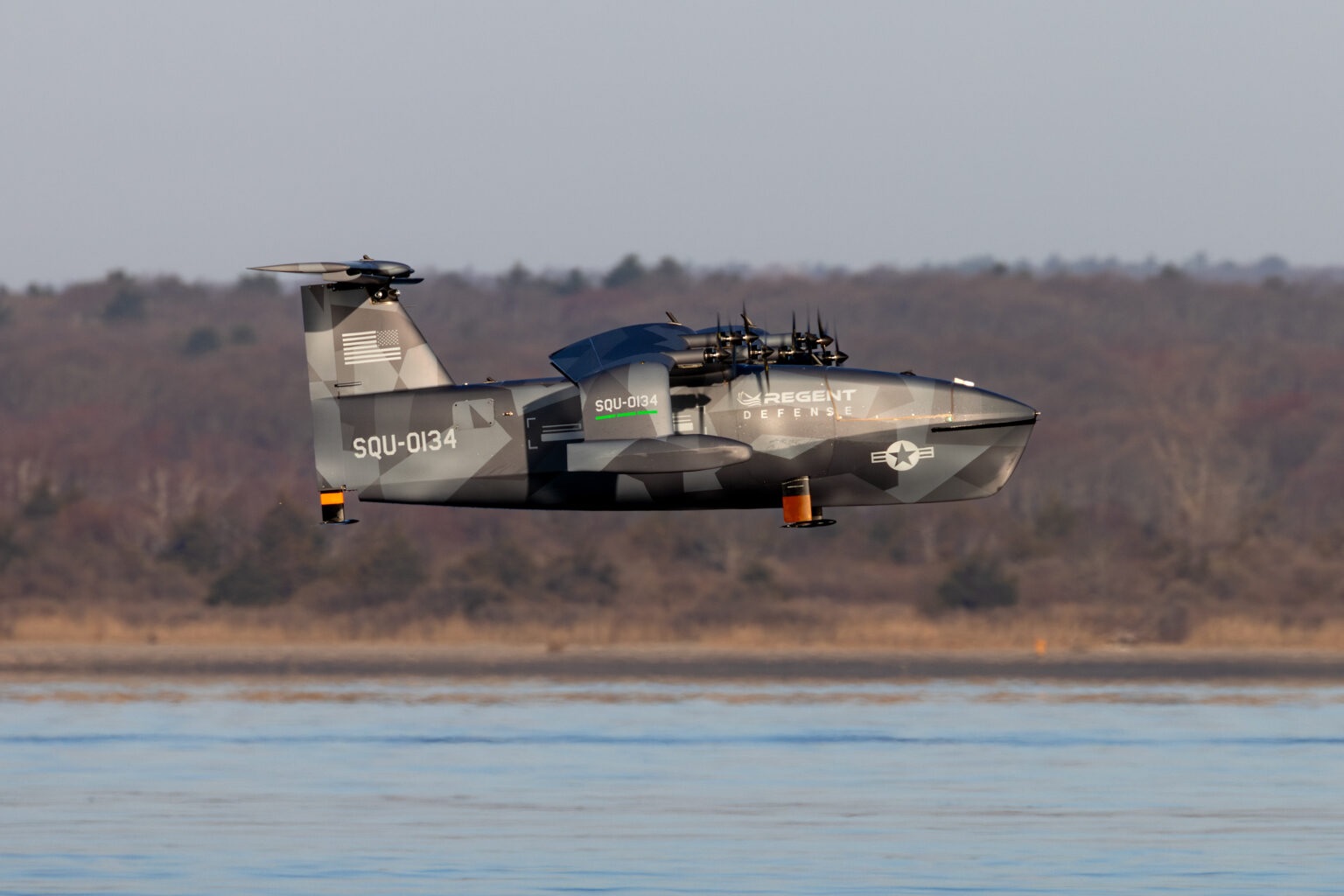
NORTH KINGSTOWN, R.I., — April 13, 2026 : U.S.-based maritime technology company REGENT announced on Monday that it has successfully completed a ground-effect flight test of its autonomous Squire Seaglider, marking what it described as the first U.S. flight of a defense-focused wing-in-ground effect craft.
The April 13 demonstration represents a transition from early-stage validation to live flight testing, advancing the Squire platform toward potential operational deployment with military users. The test follows progressive system development after the U.S. Coast Guard granted testing clearance in 2025.
Program Development and Strategic Context
REGENT is positioning the Squire Seaglider to address operational requirements in contested maritime environments, particularly in coastal regions and across the Indo-Pacific. The platform is designed to support missions without reliance on traditional infrastructure such as ports, airstrips, or large surface vessels.
Earlier in 2026, on February 9, company leadership briefed U.S. Secretary of Defense Pete Hegseth and senior officials at the Seabee Museum in Quonset, Rhode Island. The briefing focused on the system’s role in addressing gaps in contested logistics and distributed maritime operations. During the meeting, Hegseth emphasized the importance of accelerating field deployment of emerging operational systems.
Billy Thalheimer, co-founder and chief executive officer of REGENT, stated that the flight milestone demonstrates the operational potential of Seaglider technology for defense applications.
Technical Characteristics and Performance
The Squire is an uncrewed, fully electric wing-in-ground effect vehicle that operates just above the water’s surface. It utilizes a cushion of compressed air between its wings and the water to reduce aerodynamic drag, enabling higher efficiency compared to conventional marine vessels while maintaining a low operational profile.
According to REGENT, the platform has the following specifications:
- Maximum speed of 70 knots (approximately 81 mph)
- Operational range exceeding 100 nautical miles (around 115 miles) on a single charge
- Payload capacity of 50 pounds
- Dimensions of 13 feet in length, 5.5 feet in height, and an 18-foot wingspan
The vehicle operates across multiple phases, including float, hydrofoil, and ground-effect flight modes. It reaches hydrofoil speeds of approximately 35 knots before transitioning to sustained ground-effect flight at higher speeds.
REGENT stated that the Squire can take off and land in sea states of up to 2 feet and maintain operational capability across varying conditions while in flight. Its low-altitude profile allows it to remain above sonar detection while reducing radar visibility.
The system is being developed for missions including intelligence, surveillance and reconnaissance (ISR), tailored logistics, search and rescue (SAR), and anti-submarine warfare (ASW) support.
Tom Huntley, general manager of REGENT Defense, said the platform is intended to provide speed, range, and mission flexibility across wide maritime areas without dependence on fixed infrastructure.
Testing Progress and Manufacturing
Since receiving regulatory clearance, REGENT has expanded the Squire’s operational envelope, onboard systems, and autonomous flight controls through a structured test program. The April 13 flight forms part of a broader 2026 test campaign that began in March.
The company is also conducting parallel development of its larger Viceroy Seaglider prototype in Rhode Island. The Viceroy is designed to carry up to 12 passengers and approximately 3,500 pounds of cargo, supporting both commercial and defense applications. Ongoing sea trials are taking place in Narragansett Bay.
REGENT is establishing a 255,000-square-foot manufacturing facility in Rhode Island to support production of its Seaglider platforms.
Contracts and Financial Position
REGENT currently holds a contract valued at $15 million with the U.S. Marine Corps related to the Squire program. The company is backed by investors including Lockheed Martin, Founders Fund, and 8090 Industries.
According to REGENT, its commercial order backlog exceeds $10 billion, reflecting demand across both civilian and defense markets.
The Squire Seaglider is being developed under REGENT Defense as part of a broader portfolio of hybrid and autonomous maritime platforms.
——— End of Article ———