SEOUL — March 7, 2026 : Qatar has reportedly submitted a request to South Korean defense companies LIG Nex1 and Hanwha Systems regarding the Cheongung-II (M-SAM II) mid-range surface-to-air missile system, according to defense industry sources familiar with ongoing regional procurement activity. Officials indicate that the Qatari approach currently appears to be a preliminary or general request rather than a finalized acquisition plan.
The reported inquiry comes as several Middle Eastern countries deepen defense cooperation with South Korea, particularly in the field of air and missile defense systems. The United Arab Emirates, Saudi Arabia, and Iraq have all signed major contracts for the Cheongung-II system in recent years and maintain active collaboration with South Korean defense firms.
Regional Defense Cooperation
South Korea’s defense industry has established sustained partnerships in the Gulf and broader Middle East through large-scale procurement agreements, system construction projects, training programs, and technical support arrangements.
The Cheongung-II system is produced through a consortium structure led by LIG Nex1, which acts as the prime contractor and system integrator. The company manufactures the interceptor missiles and the combat control center used to manage engagements.
Hanwha Systems supplies the system’s multi-function radar, designed to detect and track multiple aerial targets simultaneously and guide interceptors during engagement operations. Hanwha Aerospace manufactures the launchers and several key ground system components used in the battery configuration.
Defense industry sources note that production capacity for the system is currently allocated to existing domestic and export orders. As a result, any new procurement contract would likely face extended delivery timelines.
Existing Regional Orders
The United Arab Emirates became the first Middle Eastern customer for the Cheongung-II system after signing a contract in 2022 valued at approximately $3.5 billion for 10 batteries.
Two of those batteries have already been delivered and deployed. According to defense officials and regional reports, the deployed units were used during recent Iranian missile and drone attacks targeting Gulf states. During those engagements, the systems reportedly launched more than 60 interceptor missiles.
Operational reports indicate an interception success rate exceeding 90 percent, with some sources estimating effectiveness at approximately 96 percent. Following these engagements, the UAE formally requested accelerated delivery of the remaining batteries and additional interceptor missiles.
Saudi Arabia signed a separate contract in 2024 valued at approximately $3.2 billion for 10 Cheongung-II batteries. As part of that agreement, Hanwha Systems secured an additional $867 million contract to provide the multi-function radar components used in the system. Deliveries under the Saudi contract are expected to begin in the coming years.
Iraq also finalized a procurement agreement in 2024, signing a $2.8 billion contract (3.7 trillion won) with LIG Nex1 for the Cheongung-II system. Production for Iraq’s order is currently underway, with deliveries scheduled to begin in 2028.
Cheongung-II (M-SAM II) System Specifications
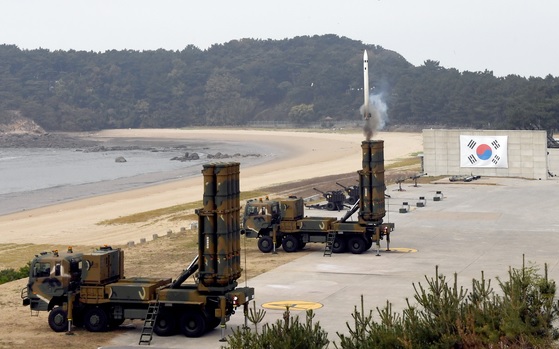
The Cheongung-II, also known as M-SAM Block II, is a mobile medium-range surface-to-air missile system designed to intercept aircraft, cruise missiles, and certain ballistic missile threats. The system forms the mid-tier layer of South Korea’s multi-layered air and missile defense architecture.
Key technical characteristics of the system include:
Missile
-
Length: 4.61 meters
-
Weight: approximately 400 kg
-
Diameter: 275 mm
-
Propulsion: single-stage solid-fuel rocket motor
-
Maximum speed: around Mach 5
-
Guidance: inertial navigation with mid-course datalink updates and terminal active radar homing
Engagement Capability
-
Maximum engagement range: 40–50 km depending on variant
-
Interception altitude: up to 15–20 km
-
Designed to intercept aircraft, cruise missiles, and short-range ballistic missiles
Radar and Detection
-
Multi-function X-band phased-array radar
-
Target detection range: around 100 km
-
Capability to track up to 40 targets simultaneously and guide multiple interceptors during engagements
Battery Configuration
A typical Cheongung-II battery includes:
-
1 engagement control center
-
1 multi-function radar unit
-
4–6 transporter-erector launchers (TELs)
-
8 interceptor missiles per launcher
-
Power generation and support vehicles
The system uses vertical launch architecture, allowing interceptors to engage threats in any direction without repositioning launchers, enabling rapid response against multiple incoming targets.
Potential Qatari Procurement
Industry observers say Qatar’s reported request fits within the broader pattern of Gulf states expanding layered air defense capabilities amid increased regional missile and drone threats.
However, officials emphasize that the Qatari request remains at an early stage and may represent only a preliminary evaluation of the system rather than a formal procurement decision.
Even if Qatar proceeds with a purchase agreement, existing production commitments could significantly affect delivery timelines.
Strategic and Industrial Cooperation
Defense cooperation between Qatar and South Korea has expanded in recent years across both military and industrial sectors.
One of the most significant examples is a large-scale LNG carrier construction agreement valued at 23.6 trillion won, awarded to South Korean shipbuilders Hanwha Ocean, Hyundai Heavy Industries, and Samsung Heavy Industries. At the time of signing, the order accounted for approximately 60 percent of global LNG carrier construction capacity.
Military cooperation has also expanded through joint training activities. Units of the Republic of Korea Army recently conducted overseas exercises in Qatar for the first time. The drills involved K2 main battle tanks, K9A1 self-propelled artillery systems, heavy armored vehicles, and roughly 100 personnel from the 11th Mobile Division.
South Korean defense companies have also increased their presence at regional defense exhibitions. In January 2026, LIG Nex1 displayed the Cheongung-II system at the Doha International Maritime Defence Exhibition, where it presented the system’s air and missile defense capabilities to regional military officials.
Outlook
Analysts note that Qatar’s reported request reflects the expanding role of South Korean defense systems in Middle Eastern air defense networks. However, the timeline for any potential delivery will depend on the status of current production commitments for existing customers, including the United Arab Emirates, Saudi Arabia, and Iraq.
Further confirmation from Qatari or South Korean officials would be required before any procurement agreement can be considered finalized.
——— End of Article ———