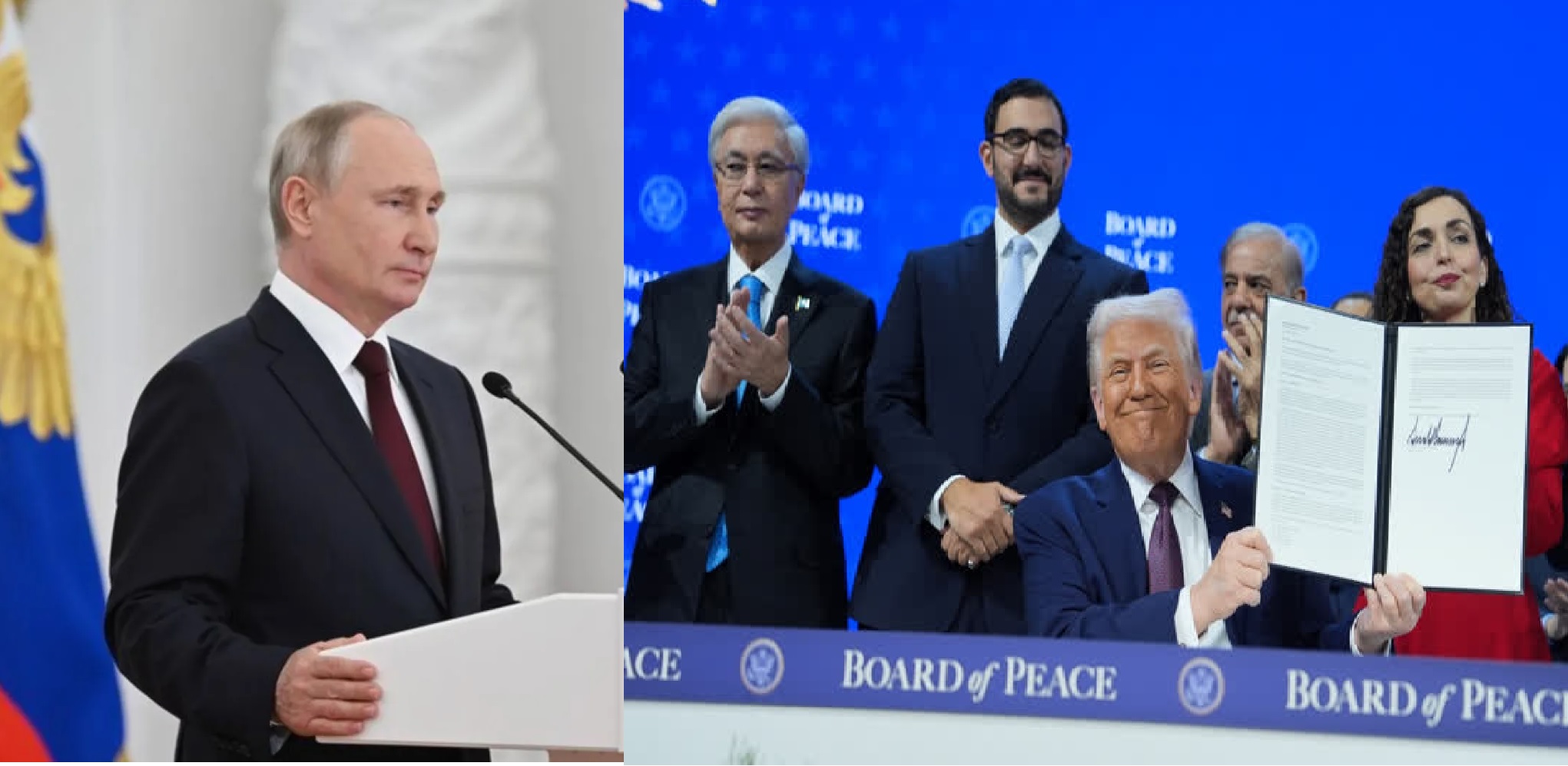
MOSCOW : Russia has thrown a major diplomatic wrench into a high-profile U.S. initiative for reshaping global conflict mediation, with President Vladimir Putin declaring that Moscow will not join President Donald Trump’s proposed “Board of Peace” unless the rights of the Palestinian people are explicitly guaranteed under existing United Nations resolutions.
In a televised meeting of Russia’s Security Council late Wednesday, Putin reframed what Washington had portrayed as a diplomatic win into a conditional negotiation, making clear that Russia would not participate in any new international body that sidelines Palestinian sovereignty or bypasses the long-standing UN framework for resolving the Israeli-Palestinian conflict.
The remarks effectively stalled the momentum of the U.S.-led proposal and repositioned Moscow not as a junior partner, but as a power demanding to set the terms of engagement.
A Direct Rebuttal to Washington
The White House had earlier suggested that Russia had already agreed in principle to join the Board of Peace, an initiative the Trump administration has promoted as a permanent, elite forum for managing major international crises. Putin contradicted that account, saying Russia is still reviewing the documents and has made no final commitment.
“The key issue is whether this structure will contribute to a genuine, long-term settlement of the Palestinian-Israeli conflict,” Putin said. “That settlement must be based on the relevant decisions of the United Nations, and it must take into account the fundamental needs and wishes of the Palestinian people.”
Russian diplomats interpreted the statement as a firm rejection of any arrangement that treats the Palestinian question as secondary or symbolic. By anchoring his position in UN Security Council resolutions, Putin signaled that Moscow will not endorse any initiative that legitimizes permanent occupation, unilateral annexation, or alternative frameworks outside international law.
Turning Frozen Assets into Leverage
Putin’s most provocative move came when he addressed the reported financial structure of the Board of Peace. According to officials familiar with the proposal, permanent membership requires a contribution of roughly $1 billion, ostensibly to fund peacekeeping, reconstruction, and mediation efforts.
Russia, Putin said, is prepared to pay—using Russian sovereign assets currently frozen by the United States and its allies.
“Considering Russia’s special and historic relationship with the Palestinian people, we could direct one billion dollars to the Peace Council from Russian assets that were frozen under the previous U.S. administration,” he said, smiling slightly as he made the point.
The proposal places Washington in a politically awkward position. Accepting the funds would amount to an implicit acknowledgment that the frozen assets remain Russian property, undermining the legal rationale for their seizure. Rejecting them would risk casting the United States as obstructing funding that could be used for Gaza’s reconstruction and broader Middle East stabilization.
One Moscow-based defense analyst described the move as “financial jiu-jitsu.”
“He isn’t just asking for a seat at the table,” the analyst said. “He’s offering to pay for it with money the host already took from him.”
Consulting the Global South
Putin also made clear that Russia would not be rushed into a decision by Western diplomatic calendars, including upcoming high-level meetings tied to the World Economic Forum circuit. He said he had instructed the Foreign Ministry to consult first with Russia’s strategic partners, a phrase widely understood to include China, Iran, and several key Arab states.
In a further signal of Moscow’s positioning, the Kremlin confirmed that Putin plans to meet Palestinian Authority President Mahmoud Abbas in Moscow in the coming days to discuss the proposal directly. The move underscores Russia’s insistence that any credible peace initiative must involve Palestinian leadership from the outset, rather than as an afterthought.
Broader Strategic Stakes
Analysts say the “Palestine First” stance serves multiple Russian objectives at once. It reinforces Moscow’s influence in the Arab world and across the Global South, where frustration with Western handling of the Gaza war and the broader Palestinian issue has grown sharply. It also allows the Kremlin to present itself as a defender of international law, contrasting UN-based legitimacy with what it portrays as Western “rules-based” flexibility.
By tying participation in the Board of Peace to explicit guarantees for Palestinian rights, Putin has drawn a clear line: Russia will support multilateral peace mechanisms, but only on terms that align with established international resolutions.
“Russia will not join any ‘Board of Peace’ unless the rights of the Palestinian people are fully guaranteed,” Putin said.
With that declaration, Moscow has transformed a U.S. diplomatic initiative into a test case for the future of the Palestinian issue itself—and signaled that any global peace architecture without Palestine at its core will face stiff resistance from one of the world’s major powers.
——— End of Article ———