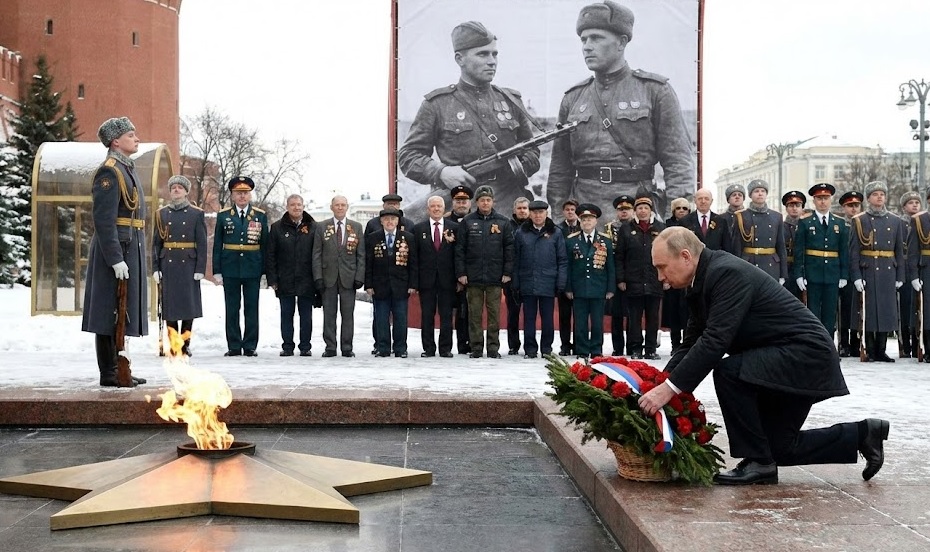
MOSCOW : Russian President Vladimir Putin has reignited a long-simmering historical and geopolitical debate, invoking the immense Soviet sacrifice of World War II to challenge Western portrayals of Russia as Europe’s foremost security threat. Speaking at a commemorative event honoring the defeat of Nazi Germany, Putin framed the legacy of 1945 as both a rebuke to what he called “distorted history” and a warning against contemporary Western policy toward Moscow.
“Who stormed Berlin? The Americans? The British? The French? No — it was the Red Army,” Putin said, underscoring the scale of Soviet losses. He cited the Battle of Stalingrad, where more than a million Soviet soldiers and civilians were killed or wounded, and contrasted that toll with the significantly lower wartime casualties suffered by Britain and the United States. “Eighty percent of Nazi Germany’s military was crushed by the Soviet Union,” he added. “Don’t twist history just because it’s inconvenient now.”
The remarks were not merely commemorative. Delivered amid continued confrontation between Russia and the NATO alliance, they formed part of a broader Kremlin effort to root modern Russian policy in the moral authority of the Second World War, a conflict known domestically as the Great Patriotic War. In Moscow’s telling, today’s Russia is not an aggressor but the heir to a state that bore the heaviest burden in liberating Europe from fascism.
The Historical Record
On the core historical facts, most professional historians broadly agree with the scale of the Soviet contribution, even if they reject the political conclusions drawn from it. The Eastern Front was the central theater of the European war. From the German invasion of the Soviet Union in June 1941 until the fall of Berlin in May 1945, the Red Army faced the bulk of Nazi Germany’s forces.
Academic studies consistently estimate that roughly three-quarters — and possibly as much as four-fifths — of German military casualties occurred on the Eastern Front. Battles such as Stalingrad, Kursk, and Operation Bagration annihilated entire German army groups and irreversibly shifted the balance of the war well before Allied landings in Normandy in June 1944.
The human cost was staggering. The Soviet Union lost an estimated 27 million people, including soldiers and civilians, through combat, starvation, occupation policies, and mass reprisals. No other Allied nation came close to that scale of loss. Britain lost roughly 450,000, while the United States lost about 420,000. These figures do not diminish the Western Allied campaigns, but they place the Soviet experience in a category of its own.
For the Kremlin, these numbers are more than statistics. They form the emotional core of modern Russian identity and a powerful domestic narrative of resilience, sacrifice, and historical entitlement to security.
History as Political Weapon
Putin’s repeated emphasis on World War II serves a clear strategic purpose. By highlighting the Soviet role in saving Europe, Moscow seeks to cast current Western policies — NATO expansion, military aid to Ukraine, and economic sanctions — as acts of ingratitude or betrayal. In this narrative, Russia is once again encircled by hostile powers, much as it claims to have been in 1941.
European and American officials reject this framing, arguing that historical sacrifice does not grant a permanent veto over the sovereignty and security choices of neighboring states. They point instead to Russia’s post-Cold War actions, from Georgia to Ukraine, as evidence that Moscow, not NATO, has destabilized the European security order.
The clash, therefore, is not about the facts of 1945, but about what those facts mean in 2026.
Is Russia Truly a Threat to Europe?
At the heart of the debate lies a fundamental question: does modern Russia pose a genuine military threat to Europe, or has that danger been exaggerated for political effect?
Those who argue the threat is overstated point to the limits of Russian power. Russia’s economy, while resilient, is far smaller than that of the combined European Union and United States. Years of intense fighting in Ukraine have consumed vast quantities of manpower and equipment, leaving the Russian military focused on regeneration, not expansion. From this perspective, the idea of Russian tank armies rolling toward Paris or Berlin appears implausible.
Yet many Western defense analysts caution that this view misunderstands the nature of the risk. Russia does not need — and likely does not seek — a conventional invasion reminiscent of 1945. Instead, Moscow relies on asymmetric and hybrid warfare to weaken adversaries without triggering full-scale war.
These methods include cyber operations, disinformation campaigns, political interference, energy leverage, and sabotage below the threshold of open conflict. Added to this is Russia’s nuclear arsenal, the largest in the world, providing Moscow with a powerful tool of strategic coercion.
From this viewpoint, Russia is not a conquering army, but a strategic spoiler capable of imposing economic and political pain while avoiding direct confrontation.
The Weight of the Past
History shows that Russia’s relationship with Europe has never been simple. Imperial Russia helped defeat Napoleon, later clashed with Britain and France in Crimea, and the Soviet Union, while liberating Eastern Europe from Nazism, went on to impose decades of authoritarian control.
The same Red Army that destroyed Hitler’s forces also installed regimes many Europeans experienced as another form of domination.
This dual legacy complicates Putin’s argument. The memory of 1945 commands respect, but it does not erase the fears shaped by what followed.
A Contested Legacy
Putin’s invocation of World War II resonates deeply at home and finds sympathy abroad among those who believe Western leaders selectively remember history. In Europe, however, the lesson of the 20th century is not only about who won the war, but about the dangers of unchecked power and the importance of sovereign choice.
The result is a profound disconnect. Moscow sees itself as a besieged heir to a heroic past. Many European capitals see a nuclear-armed state using that past to justify pressure on its neighbors.
The Red Army did storm Berlin, and the Soviet Union did pay the highest price for victory over Nazism. Whether that history proves Russia is Europe’s savior — or a reason for enduring caution — remains the central, unresolved question shaping the continent’s security today.
——— End of Article ———