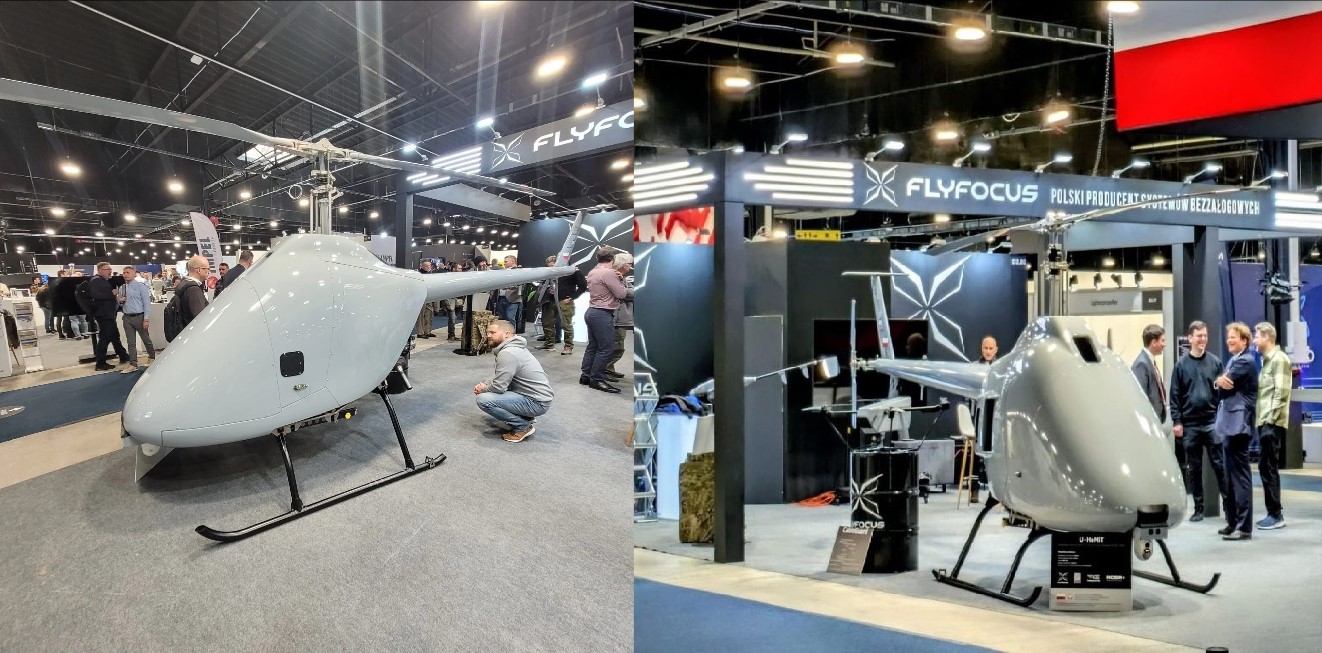
WARSAW, Poland — March 26, 2026 : Polish defence technology company FlyFocus has formally introduced its KURIER unmanned logistics helicopter, a 600-kilogram class rotary-wing platform designed to support autonomous resupply missions in contested operational environments. The system was presented publicly for the first time at the Drone World Expo 2026, held in Warsaw from March 3 to 5.
The KURIER platform has been developed under the “Unmanned Special Forces Airborne Transport Platform” (BPT WS) programme, a national initiative aimed at enhancing Poland’s battlefield logistics capabilities and technological sovereignty in unmanned systems. The programme is overseen by the Polish Ministry of Defence, with financial support of approximately €5 million (PLN 20.8 million) provided by the National Centre for Research and Development.
Development is being carried out by a domestic industrial and scientific consortium comprising FlyFocus, FusionCopter, and the Institute of Fundamental Technological Research under the Polish Academy of Sciences.
Platform Design and Technical Characteristics
The KURIER unmanned helicopter is positioned within the medium-weight unmanned logistics category and is based on the Escape ultralight helicopter platform developed by Lamanna Helicopters, adapted for fully unmanned operations.
The system has a maximum take-off weight (MTOW) of 600 kilograms and an empty weight of approximately 350 kilograms, enabling a payload capacity exceeding 200 kilograms. It is designed to transport mission-critical supplies, including ammunition, medical equipment, and logistics payloads to forward-deployed units.
In terms of performance, the helicopter can reach a maximum speed of 180 kilometres per hour. Endurance ranges between 3 and 10 hours depending on payload and mission configuration. The platform operates at a service ceiling of 4,000 metres above sea level, with potential for higher-altitude operations depending on configuration.
The avionics architecture is built around a 28V DC electrical system and incorporates triple-redundant autopilot cores supported by a programmable arbiter unit to ensure flight stability and fault tolerance. The communications suite is designed for operations in GPS-degraded and electronic warfare environments, featuring AES-128 and AES-256 encryption, MESH network capability, and compliance with MIL-STD-810 standards for environmental resilience.
The system’s hardware and software development aligns with established aviation certification frameworks, including DO-160, DO-178, and DO-254, reflecting a focus on reliability and operational safety.
Programme Progress and Operational Role
The KURIER programme was initiated in February 2024 and has since undergone a series of flight tests in Polish military training areas under simulated operational conditions. The system is currently approaching Technology Readiness Level 6 (TRL-6), indicating a prototype demonstrated in a relevant environment.
The primary operational role of the platform is to support special forces and forward units operating in denied or highly contested areas where traditional logistics routes are unavailable or vulnerable. The system is intended to autonomously deliver supplies without exposing personnel to risk.
Igor Skawiński, founder of FlyFocus, stated that the platform reflects a broader strategy focused on supply chain security and domestic capability development. He emphasized that the system is designed and manufactured in Europe using components sourced from NATO-aligned suppliers to ensure transparency, reliability, and long-term sustainability of defence supply chains.
Expanded Operational Scope and Future Applications
In addition to land-based logistics, FlyFocus and its partners are evaluating the KURIER platform for maritime and naval applications. Potential use cases include ship-to-ship cargo transfer, naval resupply operations, maritime surveillance, monitoring of critical infrastructure, and support roles in anti-submarine warfare (ASW) missions.
The company has also indicated that the underlying technology could be adapted for dual-use applications beyond the defence sector. These include offshore logistics support, disaster response operations, and border protection missions.
While the Polish Ministry of Defence remains the primary stakeholder, the KURIER system is being positioned for potential future participation in joint government-to-government procurement programmes involving NATO and European partner nations.
As the programme advances beyond TRL-6, further testing and evaluation are expected to determine readiness for operational deployment and potential export opportunities.
——— End of Article ———