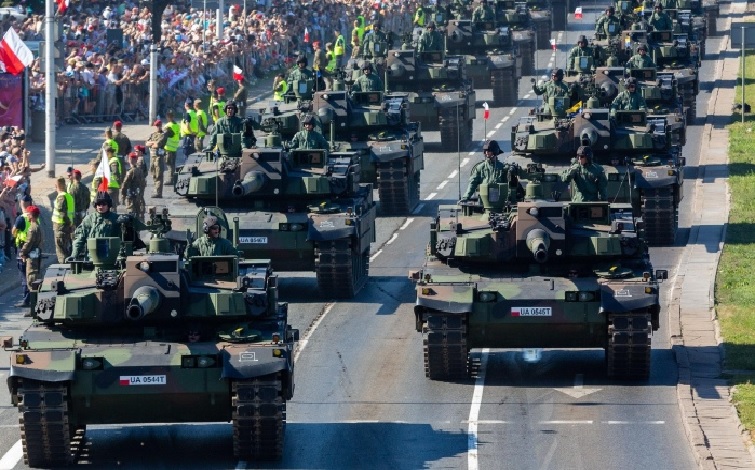
WARSAW : Poland is implementing one of the most extensive armored force modernization programs in Europe, with a stated objective of fielding approximately 1,100 main battle tanks by 2030. According to current defense planning data, this target would place Poland ahead of the combined active main battle tank inventories of Germany, France and the United Kingdom, significantly reinforcing NATO’s eastern flank posture.
The expansion forms part of Warsaw’s broader force development strategy aimed at strengthening territorial defense, increasing conventional deterrence, and replacing legacy Soviet-era platforms with modern Western systems.
Western European Tank Inventories in Context
Recent force data shows that major Western European NATO members operate comparatively smaller armored fleets following post-Cold War reductions.
Germany’s armed forces, the Bundeswehr, currently field approximately 295 Leopard 2 main battle tanks across 2A6 and 2A7 standards, with incremental modernization and limited expansion plans underway.
France operates around 222 Leclerc main battle tanks. Most of these platforms are undergoing mid-life upgrades to the Leclerc XLR configuration, extending operational service life and enhancing digital integration.
The United Kingdom maintains approximately 148 active Challenger 2 tanks. All 148 are being upgraded to the Challenger 3 standard, with remaining legacy hulls scheduled for retirement.
Combined, Germany, France and the United Kingdom field approximately 665 active main battle tanks — substantially below Poland’s projected 2030 force level.
Poland’s Current Tank Fleet
Poland’s existing armored inventory consists of a mix of Western and legacy platforms.
The Polish Land Forces operate approximately 250 German-made Leopard 2 tanks, including 2A4, 2A5 and modernized 2PL variants. The Leopard 2PL upgrade program enhances fire-control systems, armor protection and battlefield survivability.
Poland also retains PT-91 Twardy tanks, domestically produced and heavily modernized derivatives of the Soviet-designed T-72. A number of older T-72 variants have been transferred to Ukraine, accelerating Warsaw’s transition toward newer platforms.
M1 Abrams Procurement Program
Poland has signed contracts with the United States for a total of 366 M1 Abrams tanks.
This includes:
- 250 M1A2 SEPv3 tanks, the latest production configuration manufactured by General Dynamics.
- 116 refurbished M1A1 FEP “Situational Awareness” tanks previously operated by the U.S. Marine Corps.
Deliveries are underway. The M1A1 FEP tanks are intended to rapidly replenish units affected by equipment transfers to Ukraine, while the M1A2 SEPv3 platforms will form the core of Poland’s long-term heavy armored capability.
K2 Black Panther Acquisition and Domestic Production
Poland has also entered into large-scale framework agreements with South Korea’s Hyundai Rotem for up to 1,000 K2 Black Panther tanks.
The first executive contract covers 180 K2 tanks manufactured in South Korea. Many of these vehicles have already been delivered and are entering operational service.
Subsequent phases provide for the licensed domestic production of up to 820 K2PL variants in Poland. The K2PL configuration will incorporate modifications tailored to Polish operational requirements, including enhanced armor, adapted communications systems and potential integration of domestic subsystems.
The combination of Leopard 2 upgrades, Abrams acquisitions and the K2/K2PL program forms the basis of Poland’s objective to reach approximately 1,100 operational main battle tanks by 2030.
Anti-Tank Guided Missile Capabilities
In parallel with tank modernization, Poland is expanding its anti-tank guided missile (ATGM) inventory to support mechanized and territorial defense formations.
Poland’s primary heavy anti-tank system is the Israeli-designed Spike-LR missile, produced domestically under license by Mesko. Current inventory estimates indicate that Poland possesses several thousand Spike-LR missiles, supported by hundreds of launch units deployed across mechanized brigades.
To strengthen portable anti-armor capability, Poland has acquired significant quantities of the U.S.-made FGM-148 Javelin system. Procurement agreements signed with the United States cover approximately 180 Javelin launch units and more than 1,800 missiles. Deliveries have been ongoing to equip both regular forces and Territorial Defense units.
Additionally, Poland has procured Spike-LR2 missiles in recent years, further expanding its modern anti-armor inventory.
Future Polish infantry fighting vehicles, including the domestically developed Borsuk platform, are designed to integrate Spike missile systems as standard equipment. This integration enables mechanized units to maintain organic anti-tank firepower alongside heavy armored formations.
Force Structure Outlook Toward 2030
By combining upgraded Leopard 2 tanks, 366 M1 Abrams tanks, and up to 1,000 K2/K2PL tanks under phased acquisition plans, Poland is restructuring its armored force into one of the largest and most modern tank fleets in Europe.
The expansion of both heavy armor and anti-tank guided missile inventories reflects a comprehensive modernization approach, focused on conventional ground combat capability, interoperability with NATO systems, and sustained deterrence along the alliance’s eastern frontier.
Current procurement schedules indicate that the majority of new tank deliveries and domestic production milestones are planned for completion before the end of the decade, aligning with Poland’s 2030 operational target.
——— End of Article ———