WASHINGTON : The Pentagon on Friday released a sweeping new National Defense Strategy (NDS) that lays out the military priorities of President Donald Trump’s administration, framing U.S. security policy around homeland defense, hard deterrence against great-power rivals, and a sharper expectation that allies shoulder greater responsibility for regional security.
The document, one of the most consequential statements of American military doctrine, portrays a world defined by intensifying competition with China, persistent confrontation with Russia, and enduring threats from Iran and North Korea. It also marks a notable return to hemispheric defense concepts reminiscent of Cold War–era strategy, updated for what the administration describes as an increasingly unstable global order.
Homeland Defense and the “Trump Corollary”
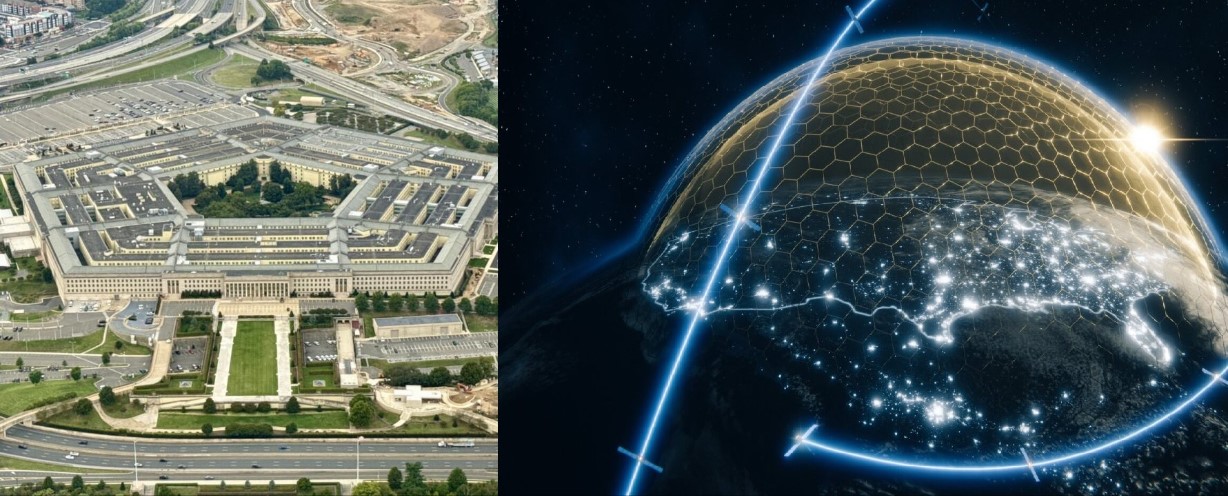
At the center of the new strategy is a renewed emphasis on defending the U.S. homeland and its immediate approaches. The Pentagon says the military will prioritize securing America’s land borders, maritime access points, and airspace, including through the development of the “Golden Dome,” a next-generation air and missile defense architecture designed to counter ballistic, cruise, and hypersonic threats.
The strategy also expands U.S. military focus across the Western Hemisphere. It pledges to actively defend American interests from the Arctic to the Caribbean, explicitly naming the Panama Canal, the Gulf of America, and Greenland as critical terrain whose security is deemed essential to both U.S. military mobility and global commerce.
Pentagon officials describe this posture as a “Trump Corollary to the Monroe Doctrine,” signaling that Washington is prepared to use military power swiftly and decisively to prevent external powers from establishing strategic footholds in the Americas. The document cites Operation ABSOLUTE RESOLVE as a recent demonstration of that capability, underscoring what it calls America’s readiness to enforce its red lines with “speed, power, and precision.”
China and the Indo-Pacific Balance
China is identified as the United States’ most consequential strategic competitor. While the strategy emphasizes that President Trump seeks “stable peace, fair trade, and respectful relations” with Beijing, it makes clear that preventing Chinese dominance over the United States and its allies remains a core objective.
The Pentagon outlines plans to strengthen denial defenses along the First Island Chain, a critical arc of territory stretching from Japan through Taiwan and the Philippines. By reinforcing this line with allied cooperation, advanced missile defenses, and forward-deployed forces, U.S. planners aim to complicate any attempt by China to project power deeper into the Pacific.
The strategy stresses that deterrence in the Indo-Pacific will increasingly rely on burden sharing. Allies and partners are expected to expand their military capabilities, increase defense spending, and contribute more directly to regional stability, while the United States provides strategic leadership, advanced capabilities, and integration.
Burden Sharing and Alliance Realignment
Across all theaters, the NDS calls for a recalibration of alliance responsibilities. In Europe, Asia, and the Middle East, the United States intends to remain engaged but will push allies to take the lead against threats that are geographically closer and more severe for them.
Pentagon officials argue that this approach allows the U.S. military to focus on the most dangerous challenges while still supporting allies with intelligence, logistics, and high-end capabilities. The strategy frames this shift not as retrenchment, but as a more sustainable model for collective defense in an era of constrained resources and simultaneous global challenges.
Russia and the European Theater
Russia is described as a “persistent but manageable” threat to NATO’s eastern flank. Despite demographic decline and economic strain, the strategy notes that Moscow’s ongoing war in Ukraine has demonstrated its ability to sustain large-scale military operations and mobilize industrial capacity.
At the same time, the Pentagon emphasizes the disparity between Russia and NATO as a whole. European NATO members, it argues, vastly exceed Russia in economic strength, population, and latent military power. Germany’s economy alone, the document notes, is significantly larger than Russia’s, reinforcing the administration’s view that Europe has the means to defend itself if it chooses to do so.
Iran and the Middle East
The strategy takes a hard line on Iran, reiterating that Tehran will not be allowed to acquire nuclear weapons. It claims Iran’s regional network, often referred to as the “Axis of Resistance,” has been severely weakened, citing Israeli military operations that have degraded Hezbollah and Hamas.
Despite these setbacks, the Pentagon warns that Iran appears intent on rebuilding its conventional forces and may again pursue nuclear capabilities, particularly if it refuses to engage in what the administration calls meaningful negotiations. The document also highlights Iran’s history of attacks against Americans and its stated hostility toward Israel, describing these factors as central to U.S. threat assessments in the region.
North Korea and Nuclear Deterrence
North Korea is identified as an acute threat to both South Korea and Japan, two U.S. treaty allies. While many of Pyongyang’s conventional forces are characterized as outdated or poorly maintained, the strategy warns that they still pose a serious invasion risk, requiring constant vigilance from Seoul.
More concerning, according to the Pentagon, is North Korea’s expanding missile and nuclear arsenal. The document states that the DPRK is now capable of striking targets in South Korea and Japan with both conventional and nuclear weapons, and that its strategic forces are increasingly able to threaten the U.S. homeland itself.
A Strategy of Deterrence and Resolve
Taken together, the new National Defense Strategy outlines a vision of American military power rooted in deterrence, hemispheric defense, and selective global engagement. It reflects the Trump administration’s belief that peace is best preserved through visible strength, clear boundaries, and allies that are prepared to defend themselves alongside the United States.
Pentagon officials say the strategy will guide force posture, weapons development, and alliance diplomacy in the years ahead, shaping how the U.S. military prepares for what it describes as an era of renewed great-power rivalry and persistent regional conflict.
——— End of Article ———