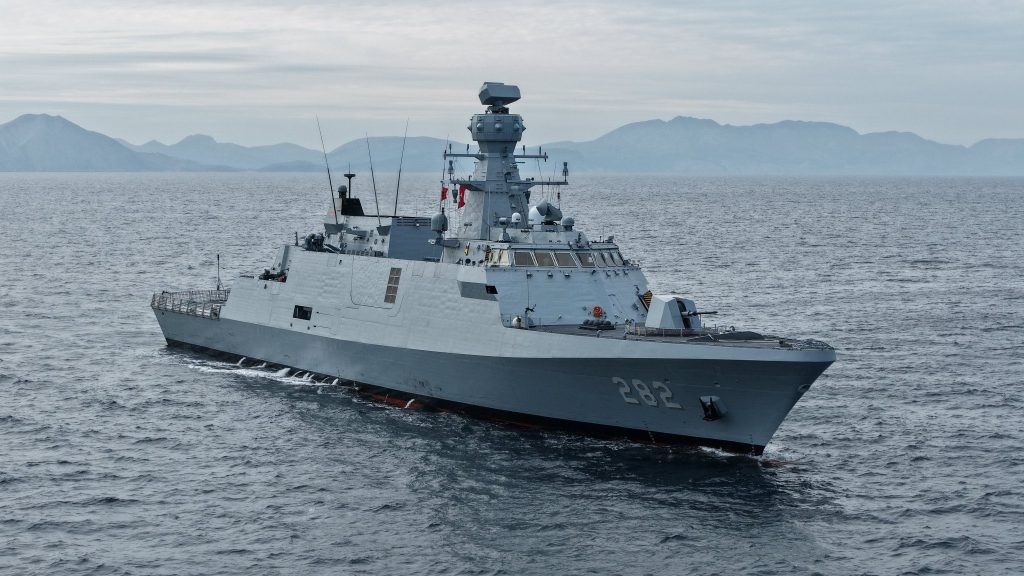
KARACHI, Pakistan — April 6, 2026 : The Pakistan Navy formally inducted its second Babur-class (PN MILGEM) corvette, PNS Khaibar (F-282), into active service during a commissioning ceremony held in Karachi on April 4, 2026. The induction represents a continuation of Pakistan’s naval modernization efforts and its ongoing defense-industrial cooperation with Türkiye.
The ceremony was presided over by Chief of the Naval Staff Admiral Naveed Ashraf, who emphasized the importance of maintaining a technologically advanced and balanced naval force to safeguard Pakistan’s maritime interests and secure vital Sea Lines of Communication (SLOCs). He highlighted Pakistan’s strategic geographic position along key global energy and trade corridors as a central factor driving naval capability development.
Prime Minister Shehbaz Sharif, in a statement issued on the same day, described the induction as a significant milestone for Pakistan’s maritime defense. He noted that platforms such as PNS Khaibar and the forthcoming Hangor-class submarines are expected to enhance operational flexibility, defense capability, and strategic reach. President Asif Ali Zardari also acknowledged the induction, stating that it reflects the Pakistan Navy’s growing professionalism and preparedness.
PN MILGEM Program and Industrial Collaboration
The Babur-class corvettes are part of the PN MILGEM program, initiated under a contract signed in July 2018 between Pakistan’s Ministry of Defense Production and Türkiye’s ASFAT A.Ş. (Military Factory and Shipyard Management Corporation). The agreement, valued at approximately $1.5 billion, was described by Turkish officials at the time as the largest single defense export in Türkiye’s history.
The program formally commenced on March 11, 2019, with ASFAT serving as the primary contractor and Turkish defense firms supporting design and systems integration. The contract includes provisions for technology transfer, joint production, and the transfer of design and construction expertise to Pakistan.
Under the program structure, two corvettes—including PNS Khaibar—are being constructed at the Istanbul Naval Shipyard, while the remaining two vessels, PNS Badr (F-281) and PNS Tariq (F-283), are under construction at Karachi Shipyard & Engineering Works (KS&EW).
PNS Khaibar’s construction milestones included steel cutting on May 1, 2021, its launch on November 25, 2022, and the completion of sea trials and live-fire evaluations in Turkish waters. The vessel was formally delivered to Pakistan in December 2025 before arriving in Karachi ahead of its induction.
Deliveries of the remaining domestically constructed ships are expected to continue through 2026 and early 2027, with initial timelines indicating deliveries at approximately six-month intervals starting from 2023.
Design and Technical Specifications
The Babur-class corvettes are based on Türkiye’s Ada-class design but incorporate modifications tailored to Pakistan Navy operational requirements. The vessels are multi-mission platforms capable of conducting anti-air, anti-surface, and anti-submarine warfare, along with reconnaissance and surveillance operations, and incorporate radar-reducing design features to lower detection signatures.
The ships have a displacement of approximately 2,900–2,985 tonnes (full load), with a length ranging between 108.2 and 108.8 meters, a beam of 14.8 meters, and a draft between 4.05 and 4.1 meters. The propulsion system is based on a Combined Diesel and Gas (CODAG) configuration, consisting of one GE LM2500 gas turbine and two MTU diesel engines, generating approximately 31,600 kilowatts of total power.
In terms of performance, the vessels can reach a maximum speed of 29 to 31 knots, have a range of 3,500 nautical miles, and an endurance of up to 15 days at sea. Each ship operates with a crew of 93 core personnel, with accommodation available for an additional 40 personnel.
Armament and Combat Systems
While certain elements remain undisclosed, available details indicate that the Babur-class corvettes are equipped with a comprehensive multi-domain weapons suite designed for modern naval warfare.
The ships are fitted with a 16-cell Vertical Launching System (VLS) configured for MBDA Albatros NG (CAMM-ER) surface-to-air missiles, providing layered air defense capability. For offensive operations, the vessels carry Harbah dual-role cruise missiles capable of both anti-ship and land-attack missions, typically deployed in two triple-cell launchers.
Additional armament includes a 76 mm OTO Melara naval gun, the Aselsan Gökdeniz 35 mm close-in weapon system (CIWS) for point defense, and two Aselsan STOP 25 mm remote weapon stations. For anti-submarine warfare, the ships are equipped with two triple 324 mm torpedo launchers.
The corvettes are further supported by advanced sensor suites, including 3D air and surface search radars, electronic warfare systems, and sonar capabilities. An aft flight deck enables the operation of anti-submarine helicopters, enhancing their maritime patrol and warfare capabilities.
Fleet Integration and Strategic Role
The induction of PNS Khaibar follows the earlier commissioning of the lead ship, PNS Babur (F-280). Upon completion of all four vessels, the Pakistan Navy is expected to operate a standardized class of modern corvettes capable of forming integrated task groups.
The Babur-class platforms are intended to enhance the navy’s capabilities across air defense, anti-surface warfare, and anti-submarine warfare, while also supporting long-range maritime security operations. The program also contributes to the development of domestic shipbuilding capacity through technology transfer and local construction at KS&EW.
Admiral Naveed Ashraf concluded by extending best wishes to the crew of PNS Khaibar and reaffirming the Pakistan Navy’s commitment to defending national maritime interests and maintaining operational readiness.
——— End of Article ———