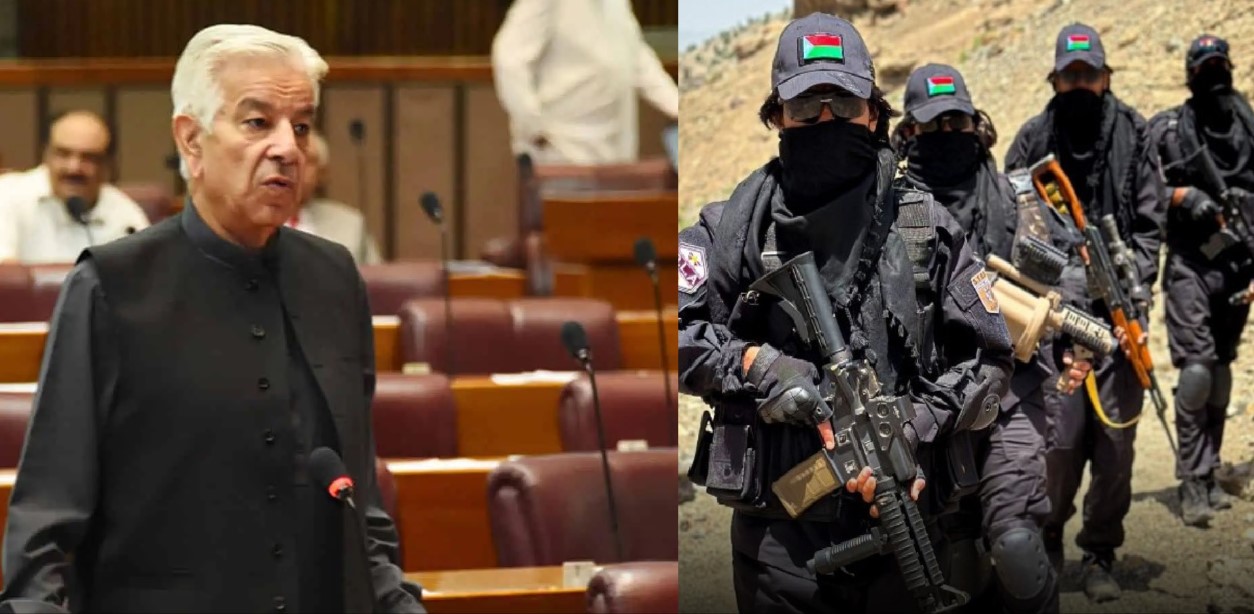
ISLAMABAD : Pakistan’s Defence Minister Khawaja Muhammad Asif told the National Assembly on Monday that security forces deployed in Balochistan are facing a serious operational disadvantage, stating that insurgent groups in the province possess weapons and battlefield equipment superior to those currently available to many units of the Pakistan Army.
The remarks came as fighting continued across large parts of Balochistan following a coordinated insurgent operation launched by the Baloch Liberation Army (BLA), which the group refers to as “Operation Herof.” The offensive has been underway for more than 72 hours and has affected over a dozen towns and cities across the province.
Admission of Equipment and Capability Gap
Addressing lawmakers, Asif said insurgents are now operating with advanced assault rifles, thermal imaging devices and laser sighting systems, enabling them to conduct effective operations during both day and night. He stated that individual rifles used by militants cost approximately 2 million Pakistani rupees each, while thermal and laser optics range between $4,000 and $5,000 per unit. According to the minister, the total value of an individual insurgent’s combat equipment is estimated at nearly $20,000.
Asif told parliament that many Pakistani soldiers deployed in Balochistan do not possess comparable night-fighting or targeting equipment. He said this imbalance has reduced the effectiveness of security operations, particularly after dark, and has limited the army’s ability to counter mobile insurgent units.
The defence minister further said the state is struggling to contain the situation, citing the vast geographic size of Balochistan and the dispersion of forces across remote areas. He described troops as operationally constrained by terrain, distance and logistics, adding that the scale of the province makes sustained area control difficult.
Details of “Operation Herof”
The BLA launched its operation on January 31 with coordinated attacks in Quetta, Gwadar, Mastung, Nushki and Turbat, according to security and local administrative sources. The offensive involved assaults on police stations, temporary seizure of road networks and attacks on government installations.
In Quetta, local sources reported that security personnel withdrew from several forward checkpoints and regrouped in cantonment areas. Insurgents were reported to have moved through multiple neighborhoods without immediate resistance, although authorities said strategic positions were secured.
In Mastung, militants overran the district jail, resulting in the release of more than 30 inmates. Local officials said security forces did not regain control of the facility for several hours following the incident.
Multiple sources also reported that reinforcements from the Quetta-based XII Corps were not deployed to some affected districts for nearly three days. This has raised questions about command responsiveness and coordination during the initial phase of the insurgent operation. The military has not publicly commented on these reports.
Night Operations and Tactical Advantage
Security analysts based in Islamabad said insurgents have gained a tactical advantage due to widespread use of thermal optics, allowing them to detect and engage targets at night. Analysts said Pakistani troops operating without comparable equipment face significant visibility limitations after sunset, reducing their ability to patrol or conduct counter-ambush operations.
According to analysts, insurgent units have used these capabilities to control movement along highways and approach security positions with limited detection.
Conflicting Casualty Claims
Casualty figures from the ongoing clashes remain disputed.
The Pakistani military has stated that 177 militants have been killed since the start of the operation, while reporting 17 fatalities among its own personnel. No visual or independent verification has been released to support these figures.
The BLA, in contrast, claims it has killed more than 180 Pakistani security personnel and captured 18 alive. The group has also released videos it says show the seizure of military camps and equipment.
Broader Implications
Opposition lawmakers and analysts said the focus on the cost of insurgent weapons highlights deeper structural issues. They noted that the presence of high-value equipment suggests sustained funding sources and logistical networks that have operated without disruption from Pakistan’s intelligence agencies, including the ISI.
Analysts said the situation reflects not only a military challenge but also political and economic weaknesses, arguing that insurgent groups have been able to outspend government forces at the individual fighter level.
Current Situation
As of Tuesday morning, security operations were continuing in multiple districts, but authorities had not announced a comprehensive counter-offensive or timeline for restoring full state control. Road traffic remained restricted in several areas, and residents in affected districts reported continued uncertainty over security conditions.
The federal government has indicated that further briefings will be provided to parliament as assessments from the field are compiled.
——— End of Article ———