MELBOURNE, Fla. : Northrop Grumman Corporation and Brazilian aerospace manufacturer Embraer have entered into a formal strategic partnership to develop an enhanced aerial refueling configuration of the KC-390 Millennium aircraft, centered on the integration of an advanced autonomous refueling boom. The agreement, structured under a joint memorandum of understanding, is aimed primarily at addressing potential requirements of the United States Air Force (USAF) and allied air forces.
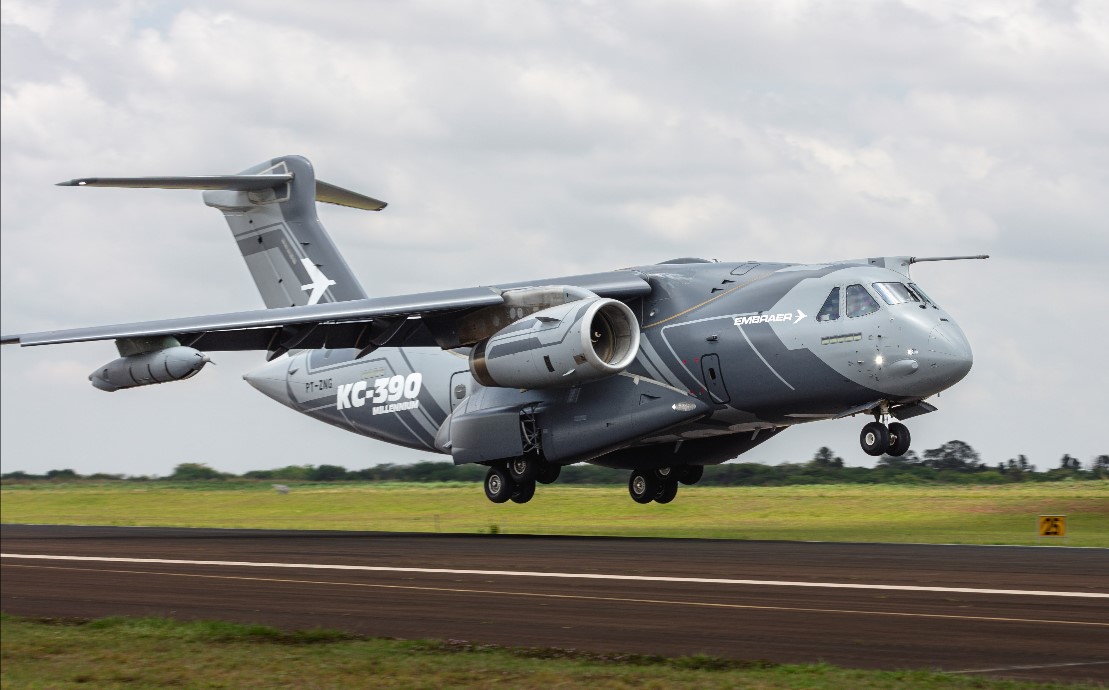
The collaboration focuses on evolving the KC-390 from its current hose-and-drogue configuration into a platform capable of supporting both probe-and-drogue and boom-receptacle receiver aircraft. At present, the aircraft is equipped with underwing Cobham hose-and-drogue pods, limiting compatibility largely to aircraft fitted with probe systems. The addition of a boom system would significantly expand interoperability with U.S. and NATO fleets, including boom-equipped fixed-wing aircraft such as the F-35A and other USAF platforms.
Autonomous Boom Development
The central technical objective of the joint investment is the design, integration, and demonstration of an autonomous aerial refueling boom. Northrop Grumman will contribute expertise in advanced systems integration, autonomy, and mission systems architecture, while Embraer will provide aircraft design and integration support based on the existing KC-390 airframe.
According to the companies, the autonomous boom is intended to reduce operator workload and improve refueling precision, particularly in dynamic operational environments. A technology demonstration of the boom system is planned within the next few years, though no specific timeline for flight testing or certification has been disclosed.
In addition to boom integration, planned upgrades include enhanced communications suites, adaptable mission systems architecture, improved situational awareness tools, and enhanced survivability options. These modifications are designed to align the aircraft with networked operational concepts and evolving air mobility requirements.
Alignment with Agile Combat Employment (ACE)
The proposed configuration is positioned to support the U.S. military’s Agile Combat Employment (ACE) doctrine. ACE emphasizes distributed operations, rapid deployment, and the ability to operate from austere or semi-prepared locations.
The KC-390 features an eight-wheel landing gear system that distributes weight evenly, enabling operations from soft-soil or unpaved airstrips. The aircraft is capable of takeoff and landing on runways shorter than 1,000 feet, supporting decentralized basing concepts. Executives described the upgraded platform as a mid-sized, non-developmental tactical refueler capable of supplementing larger strategic tanker fleets.
Executive Statements
Tom Jones, corporate vice president and president of Northrop Grumman Aeronautics Systems, stated that the partnership reflects investment in advanced air mobility capabilities to address operational gaps.
“Northrop Grumman, together with Embraer, is making strategic investments to address the gap in advanced air mobility solutions globally,” Jones said. “We’re listening to our customers, particularly in allied nations who seek greater operational autonomy and efficiency, and we’re exploring new technologies that will increase the versatility of the proven KC-390 platform and deliver that greater operational independence our customers need.”
Bosco da Costa Junior, president and chief executive officer of Embraer Defense & Security, emphasized the operational maturity of the platform and the combined capabilities of both companies.
“Together, we will leverage the strengths of two leaders in the defense industry, with a focus on developing a boom refueling system for the KC-390 Millennium so that we can bring the right capability to the U.S. Department of War and other allied nations,” da Costa said. “The KC-390 is an operationally proven and cost-effective platform that could quickly be added to the U.S. Air Force inventory.”
Aircraft Capabilities and Technical Specifications
The KC-390 Millennium is a medium-sized, twin-engine multi-mission jet transport aircraft powered by IAE V2500 turbofan engines. It can reach a maximum speed of approximately 470 knots (Mach 0.8).
In its aerial refueling configuration, the aircraft can carry up to 35 metric tons of fuel, including 23 metric tons in wing-mounted pods and 12 metric tons in internal cargo-area tanks. The aircraft has a range of approximately 4,570 nautical miles.
Beyond refueling, the KC-390 serves as a medium airlift platform, capable of transporting 26 metric tons of cargo or up to 80 passengers. According to Embraer, the aircraft can be reconfigured from cargo to aerial refueling in less than five hours, supporting multi-role operational flexibility.
International Operators and Market Position
The KC-390 is currently operated by or on order for Brazil, Portugal, Hungary, the Netherlands, Austria, the Czech Republic, Sweden, and South Korea. The aircraft is positioned as a cost-effective alternative to larger airlifters and tankers while retaining jet performance and multi-mission capability.
The partnership marks a renewed effort by Embraer to expand the KC-390’s presence in the U.S. defense market. A previous agreement with L3Harris Technologies, signed in September 2022 to promote the aircraft for U.S. tactical mobility roles, was dissolved in 2024. By aligning with Northrop Grumman, Embraer seeks to strengthen its position in future U.S. and allied aerial refueling and tactical mobility procurement programs.
The companies have not announced a formal USAF procurement program tied directly to the upgraded KC-390. However, the initiative is structured to position the aircraft as a candidate for emerging tactical tanker requirements and distributed air mobility operations.
——— End of Article ———