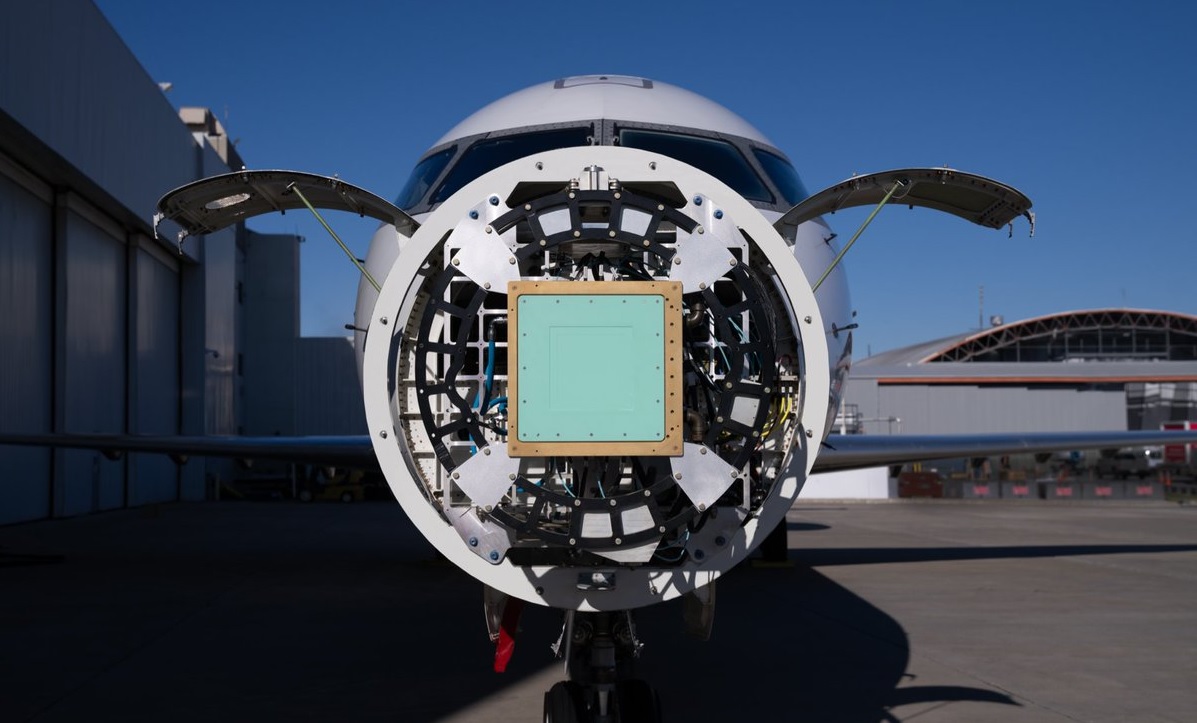
WASHINGTON : Northrop Grumman has introduced Valen, a company-funded, 3D-printed multifunction Active Electronically Scanned Array (AESA) designed to integrate radar, electronic warfare (EW), and communications into a single wideband aperture. The system was recently flight-tested aboard a Northrop Grumman-owned test aircraft, according to a company announcement released on February 16, 2026.
The flight demonstration marks a key development milestone for the array, confirming its operational performance in an airborne environment. The company has not disclosed the specific aircraft used for the test or a timeline for production and program integration.
Design and Manufacturing Approach
Valen is built using advanced additive manufacturing techniques. The array’s primary structure is 3D-printed, reducing reliance on traditional subtractive manufacturing methods and complex multi-part assemblies typically associated with legacy AESA systems.
According to Northrop Grumman, the additive process reduces raw material consumption and simplifies structural integration. This approach is intended to deliver two measurable outcomes: lower production costs and reduced long-term maintenance requirements. By consolidating components into a unified printed structure, the system decreases mechanical complexity and associated sustainment burdens.
The company describes Valen as the smallest and lightest wideband AESA currently available on the market. The array incorporates next-generation microelectronics and is engineered to operate with lower Size, Weight, and Power (SWaP) requirements compared to conventional systems. The reduced SWaP profile is designed to support broader platform integration while maintaining high-performance output.
In addition, the manufacturing process is structured to support scalable production, allowing for rapid output expansion if required.
Wideband Multifunction Capability
Valen is designed as a wideband AESA, enabling it to perform multiple electromagnetic functions through a single hardware interface. Traditional military aircraft configurations often require separate antennas or external pods for radar, electronic warfare, and communications tasks. Valen consolidates these capabilities within one aperture.
Its radar function provides high-resolution targeting, tracking, and situational awareness. In the electronic warfare domain, the array is capable of electronic attack and electronic protection missions, including disruption of adversary sensors and protection of the host platform against jamming. The communications capability supports secure, high-bandwidth data transmission.
Because the array operates across a wide frequency band, it can execute sensing, jamming, and communications functions without the need for separate dedicated systems.
Platform Integration and Operational Scope
Northrop Grumman states that Valen is optimized for integration across multiple operational domains, including manned aircraft, unmanned systems, and space-based platforms.
For manned aircraft, the system is intended to enhance sensor fusion and mission capability without imposing significant weight or power penalties. Its compact form factor is designed to support upgrades to existing fleets as well as integration into next-generation aircraft.
For unmanned aerial systems (UAVs), the reduced SWaP profile enables advanced radar and electronic warfare capabilities that have traditionally been limited by payload and power constraints in smaller airframes.
The company also identifies space assets as a potential application area. The lightweight and compact architecture is suited to satellite payload limitations, offering sensing and communications capabilities compatible with space deployment requirements.
Development Status
The successful flight test confirms the array’s operational viability in an airborne environment. Northrop Grumman has not specified which defense programs may first adopt Valen, nor has it announced a timeline for full-scale production.
The company characterizes Valen as an internally funded development effort aimed at advancing multifunction AESA technology through additive manufacturing and wideband integration.
——— End of Article ———