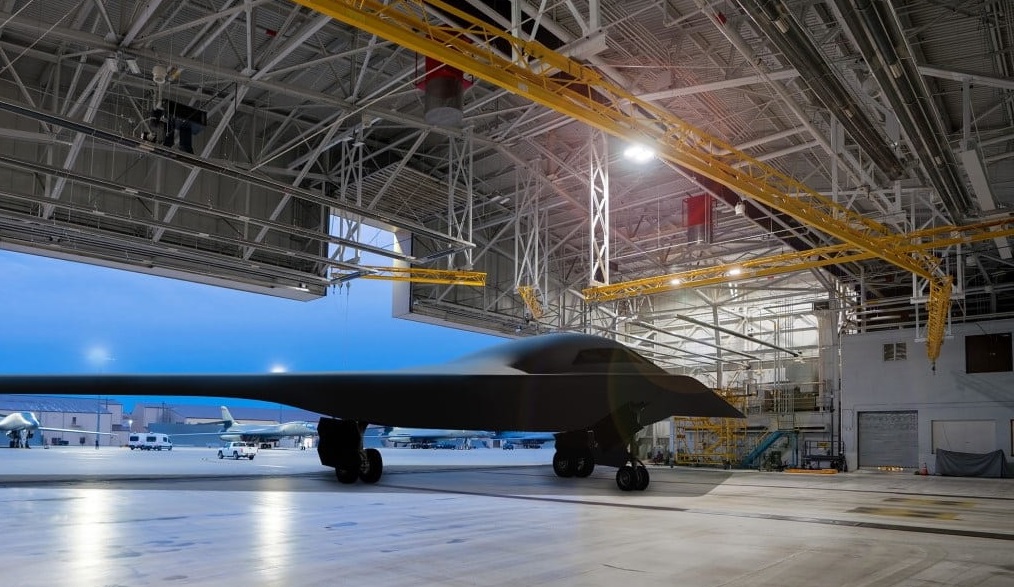
FALLS CHURCH, Va. : Northrop Grumman expects to reach an agreement with the U.S. Air Force by the end of March to accelerate production of the B-21 Raider bomber, according to Chief Executive Officer Kathy Warden, as the aircraft moves closer to operational service and the Pentagon seeks to expand long-range strike capacity.
Speaking during the company’s latest earnings call, Warden said negotiations with the Air Force are ongoing and focused on increasing the production rate of the stealth bomber, which is intended to replace portions of the Air Force’s aging bomber fleet.
“We continue to work closely with the Air Force on plans to increase the production rate of the program,” Warden said. “Our priority is to establish a mutually beneficial agreement that accelerates the delivery of this capability.”
Congressional Funding and Air Force Plans
Congress approved $4.5 billion in July to expand B-21 production capacity. The Air Force plans to allocate the full amount in fiscal year 2026, dividing the funding between procurement and research and development activities intended to support higher production throughput and program maturity.
Details of the planned production increase remain classified. The Air Force has not publicly stated whether the acceleration effort is aimed solely at delivering aircraft more quickly under the existing program of record or whether it could support an eventual increase beyond the current minimum requirement of 100 aircraft.
Northrop Grumman Investment and Production Contracts
In addition to government funding, Northrop Grumman plans to invest between $2 billion and $3 billion over multiple years to support production acceleration. Warden described the spending as “facilitizing for that acceleration,” a term typically used to refer to investments in facilities, tooling, workforce expansion, and supply chain capacity. The company did not provide further details on how the investment will be allocated.
Warden also confirmed that Northrop Grumman received the third low-rate initial production (LRIP) contract for the B-21 during the fourth quarter of 2025. The company has also received advanced procurement funding for the fifth production lot, allowing it to begin purchasing long-lead materials ahead of full contract awards.
Program Progress and Testing
The B-21 program has continued to advance through testing and early production. A second B-21 test aircraft has completed its first flight, expanding the flight-test fleet and supporting efforts to validate performance, systems integration, and maintainability as the program moves toward initial operational capability.
The Air Force has stated previously that the B-21 is designed to operate in highly contested environments and to carry both conventional and nuclear payloads. The aircraft is expected to replace the B-1B Lancer and eventually the B-2 Spirit, while complementing the B-52 fleet.
Budgetary Adjustments for Fiscal 2026
Despite the push to accelerate production, lawmakers have proposed a net reduction in B-21 funding in the base fiscal year 2026 defense budget. The proposal reduces procurement funding while increasing research and development spending, resulting in an overall cut that appropriators have attributed to classified adjustments.
Defense officials have not provided further public explanation of the changes, and it remains unclear how the proposed adjustments could affect production timelines. The separate $4.5 billion appropriation approved last year for production capacity expansion is expected to be a key factor in sustaining the acceleration effort.
If finalized as planned, the agreement between Northrop Grumman and the U.S. Air Force would mark a significant step toward increasing the pace of B-21 production as the program transitions from development into operational service. Further details on production rates, delivery schedules, and total aircraft quantities are expected to remain classified.
——— End of Article ———