FALLS CHURCH, VIRGINIA — Febuary 26, 2026 : Northrop Grumman has delivered the 500th shipset of its Common Infrared Countermeasures (CIRCM) system, reaching the milestone within two years of entering full-rate production. At the same time, the company confirmed the system has accumulated more than 30,000 operational flight hours across U.S. Army aircraft.
CIRCM serves as the U.S. Army’s program of record for directional infrared countermeasures on key rotary-wing platforms and represents Northrop Grumman’s fifth generation of infrared countermeasure (IRCM) technology. The system is designed to protect military aircraft and personnel from advanced infrared-guided anti-aircraft missiles, including man-portable air-defense systems (MANPADS).
Operational Deployment Across U.S. Army Fleet
The system has logged its 30,000 operational flight hours on standard U.S. Army platforms, including the AH-64 Apache, CH-47 Chinook, and UH-60 Black Hawk helicopters. Initial Operational Capability was achieved in September 2022 on UH-60M, HH-60M, CH-47F, and AH-64E aircraft.
CIRCM is engineered as a lightweight, highly reliable solution compatible with rotary-wing, tiltrotor, and small fixed-wing aircraft. Its architecture is specifically designed to comply with strict size, weight, and power (SWaP) requirements common to smaller airframes.
The system integrates with existing aircraft survivability equipment through an open architecture framework. This design supports interoperability with onboard systems and enables future capability enhancements and spiral upgrades without major redesign. The architecture incorporates commercial off-the-shelf processor components to enhance scalability and long-term supportability.
System Architecture and Core Components
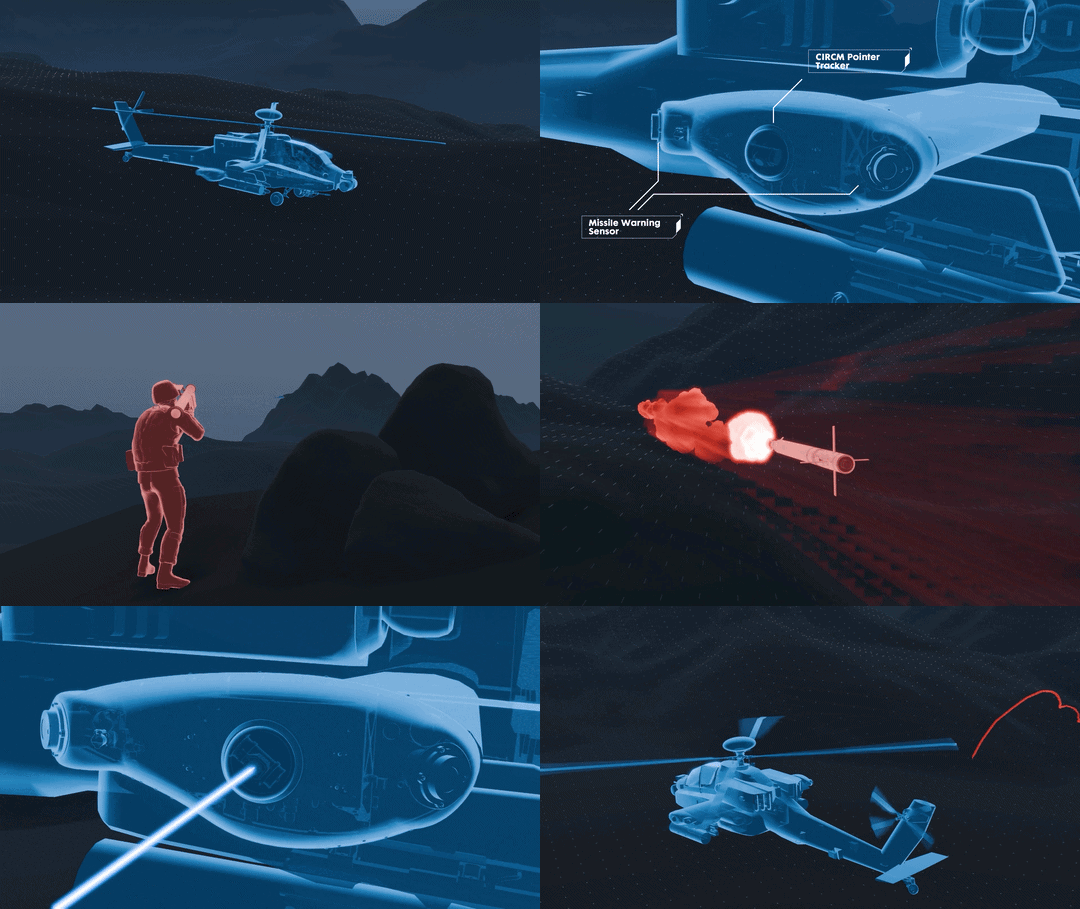
CIRCM consists primarily of two technical subsystems: the pointer/tracker assembly and the Quantum Cascade Laser (QCL) subsystem.
The pointer/tracker unit is designed for low lifecycle cost and high operational reliability. It features a lightweight configuration suitable for light helicopters and is aerodynamically shaped to minimize air-stream intrusion and drag. The subsystem’s modular design allows for hardware upgrades and incremental capability improvements over time.
The Quantum Cascade Laser subsystem provides the system’s directed infrared jamming capability. It delivers rapid, simultaneous break-lock jamming against incoming threats and generates sufficient output power to counter modern and emerging infrared-guided missile seekers. The laser relies on solid-state technology for consistent energy generation and is certified for operation across all weather conditions and altitudes. Field-replaceable components are incorporated to reduce maintenance downtime. Production is supported by dual manufacturing facilities to ensure supply chain continuity.
Operational Mechanism
CIRCM operates in conjunction with the aircraft’s Common Missile Warning System (CMWS), which uses ultraviolet sensors to detect incoming infrared-guided missiles. Once a threat is identified, CMWS transmits angular bearing data to the CIRCM processor.
The pointer/tracker rapidly slews to the missile’s location, acquires the target, and maintains tracking even after the missile motor burns out. The Quantum Cascade Laser then emits precisely modulated infrared energy tuned to the seeker’s wavelength band. This energy interferes with the missile seeker’s tracking function, producing a break-lock effect that causes the missile to deviate from the aircraft.
The engagement sequence is automatic and occurs within seconds. If the missile warning system confirms a valid threat, it alerts the crew and can deploy flares as a supplementary countermeasure. In dual-jammer configurations, the system provides near-spherical coverage around the aircraft.
Production, Contracts and Fleet Expansion
CIRCM production continues under a 2021 base contract valued at up to $959 million. Following the delivery of the 500th shipset, the U.S. Army awarded Northrop Grumman an additional $147 million production order in mid-2024 for 336 additional shipsets. Combined delivered and on-order quantities now exceed 836 units, with long-term plans to equip more than 1,500 U.S. Army aircraft.
The system has undergone laboratory testing, hardware-in-the-loop simulations, and flight evaluations against both live and simulated threats prior to fielding. Manufacturing facilities support domestic and international demand and are structured to maintain rapid sustainment capability.
International Adoption
CIRCM has also entered the export market. In late 2024, the United Kingdom became the first international customer through a Foreign Military Sales agreement. The UK Ministry of Defence plans to install the system on its fleet of 14 Boeing H-47 Chinook Extended Range helicopters.
For the UK configuration, the pointer/tracker units are supplied in partnership with Leonardo, which manufactures the component at its Edinburgh facility. Production supports both U.S. Army and international program requirements.
——— End of Article ———