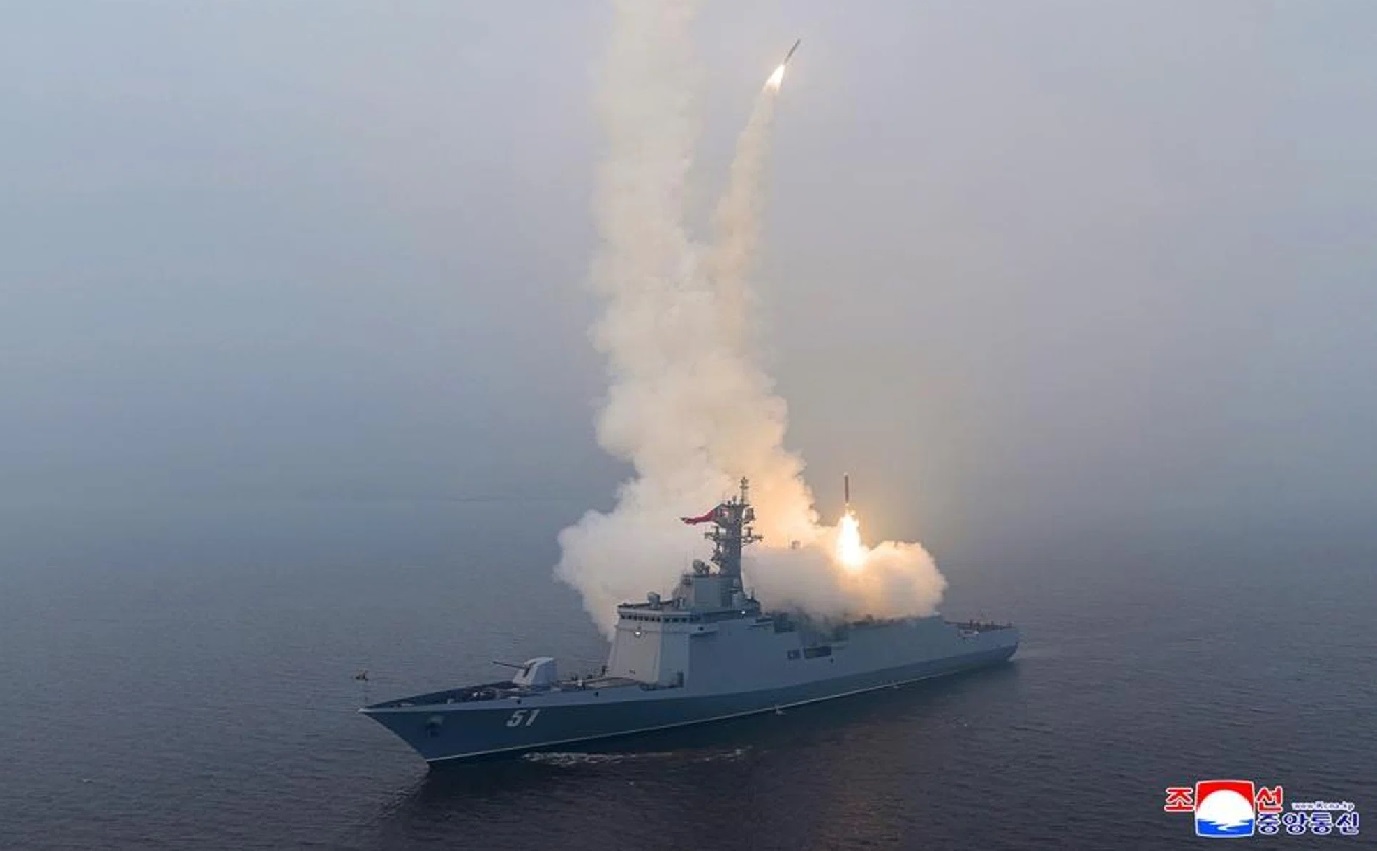
SEOUL / TOKYO — March 14, 2026 : North Korea launched a series of ballistic missiles on Saturday, firing approximately ten projectiles from its west coast toward the Sea of Japan in a test that occurred amid ongoing joint military exercises between the United States and South Korea. The launches were detected and tracked by South Korean and Japanese defense authorities shortly after liftoff.
Launch Detection and Flight Characteristics
According to the South Korean Joint Chiefs of Staff (JCS) and Japan’s Ministry of Defense, the missiles were launched from the Sunan area near Pyongyang, a site that has previously been used for missile testing activities.
Radar stations operated by the Japan Self-Defense Forces (JSDF) detected the launches simultaneously at 13:24 local time. Tracking data released by Japanese defense authorities indicates that the projectiles followed a northeastward trajectory across the Korean Peninsula, ultimately traveling toward waters in the Sea of Japan.
Preliminary analysis by South Korean military authorities estimates that the missiles traveled approximately 340 to 350 kilometers and reached a maximum altitude of around 80 kilometers during flight. Based on these parameters, analysts believe the weapons were likely 600-millimeter super-large multiple rocket launcher (MLRS) projectiles or short-range ballistic missile systems, both of which are capable of delivering conventional payloads at short to medium operational ranges.
Impact Location and Maritime Safety
Japan’s Defense Minister Shinjiro Koizumi confirmed that all projectiles landed in waters outside Japan’s Exclusive Economic Zone (EEZ). Japanese authorities reported no damage to maritime vessels, aircraft, or coastal infrastructure following the launches.
The Japan Coast Guard issued navigational advisories to vessels operating in nearby waters shortly after the missiles were detected. No emergency maritime incidents were reported.
Government and Military Response
Following the launches, the Japanese government activated an anti-crisis response headquarters at the Prime Minister’s Office to coordinate monitoring and intelligence analysis. Prime Ministerial directives instructed relevant ministries and agencies to prioritize information collection and maintain readiness for potential further developments.
In South Korea, the military increased its surveillance and reconnaissance posture. Officials stated that Seoul is maintaining a high alert status and continuing to share real-time tracking data with the United States and Japan through established trilateral security coordination channels.
Context: Freedom Shield Joint Military Exercises
The missile launches occurred during Freedom Shield, a joint United States–South Korea military exercise scheduled to run for 11 days through March 19.
Freedom Shield includes computer-simulated command post training and field exercises designed to evaluate combined operational planning and interoperability between the two allied militaries. The exercise is conducted annually and focuses on readiness for various contingency scenarios on the Korean Peninsula.
North Korea has historically criticized such exercises, describing them as preparations for military confrontation.
Earlier this week, Kim Yo-jong, the sister of North Korean leader Kim Jong-un, issued a statement condemning the drills. In her remarks, she stated that the exercises threaten regional stability and warned that continued allied military activities could lead to serious consequences. She also indicated that North Korea remains prepared to conduct a preemptive military response if it determines its security is threatened.
North Korea’s Missile Activity in 2026
Saturday’s launch marks North Korea’s third ballistic missile test of 2026.
The first launch of the year occurred on January 4, when a single missile was fired from the country’s west coast. During that test, radar systems detected the missile at 07:54 local time, according to regional defense authorities.
North Korea has continued to develop and test a range of short-, medium-, and long-range missile systems over the past decade. These include short-range ballistic missiles, tactical rocket systems, and intercontinental ballistic missiles, which Pyongyang states are part of its national defense strategy.
Regional governments and international monitoring organizations continue to track North Korea’s weapons development and testing activities closely as part of broader security assessments in Northeast Asia.
——— End of Article ———