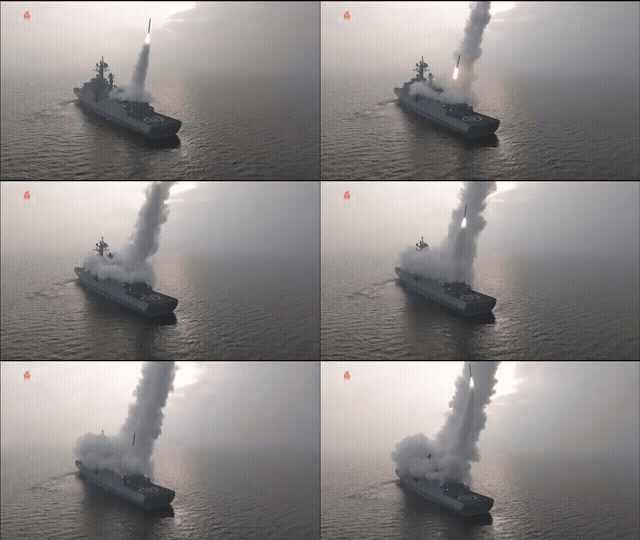
NAMPO, North Korea — March 5, 2026 : North Korean leader Kim Jong Un supervised a test launch of strategic cruise missiles from a newly developed naval destroyer, the Choe Hyon, during an inspection visit to the Nampho Shipyard earlier this week. The launch marked the final evaluation of the 5,000-ton warship before its expected entry into operational service with the Korean People's Army Navy.
State media reported that Kim conducted a two-day inspection of the vessel on March 3 and March 4 at the western port city of Nampo. During the visit he reviewed the destroyer’s maneuverability, navigation systems, crew training activities, and overall operational readiness as part of the ship’s sea trial phase.
Cruise Missile Launch Conducted as Final Capability Test
On March 4, Kim observed the launch of multiple sea-to-surface strategic cruise missiles from the destroyer’s vertical launch system. Photographs released by state media showed missiles being fired sequentially from launch cells, producing vertical plumes of smoke as they exited the ship before activating their engines.
North Korean officials described the launch as a “core element” in verifying the warship’s combat readiness before commissioning. The country routinely uses the term “strategic” to describe weapons systems it says are capable of carrying nuclear warheads.
Kim reportedly described the destroyer as a “new symbol of sea defense capability” following the test and expressed satisfaction with the ship’s performance during trials.
Design and Armament of the Choe Hyon Destroyer
The Choe Hyon, first unveiled in April 2025, is the lead vessel in a new class of multipurpose guided-missile destroyers and represents the largest surface combatant publicly known to have been built by North Korea.
The warship displaces approximately 5,000 tons and incorporates a dense vertical launch system designed to support multiple missile types. The ship is believed to contain at least 74 vertical launch cells arranged in several configurations.
These include approximately 32 small launch cells likely intended for surface-to-air missiles, 12 medium cells potentially used for cruise or anti-ship missiles, and larger launch cells—up to 30 located toward the stern—capable of firing land-attack cruise missiles or tactical ballistic missiles.
The destroyer’s weapons configuration may allow deployment of several North Korean missile systems, including the Hwasal-2 land-attack cruise missile, supersonic strike weapons, and tactical ballistic missile variants related to the Hwasong-11 series.
In addition to its vertical launch systems, the vessel is equipped with a range of other armaments and defensive systems. These include a main naval gun estimated at 127-mm or 130-mm caliber, a Pantsir-ME air defense system, AK-630 close-in weapon systems, quadruple Bulsae-4 missile launchers that may support short-range guided weapons or loitering munitions, and twin 533-millimeter torpedo tubes.
External launchers visible on the ship’s sides are believed to support Kumsong-3 anti-ship missiles, providing additional anti-surface capability.
Cold Launch System Used for Vertical Missile Cells
All vertical launch cells on the destroyer employ a cold launch system, a method in which missiles are expelled from launch tubes using gas pressure or compressed air before their engines ignite.
This technique reduces thermal stress and structural damage to the launch platform, allowing repeated missile launches in rapid succession while protecting the launcher from heat exposure. The system is widely used in modern naval vertical launch systems and submarine-launched ballistic missile platforms.
The launch cells are also angled to allow missiles to clear the ship safely in the event of an engine ignition failure.
Naval Nuclear Capability and Fleet Expansion Plans
During the inspection, Kim stated that the arming of the navy with nuclear weapons was progressing, according to state media reports.
He directed naval authorities to construct two surface warships of the Choe Hyon class or a higher class each year during the country’s new five-year military development plan beginning in 2026.
Kim also inspected the construction of a third Choe Hyon-class destroyer at the Nampho Shipyard. Officials indicated that the vessel is expected to be completed by October 2026.
Previous Launch Incident Involving the Second Vessel
The expansion of the destroyer program follows difficulties encountered during the launch of the second vessel in the class, the Kang Kon, in May 2025.
During a launch ceremony, the ship capsized shortly after entering the water. North Korean authorities later conducted a salvage and restoration operation, returning the vessel for further work after recovery.
Strategic Context of the Missile Test
The cruise missile launch was Kim’s first publicly reported military-related appearance since the beginning of the U.S. and Israeli military campaign against Iran on February 28, 2026.
Defense analysts say the timing of the demonstration may reflect North Korea’s interest in highlighting its expanding naval strike capabilities, particularly systems capable of delivering long-range cruise missiles from sea-based platforms.
North Korea has previously emphasized the development of sea-based nuclear delivery systems, including future nuclear-powered submarines and multi-mission surface vessels equipped with large vertical launch arrays.
Commissioning Expected After Final Trials
North Korean state media reported that the Choe Hyon destroyer successfully completed its final missile test and capability evaluation during the inspection.
The vessel is expected to enter operational service with the Korean People’s Army Navy following the completion of the current testing phase. Independent verification of the missile test details has not been reported, and information about the event has been released exclusively through North Korean state media outlets.
——— End of Article ———