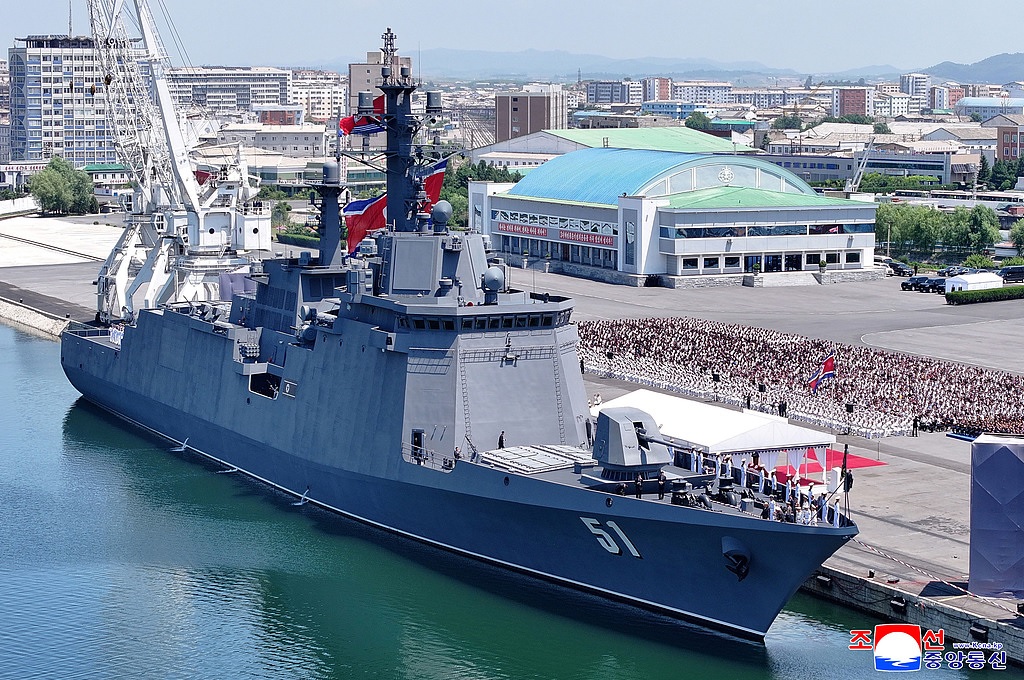
Seoul, June 24, 2026 — North Korea has officially commissioned its first guided-missile destroyer, Choe Hyon (hull number 51), into the Korean People's Navy, marking a significant step in the country's naval modernization efforts. The commissioning ceremony was held on June 23 at the Nampo shipyard and attended by North Korean leader Kim Jong Un, who outlined an extensive naval expansion program aimed at transforming the country's maritime capabilities.
During the ceremony, Kim announced that the second vessel of the class, Kang Kon (hull number 52), is nearing operational service and continues to undergo sea trials. He also confirmed that additional destroyers are already under construction as part of a long-term fleet expansion plan.
Navy Modernization and Strategic Role
Kim Jong Un stated that the navy had historically been the weakest branch of the Korean People's Army and emphasized the need to modernize it into a force capable of operating beyond coastal waters. He said the navy's mission is expanding from traditional coastal defense to a broader strategic role, including integration into North Korea's nuclear deterrence framework.
The modernization effort also includes the construction of new naval infrastructure. During a meeting of the Workers' Party Central Committee on June 22, officials discussed plans for modern naval bases designed to support the growing fleet. Kim described the development of these facilities as an essential requirement for future naval operations.
Choe Hyon-Class Destroyer Capabilities
The Choe Hyon is classified as a 5,000-ton multipurpose guided-missile destroyer and measures approximately 140 to 145 meters in length. The vessel features 74 vertical launch system (VLS) cells, consisting of:
- 32 small VLS cells
- 12 medium VLS cells
- 20 large VLS cells
- 10 extra-large VLS cells
The extra-large launch cells are reportedly capable of carrying short-range ballistic missiles and cruise missiles.
The destroyer's armament also includes:
- A 127mm or 130mm main naval gun
- One Pantsir-ME close-in weapon system (CIWS)
- Two 30mm AK-630 CIWS units
- Four quad anti-ship missile launchers
- Twin 533mm torpedo launchers
The VLS architecture enables the ship to deploy a variety of precision-strike weapons. Among them are hypersonic cruise missiles resembling Russia's Zircon missile, reportedly capable of engaging targets at ranges approaching 1,000 kilometers and speeds of up to Mach 9. Anti-ship warfare has been a key design priority for the class.
Rapid Shipbuilding Program
The Choe Hyon forms the foundation of North Korea's five-year naval construction plan. The first vessel was launched in April 2025, while the second ship, Kang Kon, was launched in June 2025 and recently resumed sea trials in early June 2026.
Construction of a third vessel is underway and is expected to be completed by October 2026, while a fourth destroyer has reportedly already been laid down.
Kim Jong Un has set a target of producing two destroyers annually. If maintained, this production rate could allow North Korea to field 12 destroyers by the early 2030s, giving it one of the world's largest destroyer fleets by numbers.
Development of Larger Warships
North Korea is also pursuing larger surface combatants. In March 2026, Kim confirmed development of an 8,000-ton destroyer, followed by plans for a 10,000-ton class.
These future vessels are expected to carry between 120 and 150 vertical launch cells, significantly increasing missile capacity. Later variants of the Choe Hyon-class are also expected to feature larger missile payloads exceeding 90 launch cells.
Production Comparisons and Regional Impact
North Korea launched two Choe Hyon-class destroyers in 2025 and aims to maintain a similar production pace in the coming years. While China remains the world's leading destroyer producer with an estimated six to ten ships launched annually, U.S. shipyards currently average around 1.6 destroyers per year.
For comparison, the latest U.S. Navy Arleigh Burke-class destroyers displace around 9,600 tons and carry 96 vertical launch cells. Although the Choe Hyon is significantly smaller at 5,000 tons, it carries 74 launch cells, reflecting a high concentration of missile firepower relative to its size.
The commissioning of the Choe Hyon marks a significant milestone in North Korea's naval modernization program and reflects the country's continued investment in larger surface combatants, advanced missile systems, and expanded maritime capabilities.
——— End of Article ———