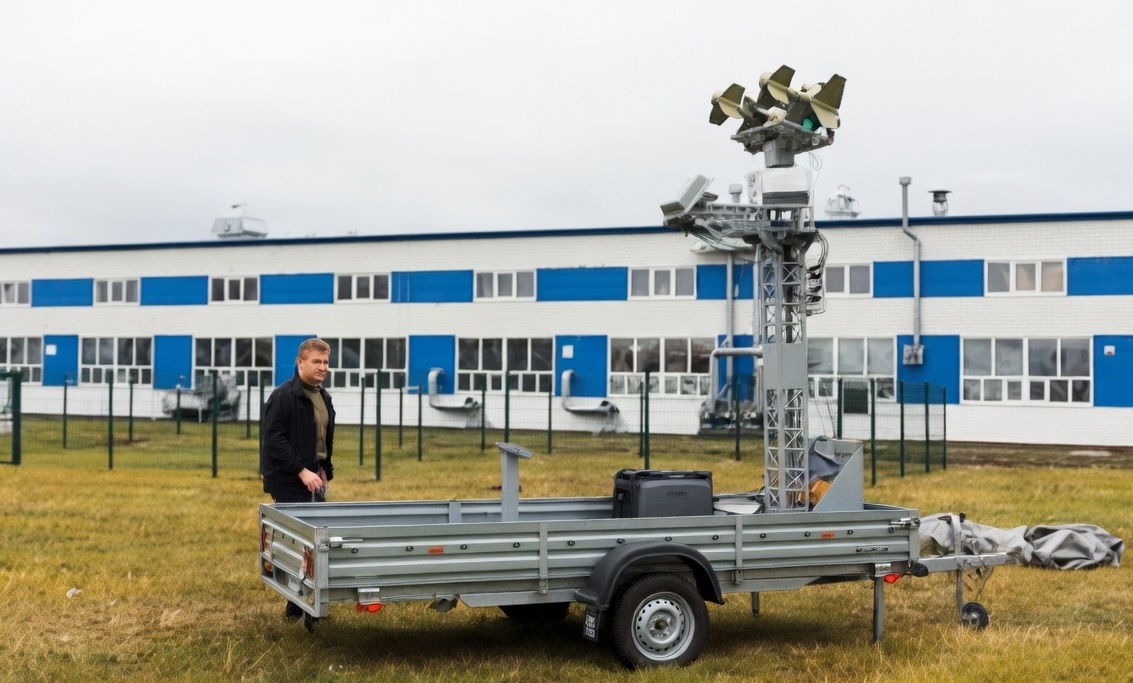
MOSCOW — April 16, 2026 : Newly circulated open-source intelligence footage indicates a technical shift in the deployment of Russia’s “Yolka” (Ёлка) interceptor drone, showing the system operating in an integrated configuration with a dedicated launcher and paired radar unit. The development marks a transition from earlier man-portable versions that relied on handheld or tripod-based catapult launches.
The footage shows the Yolka mounted on a launcher system and linked to an external radar, reportedly produced by Yumirs, enabling earlier target detection and automated cueing. This configuration supports semi-automated operation and suggests a move toward fixed or platform-based point-defense roles rather than exclusive use by individual operators.
System Development and Background
First reported in mid-2025 and manufactured by the Moscow-based company Nashe Nebo (“Our Sky”), the Yolka is designed for short-range counter-unmanned aerial vehicle (UAV) operations. The system operates on a fire-and-forget principle, using onboard processing to autonomously track and engage targets after launch with minimal operator input.
Earlier deployments involved handheld, pistol-like launchers or tripod systems, as well as mounting on platforms such as the Impulse-PVO tracked robotic chassis. The newly observed launcher-and-radar pairing reflects ongoing adaptation toward integrated air defense roles.
Technical Characteristics
Available technical data from Ukrainian defense advisors and Russian sources indicate the following specifications:
- Launch weight: approximately 1.3 kg to 2.0 kg
- Operational range: up to 3 kilometers
- Maximum speed: 200–230 km/h
- Climb rate: up to 40 meters per second
- Altitude ceiling: up to 2,000 meters
- Target engagement: capable against UAVs moving up to 115 km/h
The drone is constructed from lightweight materials, including an 8×100 mm carbon tube, carbon structural elements, and 3D-printed aerodynamic components. It uses Skystars KOKO RS 2275 1950KV motors and a Gaoneng GNB2200 6S lithium-polymer battery.
Targeting and Guidance
The system’s core processing unit, known as the “Igolka” module, integrates machine learning algorithms with a dual-channel optoelectronic system for visual identification and tracking of targets. Detection range for small drones is reported between 600 and 1,000 meters.
Once a target enters a range of approximately 700 to 1,000 meters, the onboard visual tracking system takes over for terminal guidance. If visual contact is lost, the drone is programmed to climb to about 50 meters and initiate a glide-based search pattern.
Payload Variants
The Yolka is deployed in two configurations:
- Kinetic interceptor (baseline): a non-explosive variant that neutralizes targets through direct impact
- Fragmentation variant: equipped with a 360-gram warhead designed to detonate on proximity or impact
The baseline version is described as simpler and lower-cost due to the absence of an explosive payload.
Operational Constraints
The system’s reliance on optical targeting imposes environmental limitations. Current versions operate only during daylight and are affected by high-contrast lighting conditions such as direct sunlight or dense cloud cover. The drone cannot be used in rain and is limited to wind conditions below 8 meters per second.
Operational Use and Role Expansion
The Yolka has been deployed by Russian forces since 2025 for countering small UAVs, including FPV drones, quadcopters, and bomber-type systems. It has been used for point defense of infantry positions, supply convoys, air defense systems, and critical infrastructure. Russian sources report multiple successful interceptions, including engagements against Lyutyi-type attack drones in the Bryansk region.
The integration of radar with the launcher system indicates a shift toward layered air defense applications. By enabling earlier detection and automated targeting, the updated configuration is positioned to improve response times and expand the system’s role in protecting stationary and high-value assets.
The Yolka continues to undergo iterative development, with adjustments based on operational feedback. No official production figures have been disclosed.
——— End of Article ———